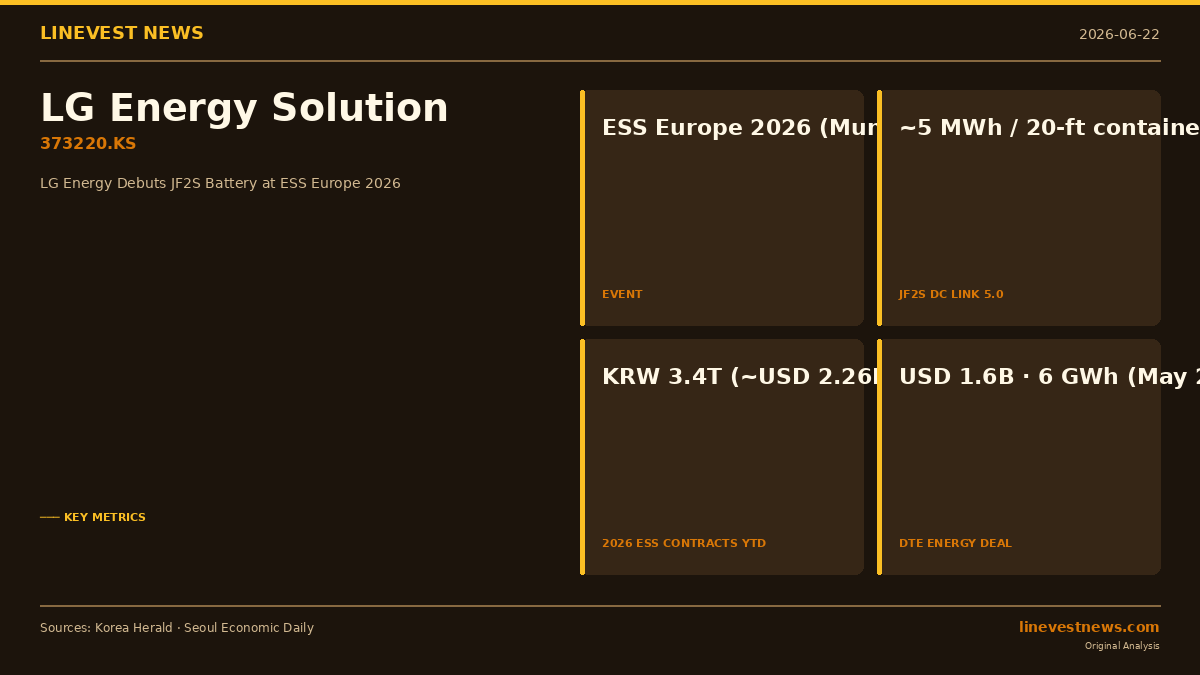
LG Energy Solution (373220.KS) will anchor its European battery push at Electrical Energy Storage Europe 2026 (ESS Europe 2026), opening Tuesday at Messe Munich, Germany, positioning its Polish manufacturing hub as the supply backbone for the continent's booming AI data center power market.
The company said it will present an integrated product portfolio spanning grid-scale battery energy storage systems, uninterruptible power supplies, and battery backup units — all purpose-built for AI data center infrastructure — at the three-day show running June 23–25 under the theme "Powering the Future of AI."
Flagship Product: JF2S DC Link 5.0
The showcase's centrepiece is the JF2S DC LINK 5.0, a 20-foot containerized energy storage system with approximately 5 MWh of capacity per unit, double the energy density of its predecessor, the JF1 DC LINK. The battery cells are produced at LG Energy Solution's Wrocław, Poland facility, enabling the company to meet European battery origin requirements and comply with the EU's forthcoming battery passport regulations, which mandate product-level lifecycle traceability.
Alongside the JF2S, LG Energy Solution will display the JP6 UPS rack system for backup power during data centre outages and the next-generation 2170 BBU (battery backup unit) optimised for high-performance server environments. The company will also showcase its Battery Passport platform, a digital system managing cell-level lifecycle data in line with EU regulatory requirements.
"With strong local production capabilities and advanced regulatory compliance solutions, we will continue expanding our presence in the European market," a company representative told the Korea Herald.
Part B: Widening ESS Footprint Offsets EV Softness
LG Energy Solution's Munich appearance comes off the back of its busiest ESS sales period on record. In May, the company signed a USD 1.6 billion, 6 GWh supply agreement with Michigan-based utility DTE Energy — the single-largest ESS contract in its history. The batteries will power eight grid infrastructure projects, including an Oracle AI data center complex under development in Saline Township, Michigan, with cells manufactured at LG's Holland, Michigan plant.
Including a separate 5 GWh supply pact with Hanwha Qcells, LG Energy Solution's ESS contract wins in 2026 have reached a combined 11 GWh, valued at approximately KRW 3.4 trillion (USD 2.26 billion) — a run rate that could make ESS the company's first consistently profitable segment.
That transformation cannot come quickly enough. In Q1 2026, LG Energy Solution posted revenue of KRW 6.6 trillion — up 1.2% quarter-on-quarter — while recording an operating loss of KRW 207.8 billion. The IRA manufacturing incentive contributed KRW 189.8 billion to the period, partially offsetting margin pressure from start-up costs at new ESS plants and a lower proportion of higher-margin pouch-type EV batteries. The ESS segment now accounts for close to 20% of total revenue and is growing at a pace that outstrips the company's legacy EV cell business.
The Messe Munich showcase signals LG Energy Solution's ambition to claim a share of Europe's AI-driven ESS buildout before Chinese rivals tighten their grip on the continent's grid storage market. The EU's net-zero industrial act, which requires 40% of European battery demand to be sourced locally by 2030, provides regulatory cover for LG's Wrocław investment — making the Polish plant a structural competitive asset rather than merely a logistics convenience.
Sources: Korea Herald, Seoul Economic Daily
"