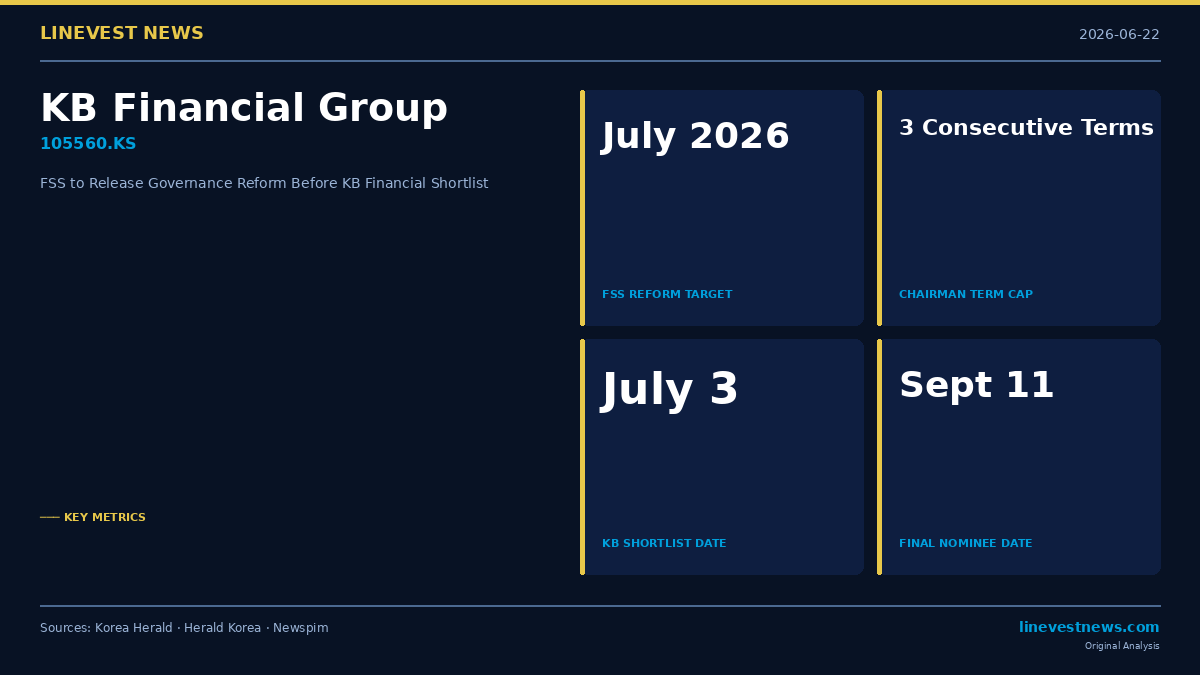
South Korea's Financial Supervisory Service (FSS) Governor Lee Chan-jin said on June 22 that the government's final corporate governance reform plan for financial holding companies will be published before KB Financial Group conducts its next-chairman shortlist selection on July 3—positioning the sweeping overhaul to take effect as early as the industry's most watched succession race enters its decisive stage.
Key reform: three-term cap on chairman reappointments
The package being readied by the FSS and Financial Services Commission (FSC) centres on a rule capping financial holding company chairmen at three consecutive terms, a direct response to long-running criticism that Korea's top lenders have allowed incumbents to entrench themselves through opaque reappointment processes.
FSS Governor Lee said: "We have completed drafting the final governance reform proposal and reported it to the FSC. We plan to announce it before KB Financial's shortlist process begins. The proposal includes provisions on three consecutive terms and some additional reinforced elements."
He added that both a best-practice code revision and statutory amendments would be submitted together, with legislative proceedings expected to advance after the standing committee convenes in July.
KB Financial: the first live test
KB Financial Group (105560.KS) is the only major Korean financial holding company yet to confirm a next-generation leader, making its November 2026 leadership handover the most likely first test of the new framework.
The group's chairman-recommendation committee confirmed a longlist of 12 candidates on June 2—six from within the organisation and six external—and is scheduled to narrow that pool to six on July 3, three on August 27, and a single finalist on September 11. A formal board recommendation is targeted for October 2, with the shareholder meeting expected in November.
Current chairman Yang Jong-hee, whose term expires in November, is widely considered a front-runner for reappointment. Under his leadership, KB Financial posted a net profit of KRW 5.0 trillion in 2024 and KRW 5.8 trillion in 2025, the group's best results on record. Its shareholder return ratio rose from 38% in 2023 to 52.4% in 2025, and the stock price roughly tripled from approximately KRW 51,000 to KRW 156,000 over the same period.
The new three-term cap, if enacted, would not apply retroactively in a way that blocks Yang's potential third term, as implementation is expected at the point of new regulation passage—but regulatory pressure and heightened shareholder scrutiny could nonetheless shape the committee's deliberations.
Broader sector implications
Governor Lee underscored that the July timeline is designed to have ripple effects beyond KB Financial alone. The framework will influence year-end CEO appointment cycles at KB Kookmin Bank, Hana Bank, Woori Bank, NH NongHyup Bank, and Shinhan Bank, all of which are due for leadership reviews in late 2026.
The FSC launched a dedicated corporate governance task force earlier this year and has signalled imminent on-site inspections of eight major financial holding companies, focusing on board independence, CEO selection transparency, and compensation structures. FSC Vice Chairman Kwon Dae-young noted that "bank holding companies have drawn sustained criticism over opaque and entrenched practices in chairman appointment and reappointment."
The reform proposal will also mandate a special shareholder resolution—requiring approval from at least two-thirds of shareholders present—whenever a chairman seeks reappointment, adding an external check on insider-driven succession processes that have historically dominated Korea's banking sector.
Sources: Herald Korea, Newspim, Korea Herald, The Korea Times, The Asia Business Daily