South Korea's FSS Regrets Approving Samsung, SK Hynix Leveraged ETFs
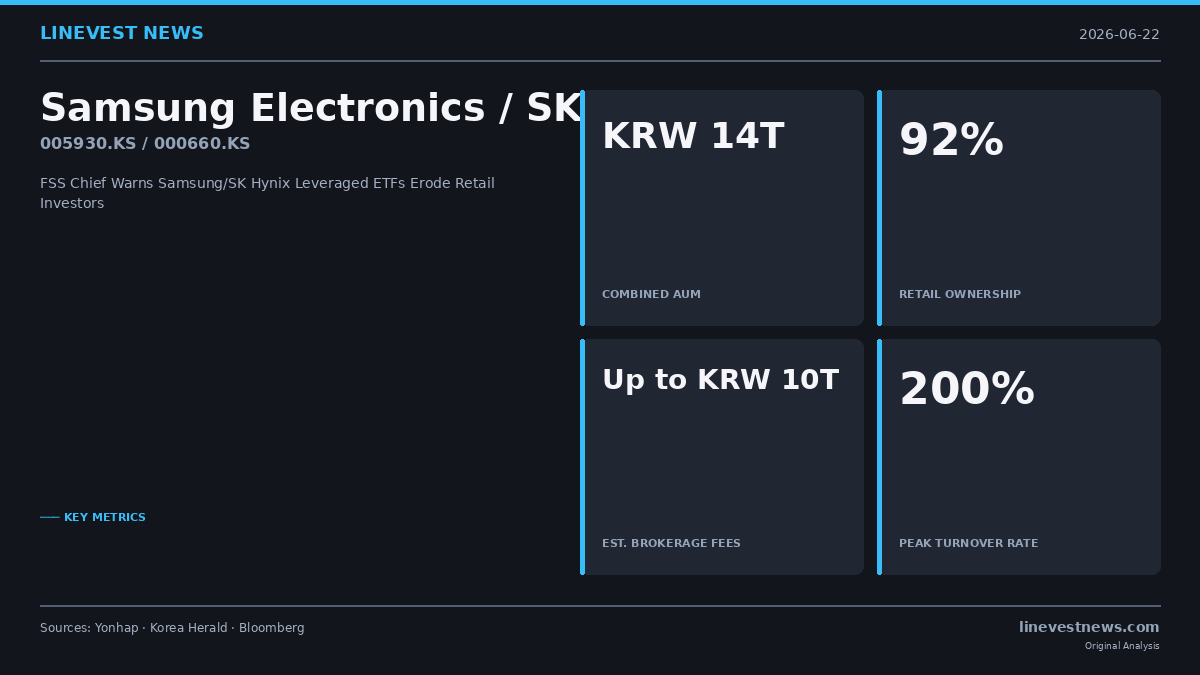
South Korea's financial regulator expressed sharp regret on Monday over the May approval of single-stock 2x leveraged exchange-traded funds tied to Samsung Electronics and SK Hynix, saying the products have generated an estimated KRW 5–10 trillion (USD 3.6–7.2 billion) in cumulative trading commissions at the expense of retail investors who account for 92 percent of holdings.
Financial Supervisory Service (FSS) Governor Lee Chan-jin told reporters at a press briefing in Seoul on June 22 that the products—which deliver double the daily return of Korea's two most-traded blue chips—had diverged sharply from regulatory intent. "I personally regret the timing of the approval," Lee said. "The effect has been minimal, but the side effects have become too significant."
The combined assets under management of Samsung and SK Hynix leveraged ETFs surpassed KRW 14 trillion in the roughly four weeks since their May 27 launch, making the products among the fastest-growing structured funds in Korean ETF history. Some products recorded turnover ratios of up to 200 percent, with commissions consuming 40–70 percent of market capitalization in isolated cases, according to FSS data.
"There is a risk that investors gain little while securities firms earn profits," Lee said, describing the outcome as securities firms "only getting fatter"—a rebuke that drew comparisons to the "tail wagging the dog" dynamic common in leveraged derivative markets.
Five Regulatory Measures Under Review
The FSS is studying the following potential interventions:
- Strengthening trading monitoring thresholds to flag excessive turnover
- Improving credit and margin risk control systems for leveraged products
- Enhancing investor risk disclosures at the point of sale
- Exploring restrictions on margin and securities lending tied to leveraged ETFs
- Tightening approval criteria for future single-stock leveraged products
No formal enforcement action has been announced. Lee acknowledged the products were originally approved in part to retain Korean capital in domestic markets rather than see it flow to overseas thematic funds, but said the actual outcome—with 92 percent retail ownership and frenzied speculative turnover—had undermined that rationale.
Market Context: Semiconductor Rally Fuels Retail Inflows
The dual ETFs launched just as Korea's semiconductor rally entered a historic phase. On the same day as Lee's remarks, SK Hynix surpassed Samsung Electronics as KOSPI's largest market-capitalization company for the first time in 27 years, lifted by artificial intelligence-driven HBM memory demand. The surge provided fertile ground for leveraged retail participation.
The FSS concerns align with a well-documented international pattern. Single-stock leveraged products carry unique structural risks compared to index-based peers: daily rebalancing creates a volatility decay effect that compounds losses on sideways or volatile trades, while high turnover magnifies brokerage revenue irrespective of investor returns.
Korea's ETF market has grown sharply in 2026: domestic-equity ETFs crossed 50 percent of total ETF assets for the first time in June, as KOSPI's breach of the 9,000-point threshold attracted fresh retail capital. The Samsung and SK Hynix leverage products have been a visible driver of that growth—and of fee generation concentrated at securities firms.
What Comes Next
The FSS's formal policy statement is expected before the end of June, timed alongside the banking governance reform announcement flagged for release before the July 3 KB Financial chairmanship shortlist. Market participants are watching whether measures include a hard cap on leverage ratios or an outright moratorium on new single-stock product approvals.
For Samsung Electronics (005930.KS) and SK Hynix (000660.KS), any tightening of leveraged ETF activity could reduce secondary-market speculative pressure—potentially smoothing intraday volatility while slowing the momentum-driven inflows that have helped both stocks reach record valuations.
Sources: Yonhap, Korea Herald, Bloomberg (June 22, 2026)
"