Woori Financial Adds ₩10 Trillion to Growth and Inclusive-Finance Targets, Tripling 2026 Safety-Net Goal
Woori Financial Group (316140.KS) — Finance
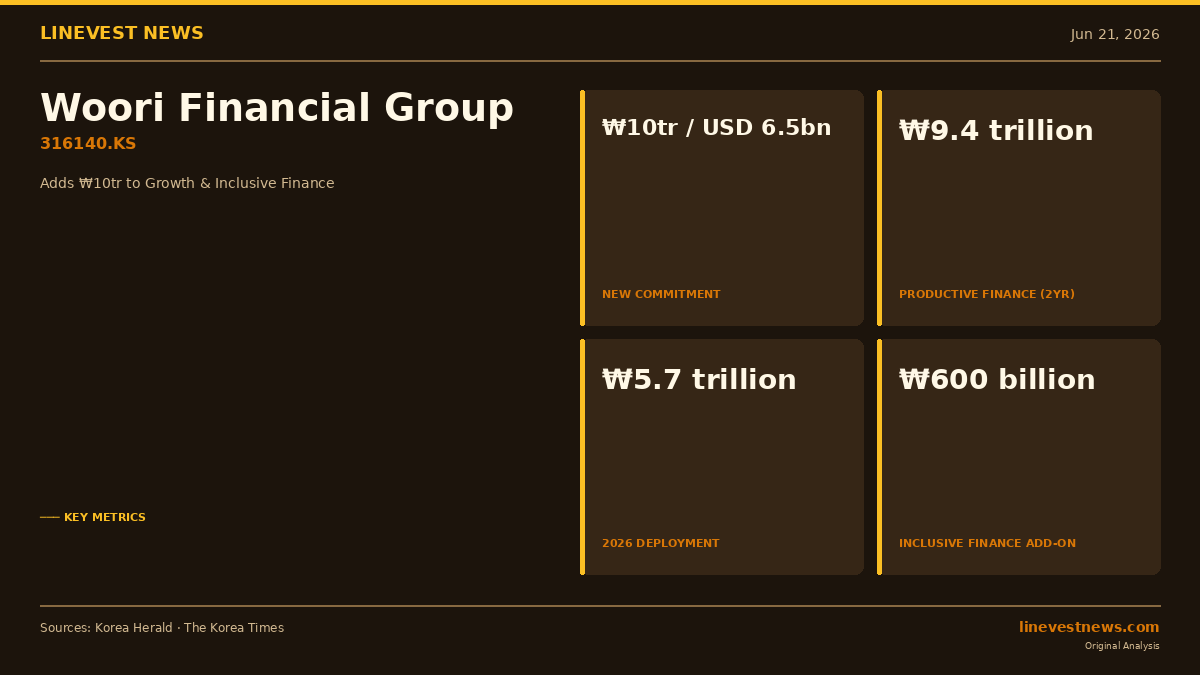
SEOUL, June 21, 2026 — Woori Financial Group (316140.KS) expanded its flagship lending program on Friday, adding ₩10 trillion (USD 6.5 billion) to its "Future Shared Growth Project" through 2027 — 94% of which will flow into productive finance for strategic industries and exporters, with the remainder allocated to low-income borrowers.
Part A — The Announcement
Chairman Yim Jong-yong announced the revision at a steering committee meeting held Friday. The new package breaks down as follows:
| Category | Amount |
|---|---|
| Productive finance — 2-year total | ₩9.4 trillion (USD 6.1bn) |
| → deployed in 2026 | ₩5.7 trillion |
| → deployed in 2027 | ₩3.7 trillion |
| Additional inclusive finance | ₩600 billion |
| Total new commitment | ₩10 trillion (USD 6.5bn) |
With the revision, the program's cumulative target rises to ₩90 trillion. The 2026 inclusive-finance goal is lifted nearly threefold — from the original ₩1.2 trillion to ₩3.5 trillion.
Productive-finance funds will target strategic exporters, regional economies, and small-to-medium enterprises, consistent with Seoul's "Real Economy First" banking reform push. The inclusive-finance tranche widens policy-backed mid-rate lending, emergency living-expense loans for credit-thin borrowers, and outright debt cancellation.
Debt Write-Off Detail
Woori Bank will cancel ₩280 billion in long-overdue loans this year, on top of the ₩40 billion in overdue interest it waived in March 2026. A further ₩120 billion write-off is scheduled for the second half.
The group's 7% interest-rate cap on unsecured personal loans has already assisted approximately 46,000 customers. The Woori WON Dream emergency product — which uses alternative credit scoring to approve borrowers without conventional credit histories — has reached roughly 3,000 borrowers since launch.
Yim said productive finance must ensure funds reach strategic sectors in a timely manner, while inclusive finance should deliver "substantive assistance" to vulnerable borrowers and those facing credit challenges.
Part B — Context and Implications
Korea's Productive-Finance Policy Backdrop
Seoul has pressed the country's four major financial groups — KB, Shinhan, Hana, and Woori — to redirect loan books away from real estate collateral toward advanced manufacturing, export industries, and SMEs. Combined, the four groups have pledged to channel ₩400 trillion into these sectors through 2027. Woori's ₩90 trillion cumulative target now represents roughly a 22.5% share of that aggregate pledge.
The Financial Services Commission has signaled that banks' productive-finance track records will factor into business expansion reviews, adding regulatory teeth to what might otherwise be voluntary commitments.
Inclusive Finance as Regulatory Currency
Korean banks have faced public pressure over record net-interest margins during the high-rate environment, while SME non-performing loans climbed. Debt cancellations and mid-rate lending expansions serve dual purposes: partial compliance with FSS social-contribution metrics, and a visible repositioning away from a pure margin-extraction narrative.
The scale of Woori's write-off plan — ₩400 billion in total across 2026 — is material relative to the group's annual net income but is unlikely to threaten capital ratios given the group's Common Equity Tier 1 ratio has remained comfortably above the FSC's 13% advisory threshold.
Takeaway
The ₩10 trillion add-on signals that Woori's board views productive and inclusive finance as a medium-term strategic pillar rather than a one-time policy gesture. Execution risk lies in credit-quality management — directing capital toward SMEs and credit-thin borrowers at scale typically widens credit-cost volatility — but the commitment aligns Woori squarely with the direction of Korean financial policy for the remainder of the decade.
Sources: The Korea Herald · The Korea Times · June 21, 2026