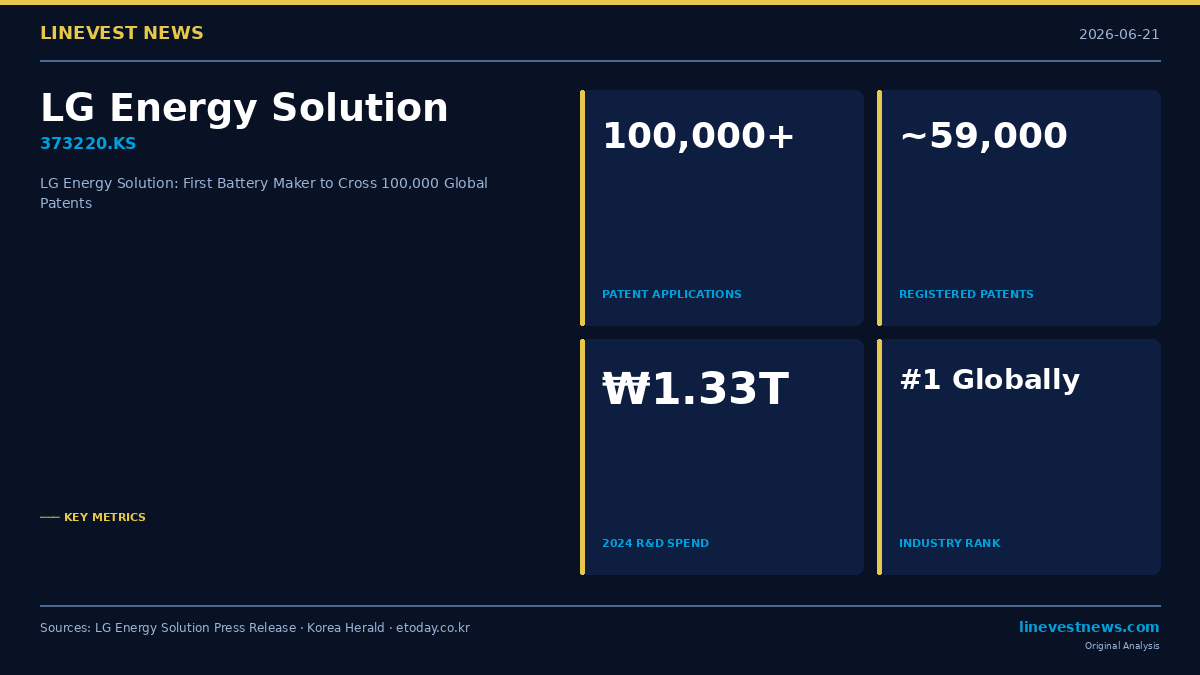
LG Energy Solution (KRX: 373220) has surpassed 100,000 global patent applications — the first battery company in the world to reach the milestone — the Seoul-based company announced Saturday.
As of the end of May, the company held approximately 59,000 registered patents and more than 100,000 applied patents worldwide, according to internal tallies. The achievement spans more than three decades of secondary battery research, covering materials science, electrode design, cell architecture, battery management systems (BMS), and manufacturing processes.
"100,000 patents are not merely a number — they are the fruits of relentless R&D and challenge," said Lee Han-seon, executive in charge of LG Energy Solution's patent group. The company frames intellectual property as a core strategic asset and key lever for future competitive advantage.
Record R&D Spending Underpins the Push
The milestone reflects an accelerating investment cycle. LG Energy Solution broke the ₩1 trillion (approx. USD 720 million) annual R&D threshold for the first time in 2023, then set a new record in 2024 at ₩1.3277 trillion (approx. USD 960 million), representing roughly 5.6% of revenue at the most recent quarterly rate.
Chief Technology Officer Kim Je-young has pointed to breadth and quality across the entire value chain: "We hold competitive superiority in both the quantity and quality of patents spanning materials, cells, and pack segments versus our rivals."
Premium IP Arsenal: What the 100,000 Cover
Among the company's commercialised "premium patents" are:
- Safety-Reinforced Separator (SRS): ceramic particles and polymer binder coating that suppresses thermal runaway — a technology now licensed globally.
- Double Layer Coating (DLC): applied to anodes to improve cycle life and fast-charging tolerance.
- Carbon Nanotube (CNT) conductive additives: enabling higher-energy-density cells without proportional cost increases.
- High-voltage electrolytes and nickel-rich cathodes: pushing specific energy above 300 Wh/kg in premium cells.
For next-generation chemistry, the company has secured approximately 450 patents covering dry-electrode manufacturing — a process that eliminates toxic solvents and could slash factory energy use by up to 40%. A Lithium Manganese Rich (LMR) battery targeting mass-market EV applications is in joint development with General Motors and aimed at commercialisation in 2028.
IP Moat as Counter-Strategy to Chinese Market Share
The patent push comes as the competitive landscape shifts sharply toward Chinese manufacturers. CATL holds an estimated 36.8% share of the global battery market; BYD ranks second; and six Chinese firms collectively account for roughly 68.4% of the global top-10. Korean battery makers — LG Energy Solution, Samsung SDI, and SK On — have seen aggregate market share erode over the past two years despite strong technology credentials.
LG Energy Solution's approach is to treat the patent portfolio as a "decisive weapon" — in the words of Lee Han-sun, Executive Vice President — in a contest where raw capacity is increasingly commoditised. The company has also recently notched a third legal victory in patent litigation against an unnamed Chinese rival over cell-structure patents, signalling willingness to enforce its IP aggressively in global courts.
Cell-to-pack (CTP) technology for automotive lithium-iron-phosphate (LFP) batteries is also expected to launch this year, backed by dedicated manufacturing and IP infrastructure developed over several years.
The 100,000-application mark puts LG Energy Solution in a position no battery maker has occupied before — and underscores the company's bet that technological differentiation, not production scale alone, will determine long-term winners in the global EV supply chain.
Sources: LG Energy Solution press release (June 21, 2026); The Korea Herald; etoday.co.kr; news.lgensol.com