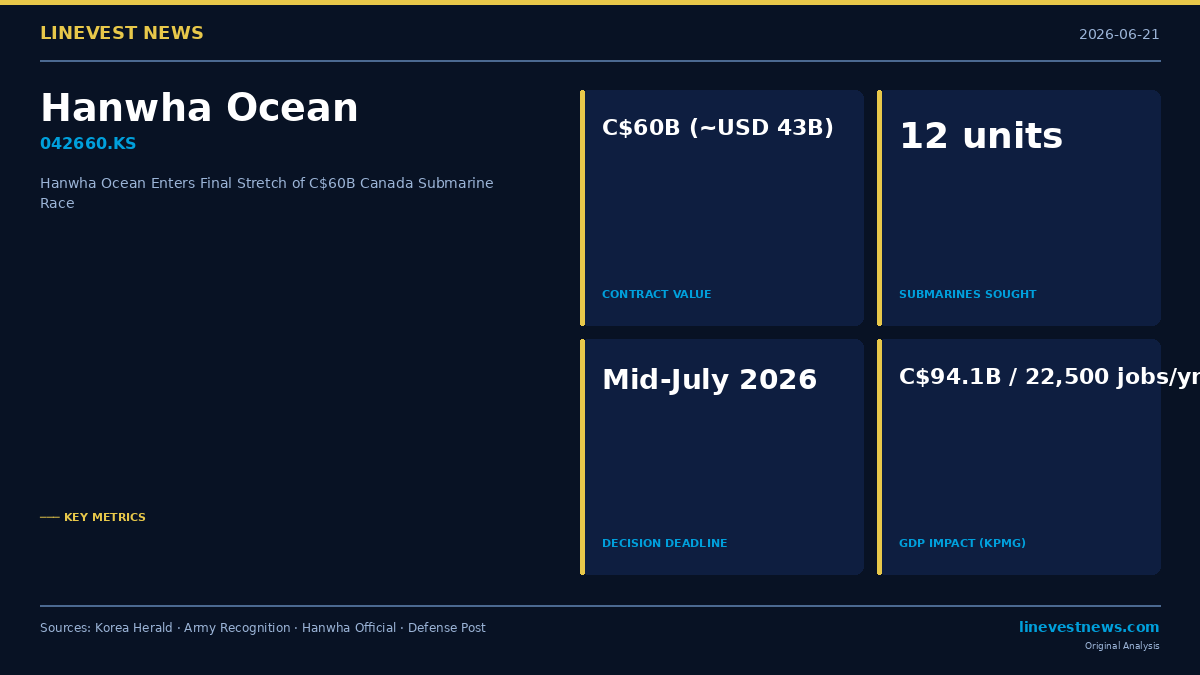
South Korea's Hanwha Ocean (042660.KS), partnering with HD Hyundai Heavy Industries (329180.KS), has advanced to the decisive final stage of Canada's landmark Canadian Patrol Submarine Project (CPSP), with Ottawa expected to name a winner before mid-July 2026. The Korean consortium faces Germany's Thyssenkrupp Marine Systems (TKMS) and its Type 212CD design in what analysts describe as the largest single defense procurement in Canadian history.
The total contract — covering acquisition, maintenance, and four decades of lifecycle support for 12 new patrol submarines — is valued at up to C$60 billion (approximately USD 42.9 billion), or roughly KRW 64 trillion.
Live Demo Off Canada's Pacific Coast
A Royal Canadian Navy crew flew to South Korea to join ROKS Dosan Ahn Chang-ho for a 14,000 km trans-Pacific voyage that departed Jinhae Naval Base on March 25 and docked at CFB Esquimalt, Victoria, on May 23. The two navies then conducted bilateral anti-submarine warfare exercises through June 2 — the first time a South Korean submarine has operated in Canadian waters.
Industry observers viewed the deployment as a carefully choreographed operational showcase for Canadian procurement officials, demonstrating the KSS-III's Arctic capability and long-range endurance ahead of Ottawa's vendor selection.
Platform: World-First AIP + Lithium-Ion
For the CPSP bid, Hanwha Ocean is proposing a scaled export variant of the KSS-III, displacing approximately 2,800 tons — smaller than the domestic Batch-II version at 3,600 tons — to fit Canadian port infrastructure. The KSS-III is the world's first diesel-electric submarine to integrate both Air Independent Propulsion (AIP) and lithium-ion battery systems, yielding superior underwater endurance and acoustic stealth relative to conventional lead-acid designs.
Delivery schedule: four submarines operational before 2035 (replacing the aging Victoria-class fleet), with the remaining eight at one-per-year cadence to complete the fleet by 2043. TKMS has pledged four Type 212CD submarines by 2036 after reallocating production capacity.
Industrial Package: C$94.1B GDP Impact
KPMG's independent economic assessment projects that Hanwha's industrial-benefits package would generate a GDP contribution of C$94.1 billion and sustain an average of 22,500 full-time Canadian jobs annually from 2026 to 2044. Rival TKMS estimates C$86 billion in total economic impact.
To lock in supply-chain credentials, Hanwha has signed teaming agreements with PCL Construction and Babcock, committed C$345 million (~USD 250 million) for CPSP facilities and domestic steel procurement, pledged C$275 million (~USD 200 million) toward a structural steel beam mill in Sault Ste. Marie, Ontario, and agreed to purchase up to C$70 million (~USD 50 million) of product from Algoma Steel. The consortium counts more than 70 Canadian companies and institutions as industrial partners.
What a Win Would Mean for Korean Defense Equities
A contract award to the Korean consortium would represent the largest single overseas shipbuilding order ever secured by a Korean company and provide multi-decade revenue visibility for both Hanwha Ocean and HD Hyundai Heavy Industries. Hanwha Ocean has grown into one of Asia's foremost naval builders, delivering 1,400-plus vessels over five decades from its 5 km2 Geoje shipyard, which employs more than 31,000 staff.
The CPSP decision is expected before mid-July 2026. Canada's choice will carry strategic weight beyond the contract itself: a Korean win would mark the first time an Asian nation has supplied the principal submarine platform to a Five Eyes partner, setting a precedent for similar procurement debates in Australia and New Zealand.
Sources: Korea Herald · Army Recognition · Hanwha Ocean Official Press Release · The Defense Post · True North Strategic Review · Canadian Defence Review