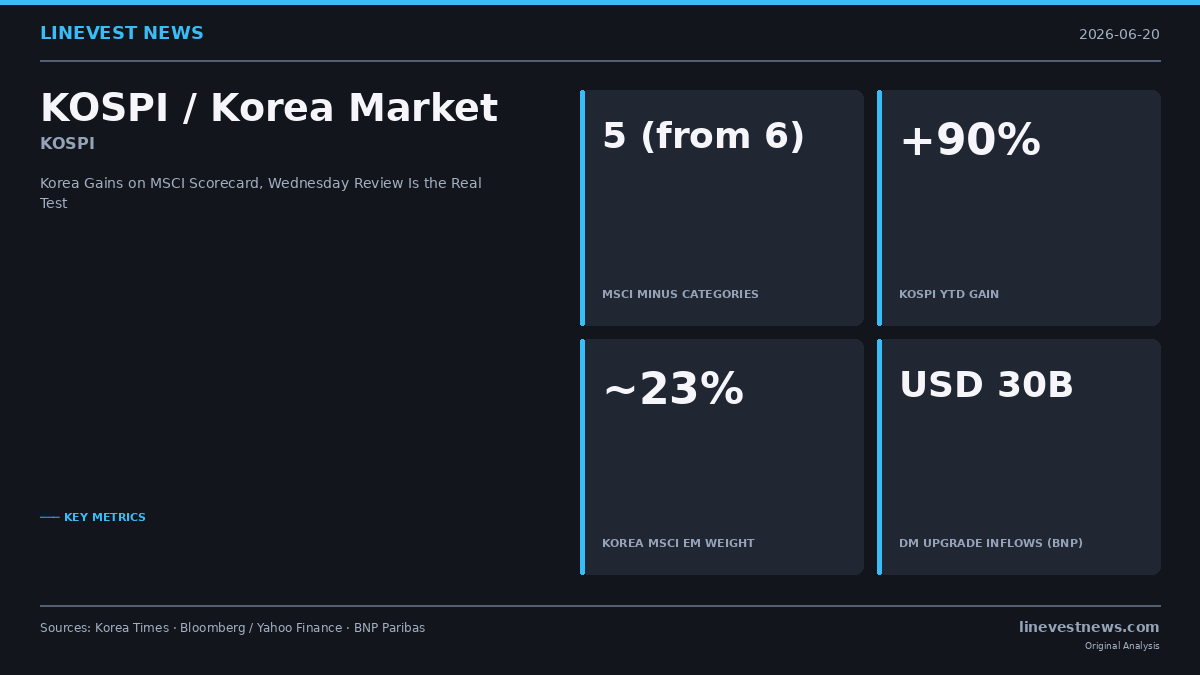
South Korea moved one step closer to developed-market recognition as MSCI upgraded the "availability of investment instruments" category in its 2026 Global Market Accessibility Review — published Friday — shifting the rating from minus to plus. The number of minus-rated categories fell to five from six a year earlier, reflecting the recent listing of derivative products linked to Korean indexes on international exchanges. The more consequential hurdle arrives Wednesday, when MSCI releases its Annual Market Classification Review: a watch-list designation there would open a 12-to-18-month path toward full reclassification.
Four categories remain in minus territory: foreign exchange liberalization, investor registration, information flow, and clearing and settlement. MSCI noted that while Korea-linked derivative products are now trading on offshore venues, restrictions on using exchange data to create new products have not been lifted. Seoul has moved to address other long-standing concerns ahead of the review, including mandatory English disclosures for listed companies, a 24-hour won-dollar market scheduled to launch in July 2026, and upgraded dividend payment procedures to reduce withholding-tax uncertainty for overseas investors.
If MSCI places Korea on the Developed Markets watch list on Wednesday, the earliest plausible timeline for index inclusion is June 2027, with effective implementation and fund rebalancing through May 2028. BNP Paribas estimates a full reclassification would attract roughly USD 30 billion in benchmark-tracking inflows. Korea currently accounts for approximately 23% of the MSCI Emerging Markets index, meaning any exit would also force an EM rebalance across peer markets.
The accessibility upgrade lands as the KOSPI has surged roughly 90% year-to-date — among the best performances of any major equity benchmark globally — lifting South Korea's total market capitalisation to nearly USD 4.4 trillion and briefly to the world's sixth-largest stock market. Samsung Electronics (005930.KS) and SK Hynix (000660.KS) together represent more than 50% of KOSPI's weighting, meaning AI and semiconductor enthusiasm has driven the bulk of the gain.
Domestic retail investors have been the backbone of the rally: Korea Investment Securities data show retail buyers were net purchasers of KRW 64.3 trillion (USD 41.9 billion) in listed shares and KRW 55.3 trillion in ETFs year-to-date, while foreign investors were net sellers of roughly KRW 111 trillion combined. A formal DM upgrade could flip that dynamic, channelling sustained institutional inflows that may broaden gains beyond the two dominant chip names.
Despite the market's outperformance, most analysts expect MSCI to keep Korea in the emerging-market category for at least one more cycle. Of 15 investors and strategists polled by Bloomberg, the majority cited won convertibility frictions and the short reform track record as reasons for caution. Korea was removed from MSCI's DM watch list in 2014; re-entry would be the country's first in more than a decade.
Sources: Korea Times · Yahoo Finance / Bloomberg · Business Standard · TradingKey