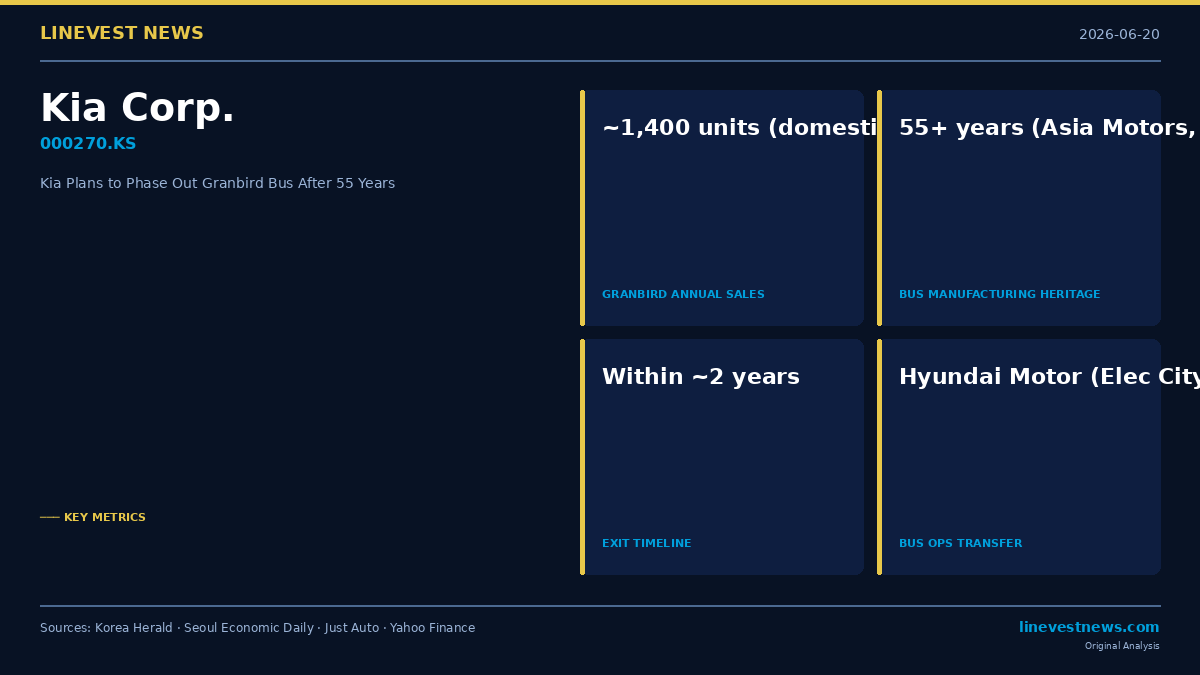
South Korea's Kia Corp. (000270.KS) plans to discontinue its Granbird large bus within approximately two years, the company informed union representatives at a labor-management committee meeting this week — ending a commercial-vehicle lineage that traces back more than five decades to its predecessor, Asia Motors.
If implemented, all bus manufacturing within Hyundai Motor Group will consolidate under sibling brand Hyundai Motor, which already operates the Elec City battery-electric and Elec City Fuel Cell hydrogen-bus platforms. Kia said it will redirect the capacity and engineering resources freed by the exit toward its Purpose-Built Vehicle (PBV) business, anchored by the emerging "PV Series" lineup.
Why Now: Chinese Pressure and Rising Regulatory Costs
Granbird sales have fallen to roughly 1,300–1,400 units annually — almost entirely in the domestic market — a level that management says no longer supports the investment required to keep the model compliant with tightening emissions standards. Chinese bus manufacturers have simultaneously expanded into the segment with lower-priced alternatives, compressing residual margins for Korean incumbents.
The economics of small-volume specialist buses have shifted sharply. Developing next-generation clean-power drivetrains across two brands within the same conglomerate is redundant when Hyundai Motor is already investing in battery and hydrogen bus platforms that Kia would simply duplicate.
Labor Union Digs In
The Gwangju branch of the Korean Metal Workers' Union rejected the plan outright. "We can never accept a halt to bus production without employment measures," union representatives said, announcing a complete suspension of labor-management negotiations until Kia provides concrete job guarantees. The Granbird is manufactured at the Hanam plant within the Kia Autoland Gwangju complex, which also produces military and special-purpose vehicles.
The labor standoff adds operational uncertainty to the timeline, though management's public posture — informing workers of the decision rather than consulting them — suggests Kia regards the strategic direction as settled.
Kia's Pivot to PBVs
Kia has positioned Purpose-Built Vehicles as a growth pillar, targeting fleet operators, logistics companies, and future mobility providers. Exiting the low-margin large-bus segment frees both floor space and engineering headcount that management can deploy toward PBV-specific platforms, where margins and volume ambitions are substantially higher than the ~1,400-unit bus cadence.
Within Hyundai Motor Group, bus consolidation mirrors similar rationalization moves seen across Korean conglomerates reshaping legacy industrial lines to fund next-generation bets.
Sources: Korea Herald · Seoul Economic Daily · Just Auto · Yahoo Finance