Doosan Corp (000150.KS), the holding company of South Korea's Doosan Group, and LG CNS (064400.KS), the IT-services arm of LG Group, signed a memorandum of understanding on June 19 at LG Science Park in western Seoul to cooperate across AI, robotics, data centers and digital manufacturing. For any investor pricing the headline, the first thing to register is what the deal is not: it is a non-binding MOU with no financial terms disclosed, and the two sides will only stand up a joint task force — with detailed operational plans — within one month, according to the Korea Herald and the Korea Times.
That framing matters because the announcement is broad. The companies listed cooperation on data centers and cloud, agentic AI, robotics, hydrogen-fueled logistics, and autonomous maintenance of plants using AI, hydrogen drones and digital-twin technology (Korea Herald). Two LG CNS platforms anchor the software side: AgenticWorks, its enterprise agentic-AI platform (Korea Times), and PhysicalWorks, its robot-learning platform unveiled in May 2026 (Korea Times, May 7, 2026). Doosan's contribution is industrial: heavy-equipment know-how and, critically, hydrogen fuel cells.
What each side actually brings
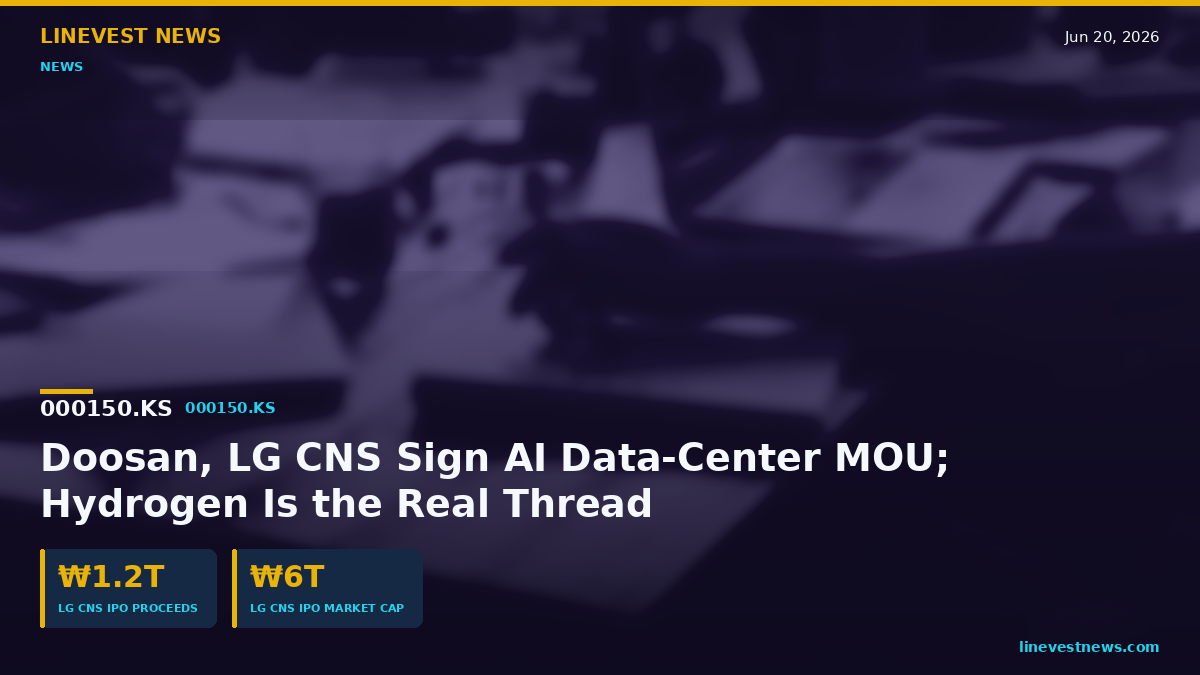
LG CNS is the larger, more liquid name. It listed on the KOSPI in February 2025 at ₩61,900 per share, raising ₩1.2 trillion ($821 million) at an implied market capitalization of roughly ₩6 trillion (approximately $4.1 billion) — at the time among the most prominent Korean listings in a sluggish IPO market, per KED Global. Its business is enterprise IT: systems integration, cloud and AI. The MOU gives it an industrial channel to deploy AgenticWorks and PhysicalWorks beyond pure IT clients.
For Doosan, the strategic logic runs through power. Doosan Fuel Cell (336260.KS), a Doosan affiliate, posted 2025 revenue of about ₩454.8 billion ($311 million), per stockanalysis.com data, and last year moved into solid-oxide fuel cells, opening an SOFC mass-production line in North Jeolla Province in July 2025 with an initial 50 MW of annual capacity. The single most concrete commercial thread in this MOU is the plan to feed hydrogen fuel cells into LG CNS's data-center operations — a direct answer to the power bottleneck that AI data centers face. LG CNS supplies the buildings and the AI workloads; Doosan supplies a way to power them.
Precedent and the open question
This is not a cold start. The two firms have collaborated since 2025 on hydrogen fuel-cell-based logistics, and both executives framed the MOU as an extension of that work. LG CNS President Hyun Shin-gyoon said the combination of LG CNS's "capabilities in AX and RX and Doosan's strong technical abilities will generate great synergy," while Doosan Corp President Yoo Seung-woo said the tie-up would take "the future value of both companies to the next step" (Korea Herald).
The verifiable test comes quickly. The companies committed to forming a cooperation task force with concrete plans within one month — by roughly mid-July 2026. Whether that body produces a defined data-center fuel-cell pilot, a capacity figure or a budget, versus another round of aspirational language, is the data point that will show whether this MOU converts into revenue. Until then, the absence of disclosed financial terms keeps it a directional signal rather than a contracted one.
This article is for informational purposes only and does not constitute investment advice. Figures are drawn from cited reporting and public market data and may be revised.