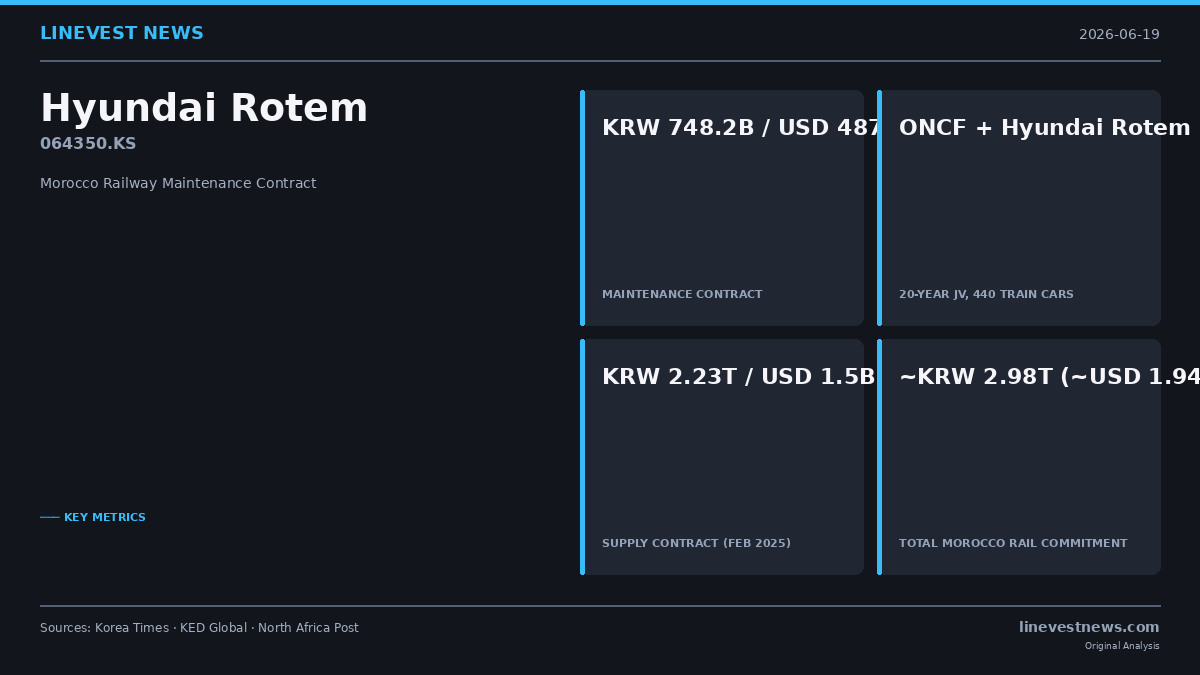
Hyundai Rotem signed a 20-year railway maintenance agreement with Morocco's national rail operator ONCF worth ₩748.2 billion (approximately USD 487.3 million) on Thursday, extending the South Korean train maker's total commitment to the North African market to nearly ₩3 trillion and securing a recurring revenue stream through 2046.
The pact covers the upkeep of all 440 double-decker electric train cars Hyundai Rotem is supplying under its ₩2.23 trillion (USD 1.5 billion) contract awarded in February 2025 — the largest single order in the company's railway history. Work under the new agreement will be carried out through a joint venture established by Hyundai Rotem and ONCF, with the signing ceremony held in Rabat and attended by Hyundai Rotem CEO Lee Yong-bae and ONCF Director General Mohamed Rabie Khlie.
Part B: Why This Matters for Investors
Morocco's 2030 World Cup Deadline Drives the Timeline. Morocco is co-hosting the FIFA World Cup in 2030 alongside Spain and Portugal. The double-decker trains are set to run rapid shuttle services (TNR) connecting Kenitra, Rabat, and Casablanca, with service launches staged to align with the tournament. That hard deadline strengthens the likelihood of on-schedule delivery and reduces renegotiation risk on the supply side.
A Bundled Supply-and-Service Model With a Long Tail. Securing the maintenance contract alongside the supply deal is significant for margin quality. Pure hardware contracts carry lumpy revenue, but a 20-year service agreement layered on top provides ONCF with operational continuity — and Hyundai Rotem with a durable annuity stream that lowers its dependence on project-by-project bidding. The maintenance JV also gives Hyundai Rotem a permanent on-the-ground presence in Morocco, building on the subsidiary it established in Casablanca in August 2025 (its third African office, following Egypt and Tunisia).
Scale in Context. The ₩2.23 trillion supply contract alone represents 61.4% of Hyundai Rotem's entire 2024 sales of ₩3.6 trillion. Adding the ₩748.2 billion maintenance deal, the combined Morocco commitment stands at approximately ₩2.98 trillion — nearly double the company's annual revenue. Hyundai Rotem's order backlog has already doubled from ₩7.1 trillion (2020) to ₩14.1 trillion (end of 2024), and this long-duration service pact reinforces that trajectory.
Korean Supply Chain Breadth. Roughly 90% of the 110 trains' components will be sourced from approximately 200 South Korean sub-contractors, meaning the economic spillover extends well beyond Hyundai Rotem itself. The arrangement was structured with South Korea's Economic Development Cooperation Fund providing concessional loans to Morocco — a government-backed financing model that helped Hyundai Rotem out-compete European rivals in the bidding process.
African Rail as a Strategic Beachhead. With offices now in Egypt, Tunisia, and Morocco, Hyundai Rotem is positioning the continent as a growth corridor alongside its domestic defense backlog and the US export market. Morocco's infrastructure pipeline extends beyond the World Cup, making this maintenance JV a potential template for future bids on ONCF's broader electrification program.
Sources: Korea Times (June 19, 2026); KED Global (February 2025); North Africa Post; Railway Technology