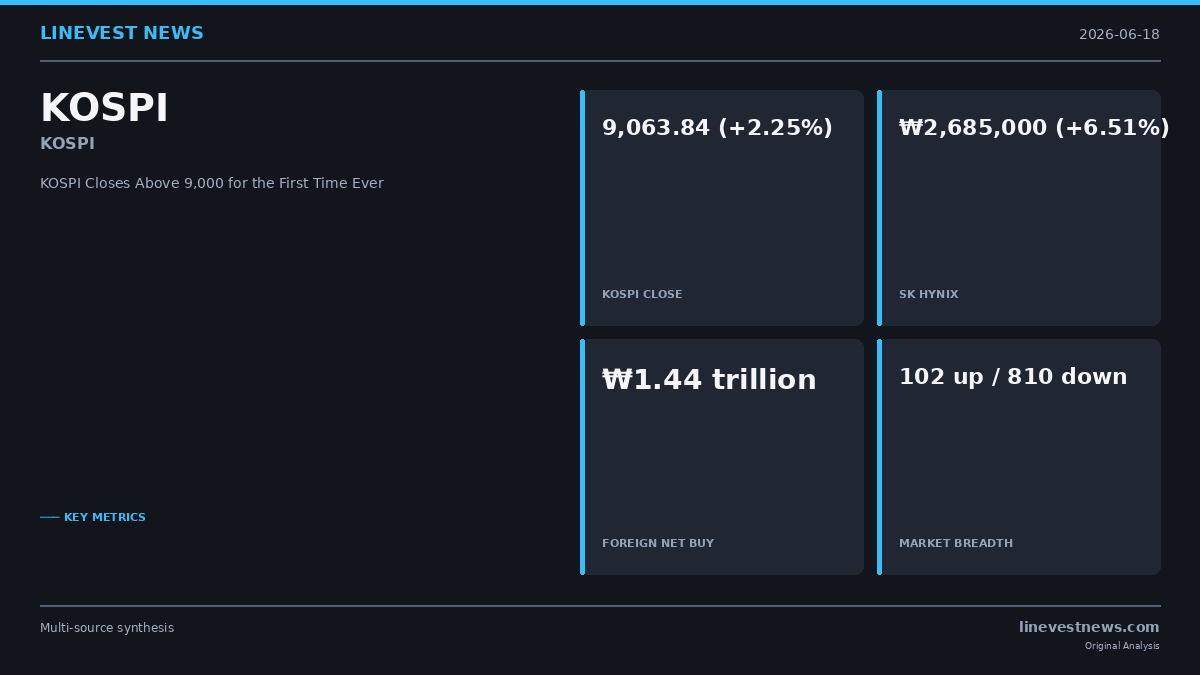
South Korea's benchmark KOSPI closed at 9,063.84 on Wednesday, June 18, 2026 — clearing 9,000 for the first time in the index's history. The gain of 199.6 points, or 2.25%, came as semiconductor heavyweights carried the rally while more than 800 constituent stocks retreated in a widening divide between chipmakers and the broader market.
Part A: The Milestone
The KOSPI touched an intraday peak of 9,106.07 before paring some gains to settle at 9,063.84. The milestone arrived just 16 trading days after the index first closed above 8,000 on May 26 — the fastest 1,000-point advance in the post-2020 bull run, which has now pushed the index more than 100% year-to-date in 2026.
SK Hynix (000660) was the standout mover, surging 6.51% to a record close of ₩2,685,000 per share. Samsung Electronics (005930) added 4.62% to ₩362,500. SK Square climbed 6.52% and Samsung Electro-Mechanics jumped 8.27%, elevating the components maker to fifth place in KOSPI by market capitalization.
Foreign investors were net buyers of ₩1.44 trillion worth of shares — the clearest signal of international conviction in the semiconductor cycle. Domestic retail investors, by contrast, net-sold ₩543.9 billion, and institutions offloaded ₩680.3 billion.
Part B: A Rally Hiding a Divide
Beneath the index record, market internals told a more divided story. Of roughly 928 KOSPI constituents, approximately 810 stocks declined while only 102 advanced on Wednesday — a breadth ratio that underlines just how concentrated the gains were in chip-linked names.
The immediate catalysts were two-fold. First, an overnight US-Iran war-end agreement lifted global risk appetite. Second, Apple CEO Tim Cook flagged a memory chip shortage driven by AI demand and signaled product price increases — a direct read-through to SK Hynix's HBM and LPDDR order books.
The peace deal, however, cut against sectors that had benefited from geopolitical tension. LIG Nex1 fell 4.95%, Hanwha Ocean slid 5.03%, and HMM dropped 6.33% as defence, shipbuilding and shipping stocks shed their risk-premium. The KOSDAQ — home to Korea's small- and mid-cap tech universe — fell 3.01% to 1,000.93, a stark contrast to the KOSPI headline.
"KOSPI has entered a typical earnings- and policy-driven market phase," said an analyst at Daishin Securities.
Samsung Electronics and SK Hynix together account for more than 50% of the KOSPI's market capitalisation, meaning the headline index increasingly reflects the fortunes of two chipmakers rather than the Korean economy at large. Korea's Financial Supervisory Service had issued consumer alerts earlier this week warning retail investors against concentrated exposure to single-stock leveraged ETFs tied to Samsung and SK Hynix — a sign that regulators are watching the divergence.
Whether a two-stock index is a reliable gauge of national economic health is a long-running debate. For now, 9,000 gives Korea's equity market a historic data point — one that, on Wednesday at least, only about one in nine listed stocks actually contributed to.
Sources: Korea Times (June 18, 2026), Seoul Economic Daily (June 18, 2026), International Business Times (June 18, 2026)