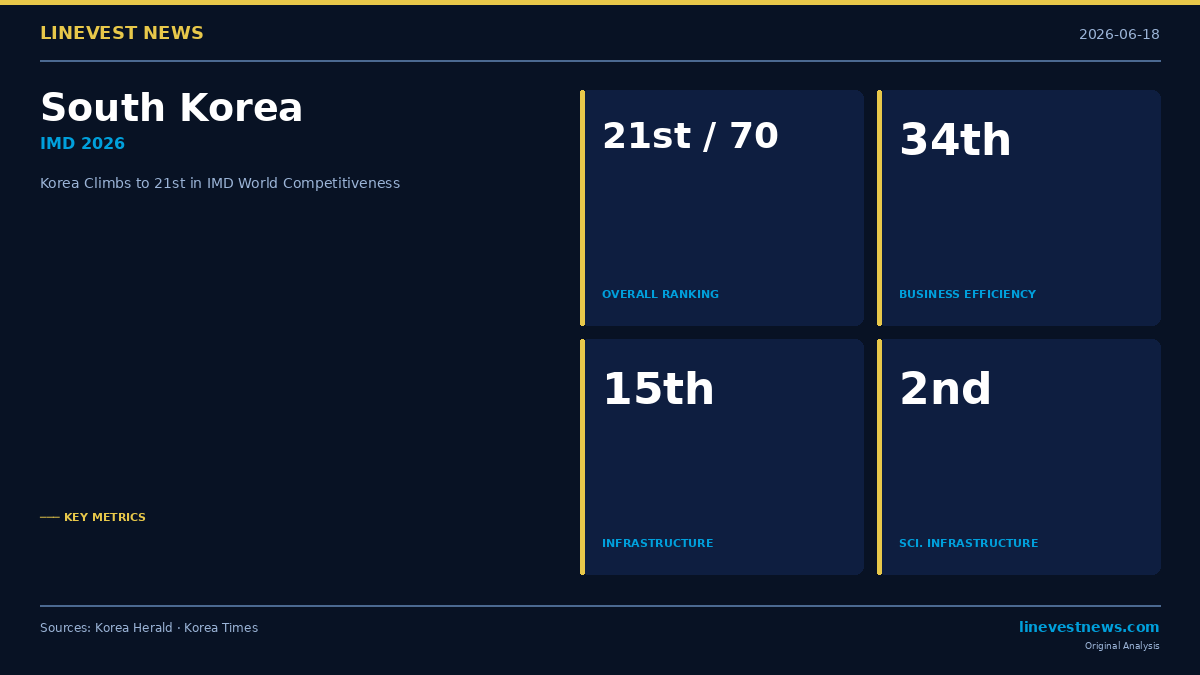
South Korea climbed six places to rank 21st among 70 economies in the 2026 IMD World Competitiveness Yearbook, reaching its second-highest position since the country was first included in the annual survey in 1997. Business efficiency led the advance, jumping 10 spots to 34th, while the infrastructure pillar rose six places to 15th — with scientific infrastructure holding a global 2nd-place finish. The Ministry of Economy and Finance said it would "analyze the strengths and weaknesses of the Korean economy and continue its efforts to improve systems and drive innovation."
Rankings Breakdown
| Pillar | 2026 Rank | Change |
|---|---|---|
| Overall | 21st / 70 | +6 |
| Business Efficiency | 34th | +10 |
| Infrastructure | 15th | +6 |
| Economic Performance | 14th | −3 |
| Government Efficiency | 31st | 0 |
Korea Among High-Income Peers
Among the so-called "USD 30,000-plus, 50 million-plus" cohort — economies with per-capita income above USD 30,000 and populations over 50 million — Korea ranked 2nd globally, up from 3rd. That puts it ahead of Germany (23rd overall), the United Kingdom (24th), and Japan (30th), trailing only the United States (10th overall).
Korea's all-time best IMD result was 20th place in 2024; Thursday's announcement brings it within one spot of that peak.
Context: Mixed 2025 Base, Strong Structural Gains
The 2025 macroeconomic backdrop was mixed. Annual real GDP growth came in at 1.1 percent after a sluggish first half, contributing to the weaker economic performance sub-score. Yet structural improvements — particularly in technological infrastructure (+12 places) and labor-market flexibility (+8 places) — dominated the overall picture.
The ranking release follows KOSPI's close above 9,000 for the first time on Tuesday, with AI chip demand and semiconductor exports driving Korea's technology standing to global prominence. Korea's 2nd-place scientific infrastructure score underscores a concentrated bet on R&D-intensive industries that increasingly defines its competitive positioning.
The full IMD World Competitiveness Yearbook 2026 covers 70 economies across 336 competitiveness criteria grouped into the four pillars above.
*Sources: Korea Herald (June 18, 2026); Korea Times (June 18, 2026)*