Samsung Electronics' (005930.KS, the world's largest memory-chip maker) biggest labor union will spend a week asking its members a blunt question: should the chairman who struck this year's wage deal keep his job? The internal confidence vote on Chairman Choi Seung-ho runs from 2 p.m. on June 24 to 10 a.m. on June 30 by electronic ballot, according to a fourth general-meeting notice the union posted on June 17 (etnews, The Korea Times). For a portfolio manager, the key point is what the vote is not: it is a governance event, not a production threat. The earlier strike was called off and the wage deal is in force. What the vote does is put a number on how badly a semiconductor-tilted bonus package has fractured Samsung's workforce.
What is actually being voted on
The body holding the ballot is the Samsung Group Joint Labor Union, Samsung Electronics chapter (chogieop union, a supra-enterprise union that spans several Samsung affiliates). Its members will decide two things: whether to reaffirm Choi as chairman, and a revision of the union's bylaws (etnews). The confidence motion passes if more than half of participating members back it (The Korea Times). Choi has said that, if reaffirmed, he will prioritize the Device Solutions (DS) division — Samsung's semiconductor business — in the 2027 wage negotiations (etnews).
Why the revolt, and how big it is
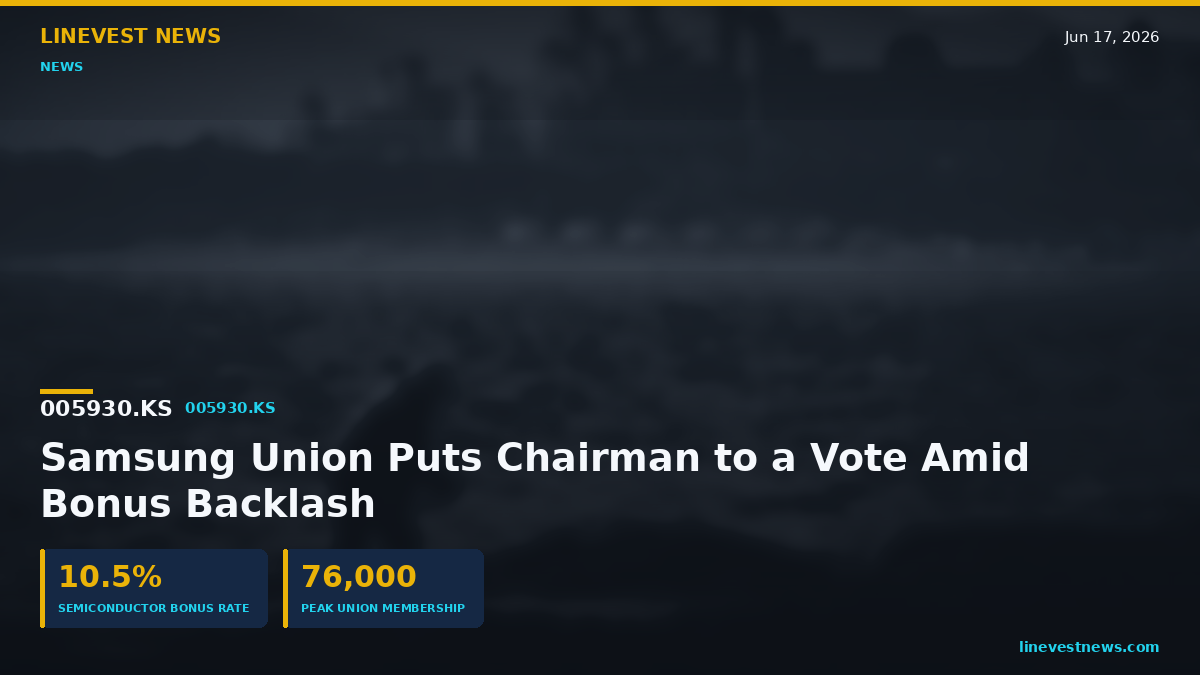
The trigger is the wage agreement reached in May. Under it, Samsung committed to a special semiconductor performance bonus equal to 10.5 percent of business performance earnings, payable in company stock over a period of at least 10 years and tied to chip-division performance targets (The Korea Times). Members outside the chip business argued the structure funnels rewards toward semiconductor staff, and many quit.
The membership math sizes the damage. During wage bargaining the union surpassed 76,000 members and secured majority union status; by 8 a.m. on June 17 it counted 56,450 members and had lost that majority (The Korea Times). That is a drop of roughly 20,000 members — about a quarter of its peak — inside a single bargaining cycle, with local media reporting the steepest departures clustered in early June.
The precedent worth weighing
This is the second straight year that bonus mechanics tied to chip profits have driven labor friction at Samsung. In July 2024 the National Samsung Electronics Union (NSEU) — the company's first union ever to walk out — staged the first strike in Samsung Electronics' 55-year history, centered on semiconductor workers in Hwaseong and on demands for a clearer, bonus-linked pay formula. That action did not materially halt chip output, and the dispute ultimately returned to the bargaining table. The 2026 episode differs in form — an internal leadership vote rather than a walkout — but shares the same fault line: how performance bonuses anchored to semiconductor profits are shared across a workforce that extends well beyond the chip divisions.
The open question
The June 30 tally is the next hard data point. A reaffirmation keeps Choi's DS-first agenda on track into the 2027 cycle; a rejection would reopen the union's leadership just as its membership base shrinks. Either way, whether the headcount stabilizes after the vote — not the vote itself — is the cleaner read on how durable Samsung's labor settlement really is. None of this currently puts wafer output at risk, but it keeps the bonus-design dispute that produced Samsung's first strike very much alive.
Sources: The Korea Times (June 17, 2026); etnews (June 17, 2026); Yonhap (June 17, 2026)
This article is for informational purposes only and does not constitute investment advice.