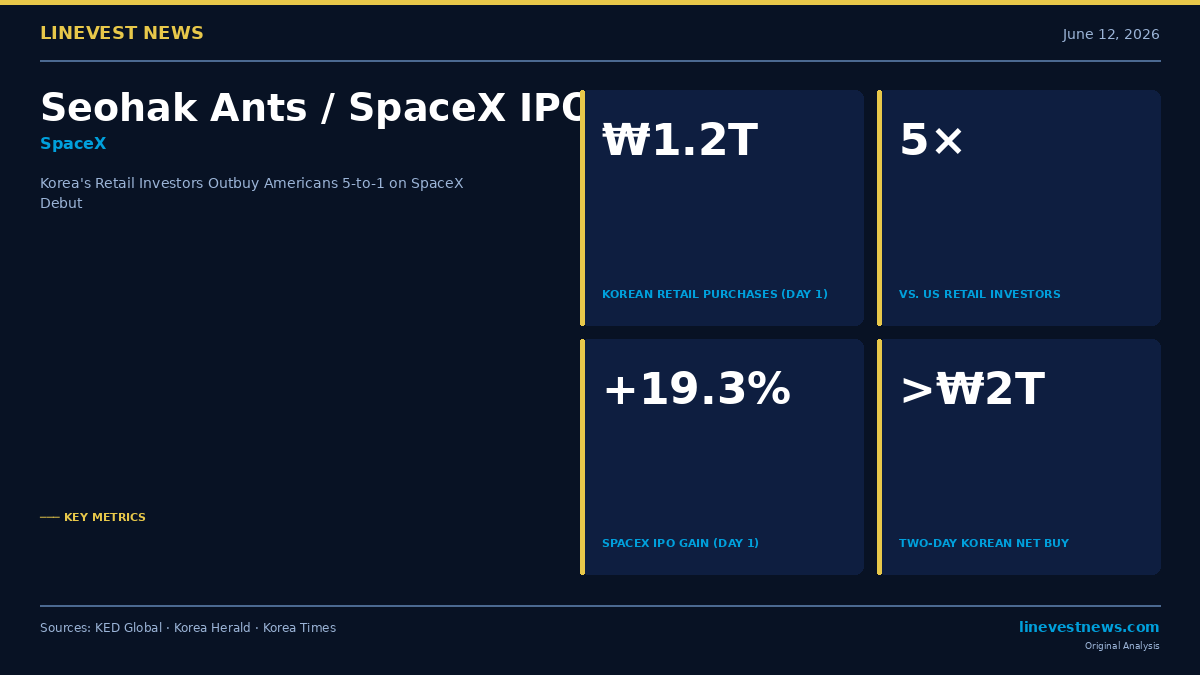
South Korean retail investors known as the "Seohak Ants" poured ₩1.2 trillion (USD 885 million) into SpaceX shares on the company's Nasdaq debut on June 12, outpacing their American counterparts by more than fivefold in one of the most aggressive single-session overseas buying sprees in Korean market history.
According to data from the Korea Securities Depository, Korean retail investors bought a net ₩1.2 trillion worth of SpaceX shares through 11 domestic brokerages — including Mirae Asset Securities, Korea Investment & Securities, and Toss Securities — on the first trading day. By contrast, US retail investors purchased a net USD 117–118 million on the same day, making the Korean figure roughly five times larger.
How SpaceX's Debut Played Out
SpaceX shares were priced at USD 135 per share in the IPO. They opened at USD 150, traded as high as USD 176, and closed at USD 161.11 — a 19.3% gain on the first day. On the second trading session (June 15), the stock climbed another 19.6%. Based on first-day closing prices, Korean retail investors accumulated approximately 5 million shares; combined net purchases over the first two trading days are estimated to exceed ₩2 trillion (roughly USD 1.4 billion).
SpaceX's IPO, described as the world's largest IPO of 2026, valued the company at roughly USD 2.1 trillion, vaulting it into the top tier of global companies by market capitalization. Korean retail investors pushed SpaceX into the top 30 most widely held US stocks among Korean investors within a single session, alongside Nvidia, Tesla, Apple, Microsoft, and Alphabet.
The Mirae Asset Snub — and Why Koreans Bought Anyway
The buying spree unfolded against a backdrop of frustration. Mirae Asset Securities had been earmarked for 2.31 million shares in the SpaceX syndicate through lead underwriter Goldman Sachs, and Korean institutional investors submitted roughly USD 500 million in subscription orders during the June 5–8 bookbuild window. At the final allocation, however, Goldman Sachs redirected all Korean allocations elsewhere, citing unexpectedly strong institutional demand. Mirae Asset received zero IPO shares, refunding all subscription deposits early on June 14.
Rather than stepping back, retail investors flooded the secondary market the following trading session — buying at open-market prices already 11–19% above the IPO price. "How were we supposed to know the fund manager was bluffing?" one retail investor wrote online, reflecting the frustration that ultimately translated into secondary-market momentum.
The Financial Supervisory Service (FSS) has since announced plans to investigate Mirae Asset's handling of the allocation and whether the firm communicated risks adequately to investors.
The 'Seohak Ants' Phenomenon
The term "Seohak Ant" (서학개미, literally "Western-study ant") describes Korean retail investors who buy Western — primarily US — stocks. The cohort gained prominence during COVID-era rallies in Tesla and Apple shares, and has since become a meaningful force in global secondary markets for high-profile US names.
Before the SpaceX IPO, nine Korea-listed space ETFs saw combined assets grow by ₩1.4 trillion in the prior month alone as anticipation built. Korea Investment Management had planned to allocate up to 25% of its ACE U.S. Space Tech Active ETF to SpaceX, while Mirae Asset Global Investments sought exposure through multiple AI-focused ETF products.
SpaceX's debut also overshadowed all other overseas securities purchases by Korean investors that day: the second-most purchased asset, the ProShares UltraPro QQQ ETF, recorded only USD 24.9 million in net Korean retail purchases — less than 3% of the SpaceX figure.
What It Signals for Korean Retail Capital
The scale of Korean retail buying reflects two converging forces: the depth of the Seohak Ant capital pool — now one of the largest non-institutional overseas buyers in global secondary markets — and the degree to which Korean households have tilted savings toward high-growth US equities. For US companies planning IPOs that tap the secondary market, Korea's retail investor base has quietly become a structural source of post-IPO buying demand.
Sources: KED Global, Korea Herald, Korea Times