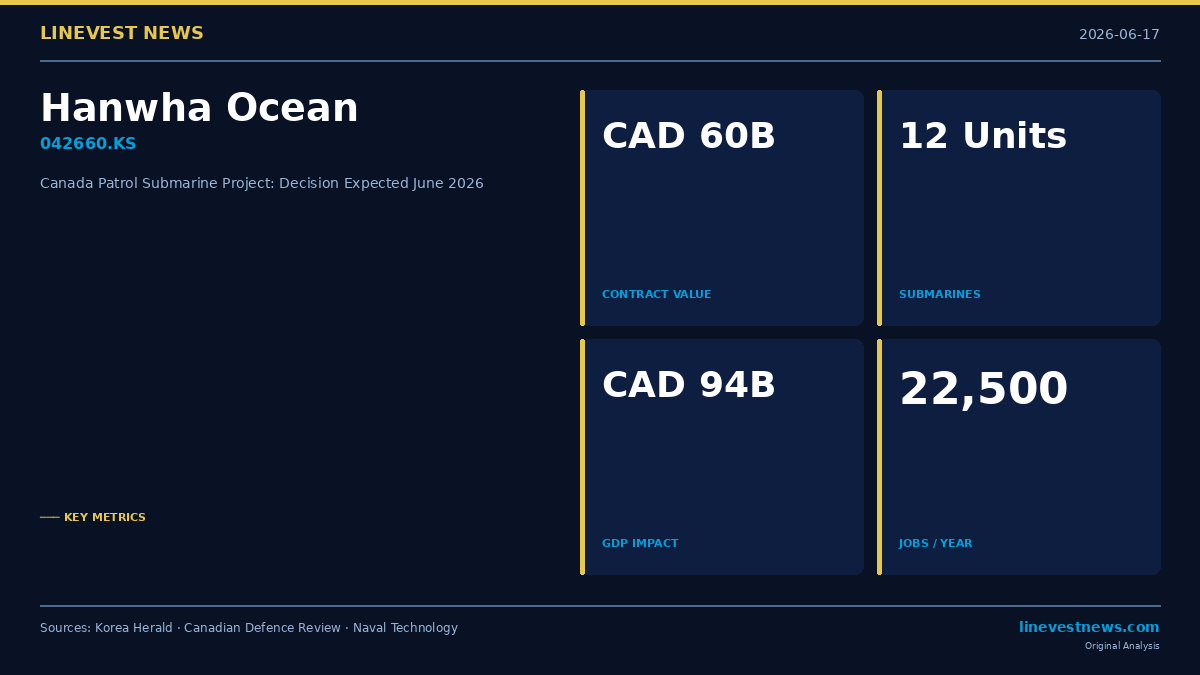
Canada is set to announce this month its winner in the Canadian Patrol Submarine Project (CPSP), pitting South Korea's Hanwha Ocean (042660.KS) against Germany's ThyssenKrupp Marine Systems (TKMS) in a head-to-head competition for up to 12 diesel-electric submarines — a contract worth an estimated USD 43.5 billion (CAD 60 billion, or ₩60 trillion).
The CPSP would replace Canada's aging Victoria-class fleet, four vessels sourced from the United Kingdom in the late 1990s. Canada's Department of National Defence narrowed the field to two qualified suppliers in August 2025 after a global evaluation. A final decision from Prime Minister Mark Carney's government is expected in June 2026, with the Royal Canadian Navy requiring first delivery no later than 2035 to prevent a strategic capability gap as the Victoria-class submarines remain operational only into the mid-to-late 2030s.
Hanwha's Pitch: KSS-III Expertise and Industrial Offsets
Hanwha Ocean is offering an export-configured variant of its KSS-III (Changbogo-III class), a 3,000-tonne diesel-electric submarine currently in service with the Republic of Korea Navy. The export version has been scaled to approximately 2,800 tonnes to accommodate Canadian port infrastructure. The KSS-III holds the distinction of being the world's first diesel-electric submarine to combine both air-independent propulsion (AIP) and lithium-ion battery technology, giving it superior underwater endurance and acoustic stealth compared with conventional lead-acid systems.
Hanwha's delivery schedule proposes the first four submarines by 2035, followed by one boat per year through 2043, completing a 12-boat fleet. Beyond the hardware, the bid includes a "Pan-Canada Economic Strategy": partnerships with more than 100 Canadian companies and institutions — including Algoma Steel — a KPMG-verified projection of CAD 94 billion in GDP impact between 2026 and 2044, and an average of 22,500 full-time jobs per year.
Hanwha underscored its operational readiness in May 2025, when the ROKS Dosan Ahn Changho — the lead KSS-III vessel — completed a 14,000-kilometre voyage to Canada's Esquimalt Naval Base for joint exercises, marking the first Korean submarine to call at a Canadian port.
Germany's Counter: TKMS Type 212CD
ThyssenKrupp Marine Systems is offering the Type 212CD, a derivative of Germany's proven Type 212A co-developed with Norway, displacing approximately 2,500 tonnes and engineered primarily for extreme acoustic stealth in Arctic and North Atlantic conditions. Germany and Norway have pledged to temporarily yield their own production slots to accelerate Canadian deliveries, with four boats committed by 2036 — one year later than Hanwha's target. German Defence Minister Boris Pistorius cited a projected CAD 86 billion GDP benefit for Canada, slightly below Hanwha's CAD 94 billion projection.
Why It Matters for Investors
For Hanwha Ocean, a CPSP contract win would be the largest-ever defense export by a Korean shipbuilder, exceeding the ₩7.8 trillion KDX-III Batch II destroyer contract the company secured domestically in June 2026. The ₩60-trillion CAD contract value alone is transformative in scale relative to Korea's defense export history.
Hanwha Group's broader defense pivot — anchored by Hanwha Ocean (042660.KS) and Hanwha Aerospace (012450.KS) — has become one of Korea's primary structural investment themes as NATO-linked global rearmament drives demand for proven platforms. Hanwha Group recently lifted its stake in Korea Aerospace Industries (KAI) to 9.04% in a USD 332 million purchase, signaling long-term commitment to the defense industrial complex.
Even a shortlist placement carries signal value: defense sector contracts of this scale typically generate multi-year sustainment, upgrade, and technology-transfer revenues that multiply the initial contract value. A Canadian win would add a G7 reference customer alongside Hanwha Ocean's existing ROKN pedigree, accelerating bids in Australia, Poland, and other markets actively seeking to expand their submarine fleets.
Background
The CPSP is Canada's largest-ever planned defense procurement, underscoring Ottawa's renewed commitment to Arctic naval power following Russia's prolonged invasion of Ukraine. Prime Minister Carney's government has accelerated the procurement amid growing NATO pressure to meet the 2% GDP defense spending target. With the two competitors identified and the final evaluation window closed, a June announcement would close more than two years of qualification, live demonstrations, and industrial-offset negotiations.
Sources: Korea Herald, Canadian Defence Review, Naval Technology, AJU Press, Stimson Center, CBC News, TechTimes.