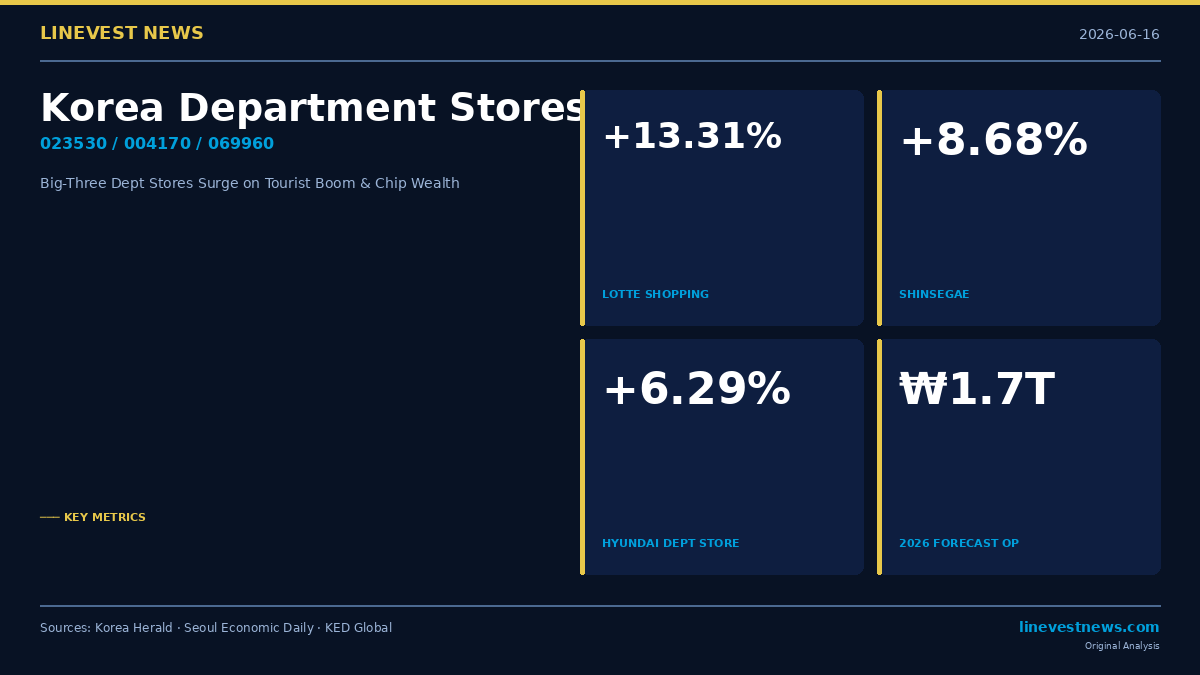
Shares of South Korea's three major department store operators surged Monday as investors bet that record foreign tourist arrivals and semiconductor industry bonuses are sustaining a luxury-spending cycle with no near-term ceiling. Lotte Shopping (023530.KS) climbed 13.31% to close at 121,700 won — hitting a fresh 52-week high of 122,000 won intraday — while Shinsegae (004170.KS) added 8.68% and Hyundai Department Store (069960.KS) gained 6.29%.
The one-day move caps a six-month run that has reset the sector's valuation. Shinsegae has risen approximately 167% since the start of 2026, Lotte Shopping 146%, and Hyundai Department Store 97%, according to Korea Herald data.
Two Engines: Chip Bonuses and Tourism Dollars
The rally rests on two largely independent spending pools that have arrived simultaneously.
The first is domestic. Department stores located in the "semicon-belt" — cities such as Suwon and Hwaseong clustered around Samsung Electronics and SK Hynix fabrication plants — have seen luxury sales surge in lockstep with memory chip margins. At Lotte Department Store's Dongtan branch, sales of luxury watches and jewelry rose 45% year-on-year. At Shinsegae's South City store, luxury jewelry sales jumped nearly 200% over the same period, as semiconductor workers converted record bonuses into high-end purchases, according to Seoul Economic Daily.
The second engine is inbound tourism. South Korea recorded 4.74 million foreign visitor arrivals in the first quarter of 2026, a new Q1 record. Card spending by international visitors in Seoul reached 1.15 trillion won (about USD 760 million) in April alone, a 50.5% increase from April 2025, according to Korea Herald. The weak won has amplified the purchasing power of Japanese and Chinese tourists in particular, who have concentrated spending at duty-free counters and branded goods floors.
First-Quarter Results Back the Re-Rating
Quarterly earnings have validated the stock move rather than chased it.
Shinsegae posted a record quarterly operating profit of 141 billion won in Q1 2026, up 30.7% year-on-year. Lotte Shopping's department store unit grew operating profit by 47.1%, and Hyundai Department Store by 39.7%. Separately, Shinsegae has been eliminating earnings drag: the group exited an unprofitable duty-free concession at Incheon Airport in 2025, reducing fixed-cost overhang.
Shinsegae has also activated shareholder returns. The company retired 200,000 treasury shares and raised its annual dividend to 5,200 won per share from 4,500 won previously.
Full-Year Estimates
Consensus forecasts compiled by Korea Herald place the combined 2026 operating profit for the big three at 1.7036 trillion won, up 21.3% from the 1.4049 trillion won recorded in 2025. Shinsegae alone is projected to reach 735.5 billion won in consolidated operating profit for the year, which would represent a new annual record.
Analysts covering the sector have drawn a comparison to Japan's department store rerating during 2023–2024, when inbound tourism from China and a weak yen set off a prolonged re-pricing of Japanese retail equities. South Korea's structural setup — semiconductor wealth driving domestic luxury demand, inbound tourism driven by K-pop and a competitive won, and years of underinvestment in shareholder capital returns — mirrors the conditions that drove that cycle.
Risks on the Periphery
Two factors complicate the picture. U.S. tariff policy has created uncertainty for Korean consumer-goods exports, indirectly weighing on how far household income gains can extend into discretionary spending. And China's recovery trajectory — a key determinant of luxury-tourist volume — remains uncertain enough that analysts have built wide ranges into second-half estimates. Any sharp won appreciation would also erode inbound visitor purchasing power.
For now, the market appears to be pricing a continuation.
Sources: The Korea Herald (Jun 16, 2026); Seoul Economic Daily (Jun 3–4, 2026); Korea Economic Daily Global (Apr 28, 2026); Bloomingbit (Jun 16, 2026)
This article is for informational purposes only and does not constitute investment advice.