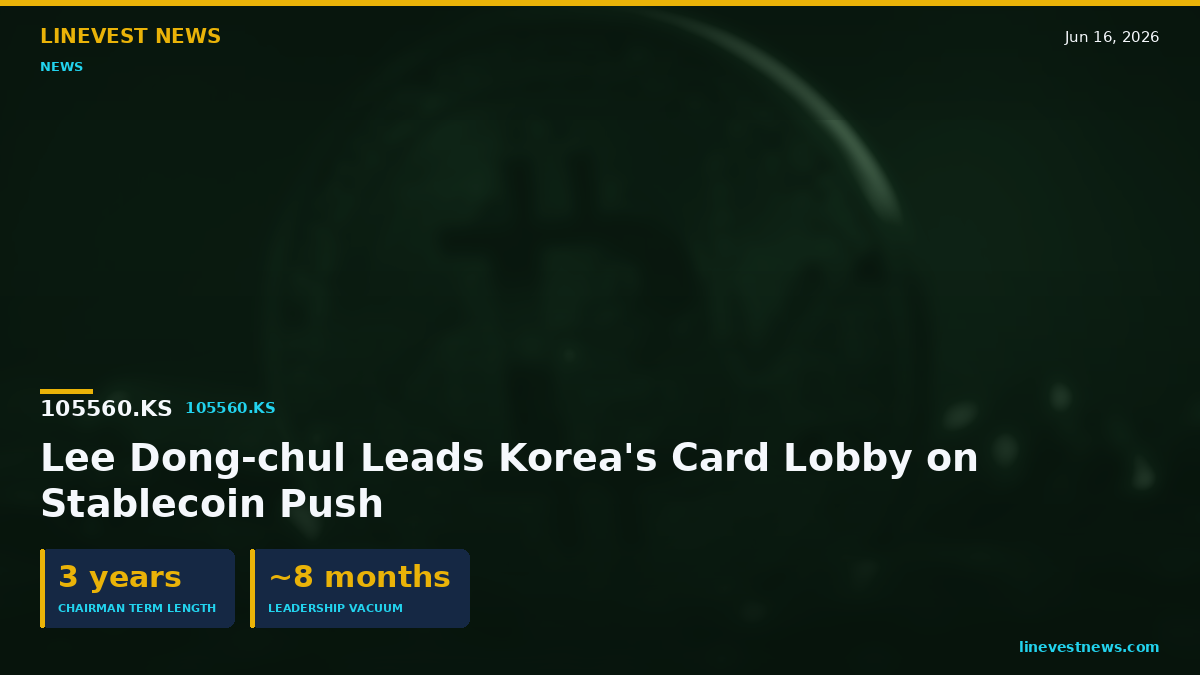
Lee Dong-chul, the former vice chairman of KB Financial Group — one of South Korea's largest financial holding companies, listed in Seoul as 105560.KS — was installed on June 16 as the 14th chairman of the Credit Finance Association (CREFIA, the lobby and self-regulatory body for Korea's card issuers and capital/installment-finance firms). His term runs three years and his duties began the same day, the association said in announcements carried by Yonhap, Asiae, ETNews and ChosunBiz.
For an industry-body appointment, the substance for anyone tracking Korean card names is what the new chairman chose to emphasize on day one: a regulatory and product agenda rather than ceremony.
What the new chairman signaled
In his inaugural remarks, Lee said card companies "must boldly transition into comprehensive financial platforms," leveraging data and AI (Digital Daily), and pledged institutional support so card firms can use stablecoins to help "lead payment-infrastructure innovation" and strengthen global competitiveness (Asiae; Digital Daily). He framed three priorities — sharpening the credit-finance sector's competitiveness, securing future growth engines for card companies, and driving regulatory reform in the capital-finance business (Digital Daily).
That emphasis matters because it maps directly onto the pressure points squeezing Korean card issuers. Per Newspim, the sector is contending with state-mandated merchant fee cuts and tighter card-loan rules that together are squeezing profitability, alongside competitive pressure from big-tech payment platforms and rising card-loan delinquency (Newspim). Lee, who previously ran KB Kookmin Card (KB's credit-card subsidiary) before overseeing global, insurance, digital and IT divisions as KB Financial's vice chairman, was chosen in part because he has sat on both sides of those issues — as a card-company chief executive and as a group-level strategist (Newspim).
Why a private-sector practitioner, and why now
Lee's selection ends an unusually long leadership vacuum. Predecessor Jung Wan-kyu's term lapsed in October 2025, and the post sat effectively vacant for roughly eight months as the nomination process dragged on (Aju Business Daily; Newstomato). Lee was put forward as the sole final candidate on June 4 through a secret ballot of the nomination committee, beating Yoon Chang-hwan, a former presidential policy secretary, and Park Kyung-hun, a former capital-company executive, before the June 16 general meeting attended by the association's 171 member firms (Newspim).
His arrival also breaks a pattern. According to Newspim, Lee is only the second private-sector figure to lead CREFIA in roughly a decade — the previous one being Kim Deok-soo, a former KB Kookmin Card chief executive who took the chair in 2016. The intervening chairmen were drawn largely from the ranks of former government officials, and the choice of a career operator over a retired bureaucrat reflects the current administration's stated preference for private experts in financial-sector posts (Newspim).
Lee, born in 1961, graduated from Korea University's law school and earned an LLM at Tulane University Law School in the United States, qualifying as a New York State attorney (ETNews; ChosunBiz). He repeatedly tied his program to the government's "inclusive finance" and "productive finance" themes, saying CREFIA would work to be "a firm pillar of inclusive finance" reaching vulnerable groups (Yonhap; Asiae).
The open question
A lobby chairman does not set policy, but CREFIA is the industry's primary interface with Korea's financial authorities, and the chairman's priorities shape what the sector formally asks for. The near-term test of whether Lee's stablecoin-and-deregulation agenda gains traction will be Korea's next merchant-fee rate review cycle and the progress of digital-asset legislation — the two arenas where his stated priorities meet decisions that actually move card-issuer economics. Until those processes produce rulings, his inaugural agenda remains a statement of intent rather than a changed rulebook.
This article is for informational purposes only and does not constitute investment advice. Figures and statements are attributed to the sources cited inline.