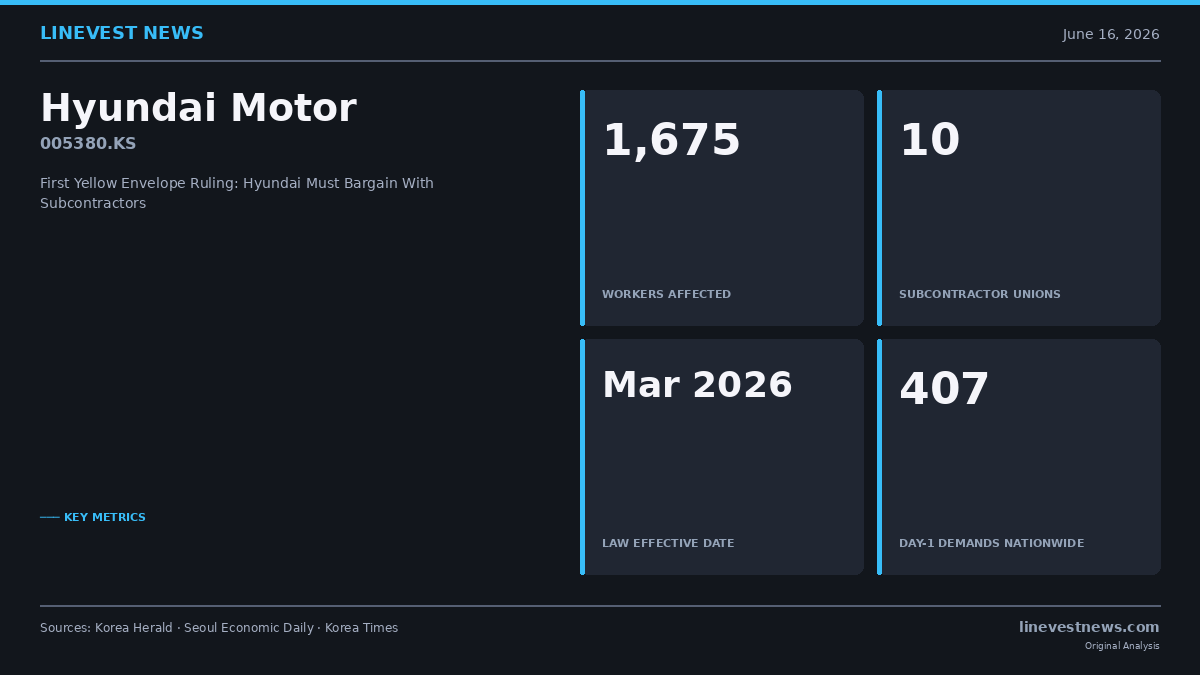
South Korea's Ulsan Regional Labor Relations Commission on Monday ordered Hyundai Motor (KRX: 005380) to negotiate directly with 10 subcontractor unions representing 1,675 workers — the first ruling against a major automaker since the amended Trade Union Act, commonly known as the "Yellow Envelope" law, took effect in March 2026.
The commission recognized Hyundai Motor as the effective employer of workers hired through subcontractors for roles spanning logistics, security, cafeteria services, research support, and vehicle sales. The affected facilities include Hyundai's Ulsan, Asan, and Jeonju manufacturing plants and its Namyang R&D center in Hwaseong.
What the Yellow Envelope Law Changed
The amended Trade Union and Labor Relations Adjustment Act — nicknamed the "Yellow Envelope" law after the color used in Korean labor solidarity campaigns — expanded the legal definition of "employer" to include any company that substantially controls working conditions, even when workers are formally employed by third-party contractors.
The law took effect on March 10, 2026. On its first day alone, 407 subcontracted unions across South Korea filed collective bargaining demands at 221 principal companies, signaling the depth of pent-up demand among Korea's subcontracted workforce.
Monday's Hyundai decision marks the first time a major automaker has been ordered to recognize this expanded obligation under the new framework.
Ruling Details
The 10 unions filing the bargaining demand are affiliated with the Korea Metal Workers' Union (KMWU), the country's largest industrial union by membership. The workers perform non-production roles — including security, cafeteria operations, vehicle sales at dealerships, and research-center support — functions that Hyundai has historically separated from its direct employment structure.
The commission convened three formal sessions before reaching its ruling. The written decision, which will include full legal reasoning, is expected within approximately one month.
The ruling grants workers the right to bargain directly with Hyundai Motor rather than only with their nominal subcontractor employers. It does not compel any specific wage outcome but establishes the automaker's legal obligation to participate in good-faith negotiations.
Hyundai Motor's Response
A Hyundai Motor representative said the company would "review the case comprehensively" and "carefully consider our response in accordance with legal procedures" after receiving the full written decision. Hyundai has not publicly stated whether it will appeal.
Hyundai Motor shares closed at ₩640,000 on Monday, down ₩7,000 (-1.1%) on the day.
Industry Implications
The ruling carries implications well beyond Hyundai's facilities. South Korea's manufacturing sector — from automotive and electronics to shipbuilding and petrochemicals — relies heavily on tiered subcontracting for non-core operations. Legal analysts expect the Hyundai decision to accelerate similar filings at other large conglomerates.
"We expect changes in labor-management relations across manufacturing and service industries" with comparable subcontracting structures, analysts noted following the ruling.
For Korea's automakers specifically, the ruling raises the prospect of expanded bargaining coverage: Hyundai Motor's direct workforce already includes tens of thousands of unionized workers who periodically engage in contentious wage negotiations. Adding subcontractor unions to the bargaining matrix introduces a new layer of complexity to annual labor rounds.
Sources: Korea Herald, Seoul Economic Daily, Korea Times
Disclaimer: This article is for informational purposes only and does not constitute investment advice.