Hanmi Pharmaceutical (128940.KS), one of South Korea's most R&D-intensive drugmakers — which spent 14.8% of 2025 revenue on R&D and has led domestic outpatient prescription sales for eight consecutive years per UBIST data — used the American Diabetes Association's 2026 Scientific Sessions (ADA, the world's largest diabetes meeting, held June 5–8 in New Orleans) to present eight research abstracts on a next-generation obesity pipeline built around a single idea: shedding fat without shedding muscle.
The headline asset is HM500197 (LA-MSTN), which Hanmi describes as the world's first peptide-based myostatin inhibitor — myostatin being a protein that suppresses muscle growth (Korea IT Times; etnews). A second candidate, HM17321 (LA-UCN2), a UCN2 analog aimed at improving body composition, was also featured (Korea IT Times; The BioNews). Both were generated through Hanmi's AI-driven discovery platform, HARP. In obese-mouse studies, the lead compound raised lean and skeletal-muscle mass, and when paired with a GLP-1 drug it curbed the muscle loss those drugs typically cause, the company said (Chosun Biz).
Why a fund manager cares: the muscle-loss gap
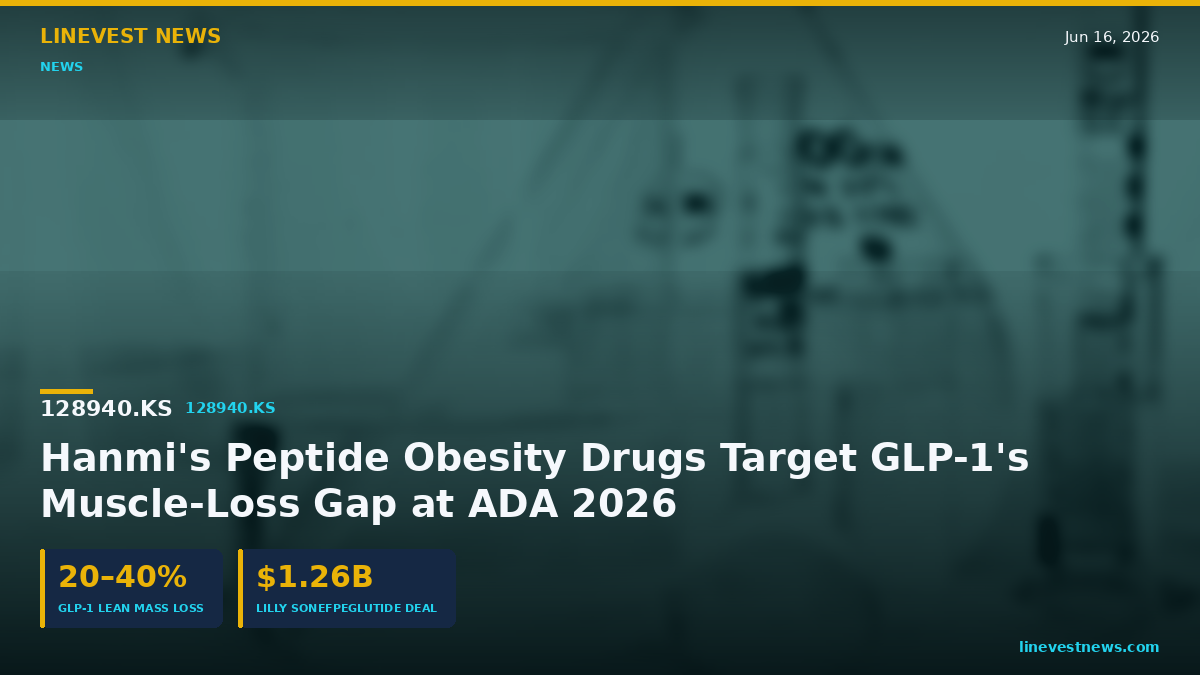
The pitch targets the best-documented weakness of the Wegovy/Zepbound generation. Roughly 20–40% of the weight lost on GLP-1 therapies is lean body mass rather than fat (Korea IT Times; The BioNews) — a problem for basal metabolism, strength and, especially, older patients. "The muscle-increasing obesity drug is a game changer," said Choi In-young, head of Hanmi's Future Growth Division (Chosun Biz).
The target itself is already validated in humans — which is both the opportunity and the catch. Scholar Rock's apitegromab, a myostatin-targeting antibody, posted positive Phase 2 EMBRAZE results in 2025 showing statistically significant lean-mass preservation alongside tirzepatide (BioPharma Dive). Eli Lilly bought Versanis Bio for up to USD1.9 billion in 2023 to acquire the muscle-sparing antibody bimagrumab (BioSpace). Hanmi's differentiation is the format: a peptide rather than an antibody, which can carry different manufacturing and dosing economics. The catch is stage — Hanmi's muscle data is still preclinical, leaving it years behind rivals already generating human Phase 2 readouts.
Sizing it against the company
Hanmi is presenting this from a position of strength rather than desperation. The company reported record 2025 revenue of ₩1.54 trillion (USD1.05 billion, per Korea Biomedical Review), operating profit of ₩257.8 billion (USD176 million) at a 16.7% margin, and R&D spending of ₩229 billion (USD156 million), or 14.8% of sales. Its licensing engine is also running: on May 31, 2026, Hanmi out-licensed its GLP-2 analog sonefpeglutide to Eli Lilly in a deal worth up to USD1.26 billion (about ₩1.9 trillion), comprising a USD75 million upfront payment plus up to USD1.185 billion in milestones and royalties (BioSpace). Against that base, the ADA disclosures read as an early-stage option on the obesity market, not a near-term revenue line — the kind of program Hanmi has historically monetized through partnerships well before commercialization.
The open question
For now these are mouse data and conference abstracts. The data point that would convert interest into conviction is human evidence: an IND filing and Phase 1 start for HM500197, and dosing for HM17321, which Hanmi has said is entering U.S. Phase 1 (The BioNews). The company's more advanced obesity asset, the GLP/GIP/GCG triple agonist HM15275, is in U.S. Phase 2 (The BioNews); a clean muscle-preservation signal there or in the LA-MSTN program would show whether Hanmi's peptide bet can stand against the antibody incumbents.
This article is for informational purposes only and does not constitute investment advice. Preclinical results do not predict clinical outcomes. Readers should conduct their own research before making any financial decisions.