Samsung SDI's Data Center Bet Begins to Pay Off as Q1 Loss Narrows 64%
Samsung SDI (006400.KS), long battered by the electric-vehicle battery downturn, is drawing its first credible sign of a turnaround — not from EV recovery, but from the AI data center buildout.
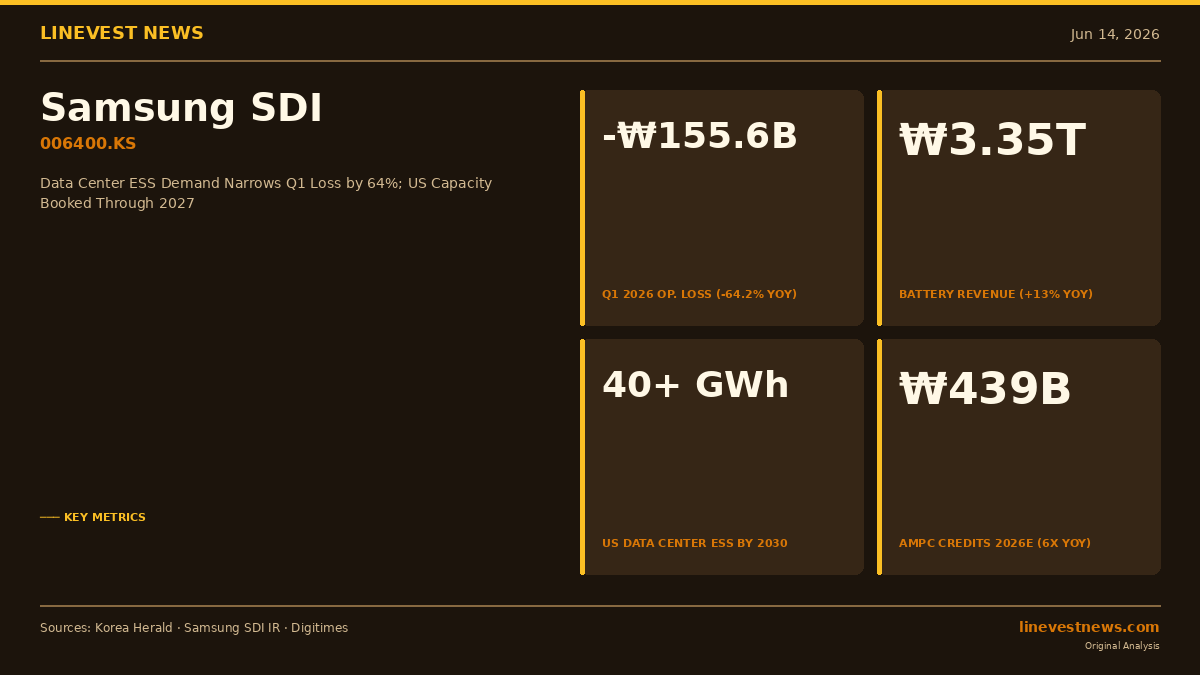
The company posted a first-quarter 2026 operating loss of ₩155.6 billion (USD 105.6 million), a 64.2% improvement year-on-year, as surging demand for battery backup units at AI data centers and utility-scale energy storage systems (ESS) lifted battery-segment revenue 13% to ₩3.35 trillion. Total revenue rose 12.6% to ₩3.58 trillion. After six consecutive quarters of operating losses, Samsung SDI returned to net profitability in Q1, recording a net profit of ₩56.1 billion — a threshold the market had doubted it could reach before mid-year.
From EV Champion to ESS Contender
Samsung SDI built its industrial identity as South Korea's flagship EV battery supplier. That identity worked well through 2022, when EV demand growth seemed limitless. Then came the slowdown: European automakers cut orders, Chinese rivals undercut on price, and Samsung SDI's operating margins evaporated. The stock shed more than half its value from peak to trough.
The recovery thesis has shifted to three growth vectors that EV exposure alone could not provide:
Battery Backup Units for AI Data Centers. Samsung SDI's high-margin cylindrical cells — which power uninterruptible power supplies and battery backup units (BBU) that protect AI inference clusters from outages — began large-scale supply to hyperscalers in Q1. Tabless cylindrical cells, which offer higher energy density and faster charge-discharge cycles, are set to ramp further in Q2 2026 before hybrid EV applications begin shipping in H2.
Utility-Scale ESS. Grid-scale storage demand is accelerating as utilities scramble to pair intermittent renewables with fast-response backup. The US data center ESS market alone is projected to grow at more than 30% annually, expanding from 9 gigawatt-hours in 2025 to over 40 GWh by 2030. Samsung SDI disclosed that its US ESS production capacity is "already booked for the next two to three years."
AMPC Tailwinds. As Samsung SDI scales up US-made ESS production, it collects Advanced Manufacturing Production Credits under the Inflation Reduction Act. AMPC receipts are forecast to jump sixfold in 2026 to ₩439 billion, and nearly triple again to ₩1.1 trillion by 2027 as capacity fully ramps.
The 2027 Crossover
Analysts now project ESS overtaking EV batteries as Samsung SDI's largest revenue category by 2027, with ESS revenue forecast at ₩6.5 trillion versus ₩5.8 trillion for EV batteries. The ESS segment would then account for 56% of consolidated operating profit — a structural reversal from the EV-centric model the company championed through the early 2020s.
Samsung Securities maintained a Buy rating on Samsung SDI following the Q1 print, citing improving earnings trajectory and order backlog visibility in the ESS pipeline.
Quarterly Breakeven in Sight
Management guided for a return to quarterly operating profitability in the second half of 2026, contingent on US ESS production running at scale, tabless cylindrical cell shipments ramping into data center and hybrid EV programs, and electronic materials customer diversification continuing to broaden.
If the company meets that target, it would complete a turnaround in under 12 months — from a six-quarter loss streak to breakeven — driven primarily by the AI infrastructure capex cycle rather than the EV rebound the market had originally priced in.
Sources: Korea Herald; Samsung SDI Q1 2026 IR; Digitimes; Indian Chemical News; Asia Economy Daily