Samsung Electro-Mechanics (SEMCO) and LG Innotek are drawing accelerating analyst upgrades ahead of second-quarter results, with FC-BGA substrate demand outstripping production capacity by more than 50% and no new supply coming before the first quarter of 2028 — a structural squeeze that is reshaping how the market values Korea's component makers relative to the chipmakers they serve.
Q2 Earnings: The Numbers Analysts Are Watching
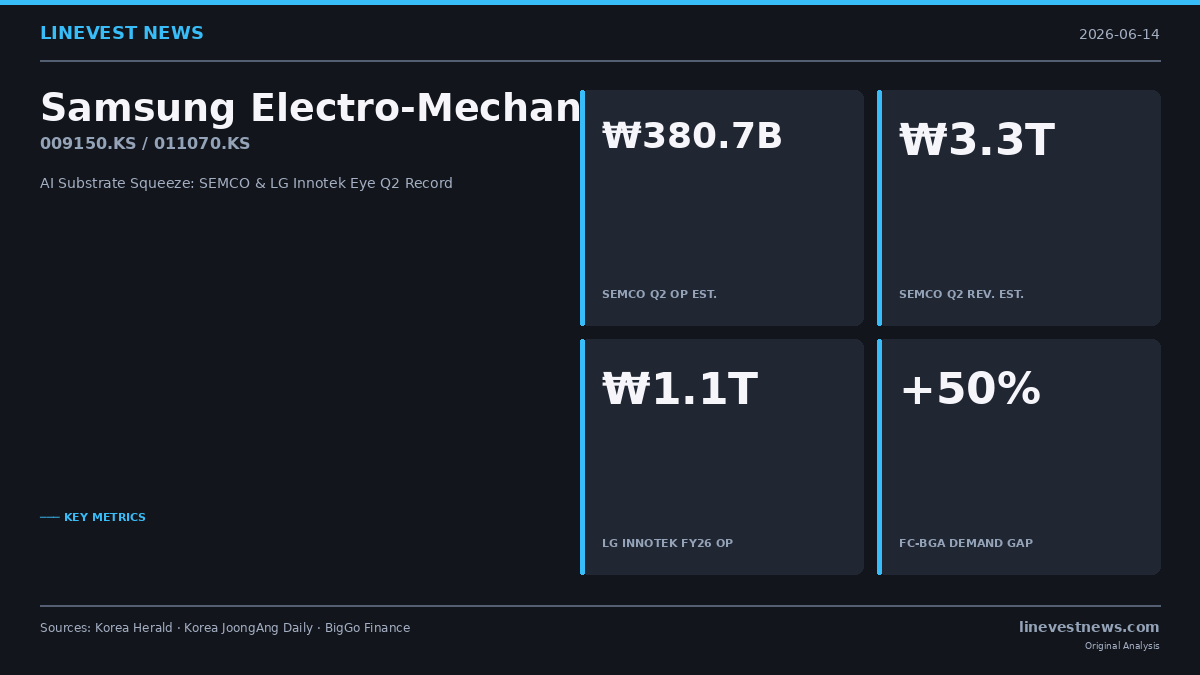
Consensus calls for SEMCO to report second-quarter revenue of ₩3.3 trillion (USD 2.4 billion), up 19% year-on-year, with operating profit reaching ₩380.7 billion — a 79% jump from the same period in 2025, according to Daol Investment & Securities. For the full year, Daishin Securities forecasts SEMCO operating profit of ₩1.534 trillion, representing a 68% increase year-on-year, with the figure seen climbing further to ₩3.007 trillion in 2027 if the substrate shortage persists as expected.
LG Innotek is tracking a similar upgrade cycle. Hana Securities estimates the company's full-year 2026 operating profit at approximately ₩1.1 trillion, a figure analysts have been revising upward as new substrate application wins emerge beyond the GPU segment.
What Is Driving the Squeeze
At the center of the earnings story is the FC-BGA (flip-chip ball grid array) substrate — the precision component that physically and electrically connects high-performance AI chips to the boards inside servers. As chips grow more complex, FC-BGA specifications tighten and yields fall, compressing supply even as orders from hyperscalers swell.
Analyst Kim Yeon-mi at Daol Investment & Securities put the current demand-capacity gap at more than 50%, with the imbalance projected to persist through 2027. "Meaningful capacity additions are not expected until the first quarter of 2028, making price hikes highly likely," Kim said.
SEMCO is benefiting across three product lines. Its multilayer ceramic capacitors (MLCCs) — which stabilize power flow in AI servers, with tens of thousands installed per rack — are seeing record demand alongside its FC-BGA substrates. Late in May, the company disclosed a ₩1.5 trillion (USD 1 billion) silicon capacitor supply agreement with an undisclosed global customer, adding a third revenue pillar to the AI-driven upcycle.
LG Innotek, meanwhile, is expanding its FC-BGA addressable market beyond GPU substrates into CPU, memory, and networking chip packaging — a diversification it showcased at the ECTC industry conference in Orlando, extending its exposure beyond a single chip type.
Resilience Where the Market Least Expected It
Both stocks have compounded gains well above the chipmakers themselves. SEMCO has risen 688% year-to-date from ₩270,000 on January 2 to a closing price of ₩2.127 million in late May, while LG Innotek has gained 445% from ₩267,500 to ₩1.458 million over the same period.
More notably, the component stocks held up when semiconductor bellwethers came under pressure in early June — SEMCO advanced more than 2% on days when Samsung Electronics and SK Hynix declined — suggesting the market is pricing a "stickier" earnings cycle in substrates and capacitors than in memory chips.
Mirae Asset Securities raised its FC-BGA average selling price assumptions in its latest sector note, while KB Securities lifted its LG Innotek target price to ₩1.6 million, citing "prolonged substrate shortages extending profitability through the forecast period."
What to Watch in Q2
SEMCO is expected to begin full-scale shipments to new big-tech networking substrate customers in the current quarter, a development that could lift revenue above consensus if order ramps proceed as guided. Analysts say the networking substrate segment carries higher margins than GPU substrates, adding mix-shift upside to any volume beat.
The formal Q2 earnings releases are expected in late July. If the current demand trajectory holds, the question for the second half will be whether SEMCO and LG Innotek can manage yield improvements fast enough to capture the pricing power the market is already pricing in.
Sources: Korea Herald, Korea JoongAng Daily, Seoul Economic Daily, BigGo Finance, Korea Times