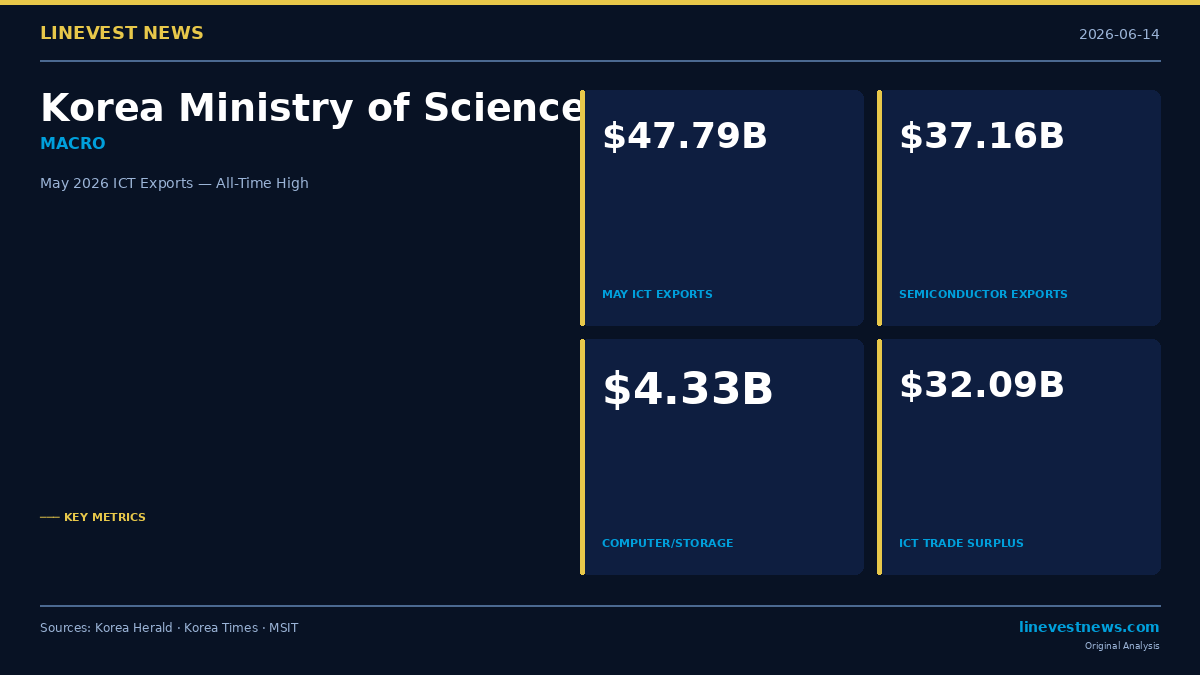
South Korea's outbound information and communications technology shipments hit $47.79 billion in May — a monthly record and a 128.9% leap from $20.88 billion a year earlier — as relentless demand for artificial intelligence server infrastructure pushed the country's export engine to its highest reading since modern trade statistics began, according to data released Saturday by the Ministry of Science and ICT.
The milestone makes May the third consecutive month Korea's ICT exports have cleared the $40 billion threshold, a streak that has never occurred before and that officials say reflects a structural, not merely cyclical, shift in global semiconductor demand.
Semiconductors doing the heavy lifting
Within the total, semiconductors led with $37.16 billion — up 169.2% on the year — as hyperscalers in the United States and China accelerated server build-outs. High-bandwidth memory, where SK Hynix (000660.KS) commands an estimated 50%+ market share and Samsung Electronics (005930.KS) holds the majority of the remainder, remained the primary driver, with memory pricing firming on supply constraints.
Computer and storage equipment — a category that captures solid-state drives installed in AI data centers — surged to $4.33 billion, roughly tripling from year-earlier levels, as server operators standardized on higher-capacity NVMe arrays. Smartphones rose a more modest 15.9%, and display panels gained 2.8%, underscoring how the AI infrastructure cycle is pulling far harder on logic and memory than on consumer electronics.
Destination mix shifts toward the United States
Exports to the United States more than tripled to $8.1 billion (+250% year-on-year), reflecting direct shipments to large U.S. cloud operators and semiconductor assembly clusters. China and Hong Kong combined absorbed $19.5 billion — more than doubling as mainland factory orders for AI servers resumed — while Vietnam received $6.8 billion (+90.8%), partly from Samsung's handset and component assembly operations there.
The regional pattern points to a bifurcated demand picture: U.S.-bound volumes skew toward high-end HBM and DRAM targeted at hyperscalers, while China-bound volumes mix commodity NAND with packaged memory for domestic AI server makers.
Trade surplus swells
Imports rose 36% to $15.7 billion, resulting in an ICT trade surplus of $32.09 billion for the month. The import acceleration reflects Korean chipmakers importing advanced lithography equipment and packaging materials as they expand capacity, a spending pattern that typically presages higher future output.
What it means for Korean chipmakers
The data arrived as SK Hynix is pursuing a U.S. ADR listing targeting $14 billion — a sign management believes the AI memory supercycle will sustain equity valuations at current levels. Samsung, meanwhile, is navigating a more complicated picture: its foundry division is loss-making, but the memory unit's resilience is keeping consolidated earnings afloat.
Nomura, which last week lifted its KOSPI target to 11,000, cited semiconductor export strength as a primary driver; the brokerage argued the chip supercycle is "just beginning." Saturday's data adds empirical support: at $47.79 billion and rising, Korea's ICT export engine is showing no sign of reaching peak velocity.
Sources: Korea Herald, Korea Times, Ministry of Science and ICT (MSIT), NewKerala/Yonhap