South Korean biotechs — led by Samsung Biologics — are accelerating investment in AI-driven drug-screening platforms and patient-derived organoids, as landmark U.S. and European Union regulations push the global pharmaceutical industry away from animal testing.
FDA and EU Converge on Non-Animal Drug Testing
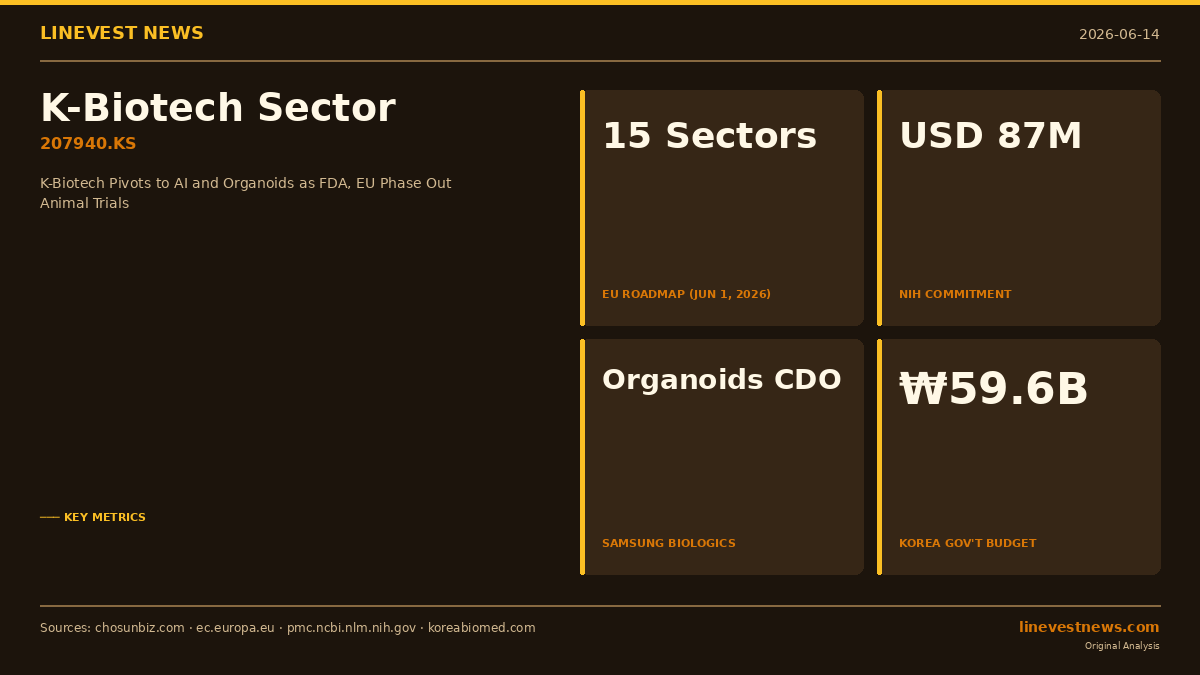
The European Commission on June 1, 2026, published a roadmap to phase out animal use across 15 categories of chemical safety assessment — including pharmaceuticals — laying out more than 30 recommendations that will steer drug developers toward non-animal methodology (NAM) systems including organ-on-chip devices and organoid-based assays.
The roadmap follows a two-year cascade of U.S. action. The FDA Modernization Act 2.0 removed the long-standing statutory requirement for animal studies in new drug license applications, and May 2026 draft guidance directed companies to adopt NAMs wherever feasible. The U.S. National Institutes of Health has committed USD 87 million to establish a Standardized Organoid Modeling Center — a federal bet that human-cell-based protocols can replace large animal cohorts within the decade.
"What used to be a competitive differentiator is becoming a regulatory baseline," one Korean biotech executive told Chosunbiz. "The ability to accurately predict human drug response through AI and organoids will determine who survives in global drug development."
Approximately 200 million animals are used annually in pharmaceutical experiments worldwide; regulators in both blocs indicate the phaseout will unfold over five to seven years, with early-adopter companies set to gain approval advantages from cleaner preclinical data packages.
Samsung Biologics Moves to the Vanguard
Samsung Biologics (207940.KS) has positioned itself at the forefront of Korea's organoid buildout. The Incheon-based CDMO launched its Samsung Organoids platform in June 2025, delivering patient tumor-derived organoid screening services across colorectal, lung, liver, gastric, and breast cancers — placing human-relevant biology at the front end of its contract development offering.
At the American Association for Cancer Research (AACR) 2026 annual meeting in April, the company unveiled organoid-based drug discovery results alongside its bispecific antibody platform S-DUAL®, pitching an "early lock-in" strategy designed to bring sponsors aboard before clinical candidate selection. The approach pairs DEVELOPICK® v3.0 — an AI-assisted developability assessment tool — with its organoid service to compress preclinical timelines and reduce late-stage clinical attrition.
Korea's Emerging Non-Animal Ecosystem
Beyond Samsung Biologics, a cohort of Korean firms is mobilizing. Organoid Sciences is preparing to complete Phase 1 clinical validation of its ODISEI platform by end-2026, targeting commercial launch in 2027, with the technology promising to replace animal models in safety toxicology screens. HLB has partnered with Vasgenbio to co-develop an AI-integrated alternative pre-clinical service combining in silico toxicity modeling with organ-on-chip readouts. Separately, K-Medi Hub, Arontier, and HLB Life Science are three years into a ₩2.2 billion AI project targeting blood-cancer drug candidates.
NVIDIA's BioNeMo platform — spotlighted at the January 2026 JPMorgan Healthcare Conference alongside a joint AI drug-development lab with Eli Lilly — has drawn attention from Korean research institutes as a potential data backbone for organoid-AI integration, particularly after CEO Jensen Huang's high-profile Seoul visit reignited local interest in physical AI and lab automation.
The Korean government is adding fiscal muscle: the Ministry of Health and Welfare and the Korea Pharmaceutical and Bio-Pharma Manufacturers Association have jointly launched a ₩37.1 billion "K-AI Drug Development Pre-clinical/Clinical Model" initiative. The Ministry of Science and ICT is contributing a further ₩22.5 billion over four years to build AI systems capable of predicting where organoid and animal drug-response profiles diverge — a critical technical gap the industry must close to satisfy regulators on both sides of the Atlantic.
Strategic Stakes for Korea's CDMO Leaders
For Samsung Biologics, whose contract development backlog and premium valuation track the forward pipeline of novel biologic modalities, the organoid pivot is a strategic hedge. Next-wave cell and gene therapies — and complex targeted oncologics — increasingly require human-relevant preclinical data to satisfy FDA and EMA reviewers; the CDMO that owns that capability earliest stands to lock in clients at the candidate selection stage, well before manufacturing contracts are written.
The combined regulatory pressure from Washington and Brussels, backed by USD 87 million in federal infrastructure investment, suggests the non-animal transition is no longer a matter of when but how fast — a dynamic that Korea's biotech sector, still rebuilding clinical-stage credibility after a series of overseas trial setbacks, sees as an opportunity to establish a new layer of competitive advantage before Chinese CDMO rivals scale the same platforms.
Sources: Chosunbiz (June 13, 2026); European Commission, ec.europa.eu (June 1, 2026); PMC/NIH, pmc.ncbi.nlm.nih.gov; Korea Biomedical Review, koreabiomed.com; Seoul Economic Daily, en.sedaily.com; Korea Herald, koreaherald.com.