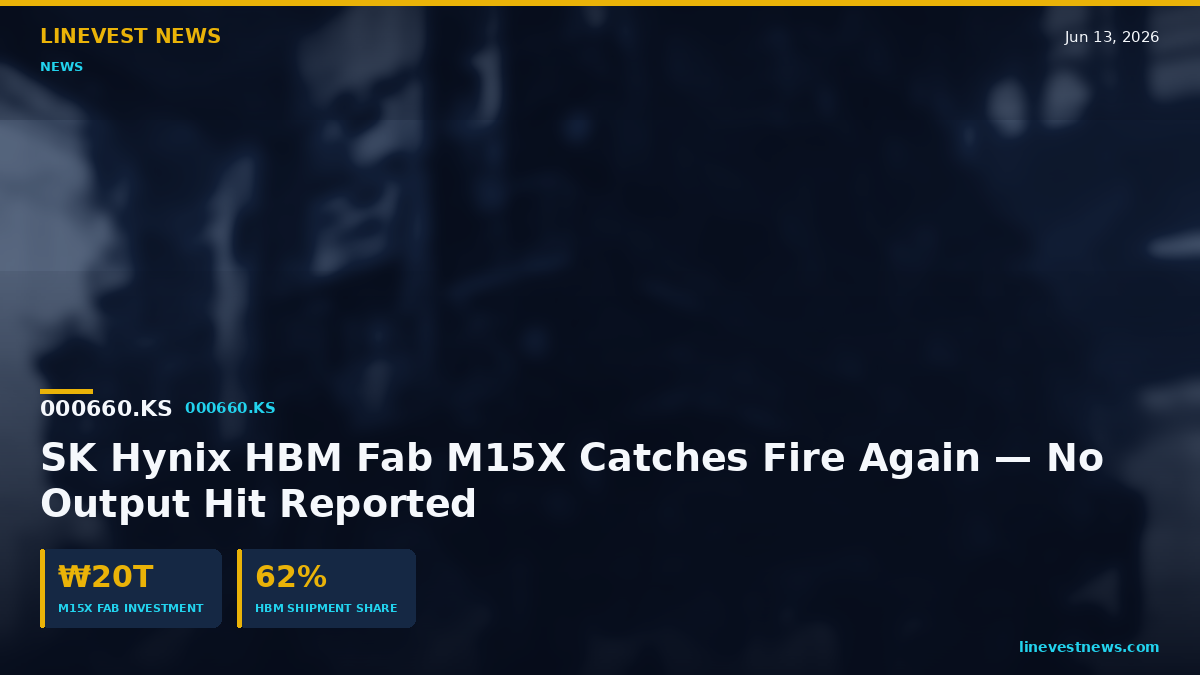
SK Hynix (000660.KS), the world's largest supplier of high-bandwidth memory (HBM) and Nvidia's principal HBM partner, reported a fire on June 12 at M15X — the new Cheongju fab it is racing to bring online for next-generation AI memory. It was the second fire in 11 days at the same campus, and the latest in a string of safety incidents at the facility that anchors the company's HBM4 ramp. So far, no production has been lost. The unresolved question is whether a cluster of accidents at this specific building eventually threatens a supply chain the AI industry cannot afford to lose.
What happened on June 12
The fire broke out around 9:55 a.m. local time in a gas room on the second floor of the M15X plant at SK Hynix's Cheongju Campus 4 in North Chungcheong, while six workers were mixing fluorine and nitrogen inside a gas cabinet, according to the Korea JoongAng Daily. The sprinkler system extinguished it within roughly 10 minutes. About 4,000 employees were evacuated as a precaution; eight were treated for dizziness at the company's on-site clinic and one worker developed a rash, the paper reported. Fire authorities determined no actual gas leak occurred, and SK Hynix said production was not disrupted. A company representative said it would "conduct a thorough investigation to determine the cause and prevent recurrences" (Korea JoongAng Daily).
Why a fund manager should care: M15X is the HBM4 linchpin
M15X is not a peripheral line. SK Hynix has committed more than ₩20 trillion ($14.6 billion) to the fab, dedicated to advanced DRAM and HBM — including HBM3E, the forthcoming HBM4, and 10-nanometer-class sixth-generation DRAM, with the first cleanroom slated for completion in May 2026 and mass production targeted for later this year (Seoul Economic Daily). The company holds roughly 62% of HBM shipments as of Q2 2025 and is projected to take about 70% of Nvidia's HBM4 allocation for its Rubin platform (Astute Group, citing UBS). With HBM widely expected to stay in shortage through 2028 and Nvidia's CEO publicly urging SK Hynix on June 2 to produce more HBM (UPI), M15X's ramp is one of the most closely watched capacity events in the AI hardware supply chain. A serious stoppage there would be felt well beyond Cheongju.
A pattern, not a one-off
The June 12 fire follows a run of incidents at the same site. On June 1, a blaze in a sixth-floor gas room connecting M15 and M15X released hydrogen fluoride at 5 parts per million — above the 3 ppm legal ceiling — and forced about 3,600 workers to evacuate, again without halting production (Tom's Hardware, Seoul Economic Daily). On June 10, a liquid suspected to be TMAH, a semiconductor process chemical, was found and two workers were hospitalized, though authorities later determined it was not a hazardous substance (Chosun Biz). Earlier incidents included a spark at the M11 NAND line on May 27 and a chemical-contact accident during pipe work in January (Chosun Biz). The frequency prompted SK Hynix to declare a "company-wide safety system overhaul week" on June 4 (Chosun Biz).
The precedent that frames the risk
Fab fires can move the global memory market. In September 2013, a fire at SK Hynix's Wuxi DRAM plant in China — a facility then accounting for about 15% of global DRAM supply — sent contract prices climbing nearly 15% in the following weeks (TrendForce). That is the bear case the Cheongju incidents have so far avoided: both June fires were contained within about 10 minutes with no reported output loss. The market has treated them as such — SK Hynix shares touched a 52-week high of ₩2,363,000 ($1,724) around the June 1 event, up roughly 249% in 2026 on HBM4 optimism (ad-hoc-news).
What to watch next
The data point that confirms or refutes the supply-risk thesis is the M15X production ramp itself: SK Hynix pulled its start schedule forward by about four months, and any slippage tied to repeated safety stoppages would be the first hard signal that the incident cluster is more than a string of contained scares. SK Hynix's Q2 results, due in late July, are the next checkpoint for management commentary on the fab's timeline and the cost of its safety overhaul.
This article is for informational purposes only and does not constitute investment advice. All figures are attributed to the sources cited inline. Currency conversions use an approximate rate of 1 USD = 1,370 KRW except where a source provided its own conversion.