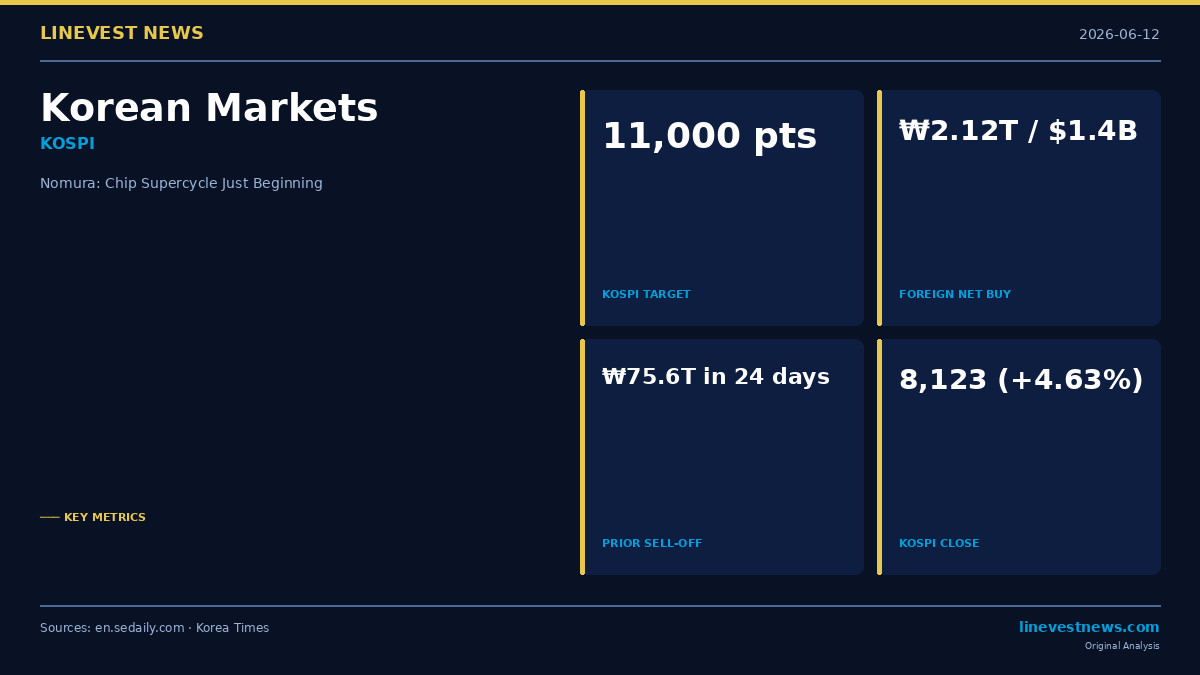
Nomura Securities declared at a Seoul briefing on June 12 that South Korea's semiconductor supercycle has “only just begun” — even as the KOSPI was still digesting a seven-week foreign-investor exodus that erased ₩75.6 trillion (USD 51 billion) in net equity outflows. Hours later, overseas funds reversed course, buying ₩2.12 trillion (USD 1.4 billion) of Korean shares in a single session.
Part A — The Supercycle Thesis
The declaration came from Chung Chang-won, co-head of Nomura Asia Research, at the Seoul Finance Center. He described memory-chip revenue as showing a pattern “that has never been seen before,” driven by artificial-intelligence infrastructure spending that could lift AI-driven memory demand 10,000-fold over the next five years.
Nomura holds a KOSPI target of 11,000 points — roughly 35% above the June 12 close — alongside individual price targets of ₩590,000 for Samsung Electronics (005930.KS) and ₩4 million for SK hynix (000660.KS). The bank's bull case centres on what it calls a “triple supercycle”: simultaneous demand surges for high-bandwidth memory (HBM), DRAM, and NAND chips that are reshaping how the memory industry generates revenue. Chung called this “an entirely new world” for chipmakers.
Adding a potential structural tailwind, Nomura put the odds of Korea being added to the MSCI developed-market watchlist at roughly 60%, citing recent foreign-exchange modernisation and improved corporate governance. A watchlist placement typically precedes full reclassification by two years, but even elevated odds could draw in index-tracking capital that has so far stayed on the sidelines.
Part B — The Foreign-Flow Reversal
Nomura's bullish call coincided with the largest single-session foreign inflow in weeks. On June 12, overseas investors net bought ₩2.12 trillion (USD 1.4 billion) worth of Korean equities — reversing a 24-session selling streak that had accumulated ₩75.6 trillion in outflows (₩84.6 trillion including alternative trading platforms). SK hynix alone absorbed ₩1.29 trillion of that buying.
The KOSPI closed at 8,123.62, up 359.67 points (+4.63%), with an intraday peak of 8,424.13. Samsung Electronics gained nearly 8% on the day, even as overseas investors had previously shed ₩31.9 trillion of Samsung shares and ₩28.9 trillion of SK hynix shares in the preceding weeks.
Three macro tailwinds converged to catalyse the reversal: U.S. core PPI printed below forecasts at 4.9%, ceasefire hopes between Israel and Iran pushed oil prices into the mid-to-high USD 80s per barrel, and the 10-year Treasury yield fell below 4.5%. Kang Jin-hyuk of a domestic securities firm described the preceding volatility as “a pause rather than a trend-based decline” given solid market fundamentals.
Kim Dae-jun of Korea Investment and Securities added that “the market's previously extreme fear is showing signs of gradually subsiding,” while Lee Jae-won of Yuanta Securities cited semiconductor pricing trends as supporting a “long-term outlook for Korea's semiconductor supply chain.”