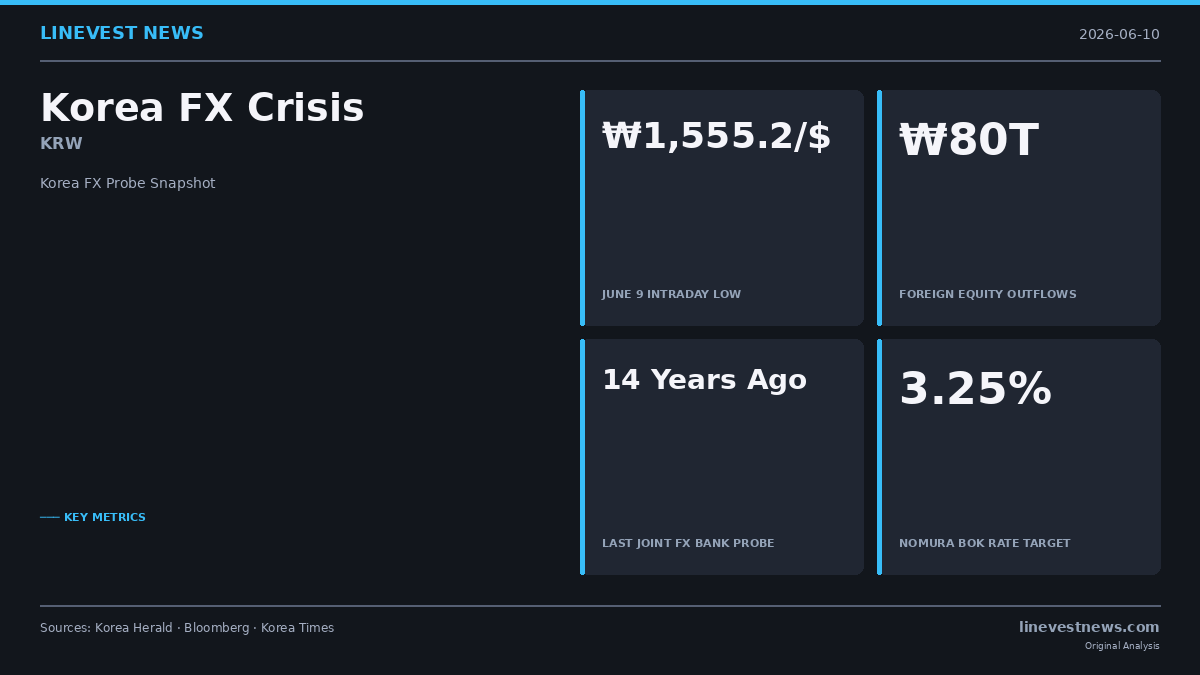
South Korea's two top financial regulators have moved from verbal warnings to on-site scrutiny, opening the first joint examination of foreign-exchange banks in 14 years after the won's relentless slide pushed the currency to levels not seen since the 2008 global financial crisis.
Regulators Draw a Hard Line
The Bank of Korea (BOK) and Financial Supervisory Service (FSS) announced on June 10 a joint inspection of major domestic and foreign banks operating in Korea's FX market — the first such combined probe since 2012. Authorities are examining whether lenders engaged in speculative positioning that amplified one-way won weakness, secured improper gains by anchoring exchange rates, or used overnight non-deliverable forward (NDF) settlements to distort the domestic spot market at open.
BOK Governor Shin Hyun-song described the mechanism bluntly: "The tail is wagging the dog" — a reference to offshore NDF prices setting the tone for domestic market opens, often locking in losses before Seoul trading even begins.
The won breached KRW 1,500 per dollar on May 15 and has not recovered that threshold in the nearly four weeks since. On June 9 the exchange rate briefly touched KRW 1,555.2, its weakest intraday print since January 2009 — the depths of the global financial crisis — before closing near KRW 1,525. As of June 13, it settled at KRW 1,519.8. Over the same stretch, overseas investors sold approximately KRW 80 trillion in Korean equities across more than three consecutive weeks; a single session recorded nearly KRW 3 trillion in net outflows.
Policy Escalation
Deputy Prime Minister Koo Yun-cheol fired a joint warning with the BOK a day before the inspection launched, pledging the government "will not tolerate excessive volatility and one-way herd behavior" and pointing to NDF-driven momentum as the primary source of dislocation. The dual-agency rebuke — combining the Treasury and central bank in one statement — is itself rare, signaling that standard FX smoothing operations were no longer sufficient.
Analysts now broadly agree that an interest-rate increase is the strongest remaining lever. The BOK held its benchmark at 2.5 percent at its May 28 meeting but signaled a hawkish pivot. Nomura forecasts three 25-basis-point hikes bringing the policy rate to 3.25 percent; a tail-risk scenario extends to 3.75 percent. Korea Times analysts added that conventional intervention — spot-market dollar sales — has "lost punch" as current-account dynamics and portfolio flows work against BOK firepower.
What It Means for Investors
The inspection raises the compliance cost of aggressive speculative positioning in the NDF market, but structural pressures persist: U.S. rate-cut uncertainty, a widening Korea-U.S. rate differential, and sustained foreign equity outflows. Currency risk has become the dominant deterrent for overseas buyers, eclipsing the earnings recovery visible in Q1 results across semiconductors, brokerages, and defense contractors.
A credible BOK rate hike at the July meeting would narrow the differential and could provide the stability foreign buyers need to rebuild positions. Until then, the combination of a regulator-imposed compliance chill on NDF desks and a 17-year-low exchange rate sets up a binary outcome: either the BOK moves decisively in July, or the inspection alone is unlikely to arrest the won's descent.
Sources: Korea Herald · Korea Times · Bloomberg · Seoul Economic Daily