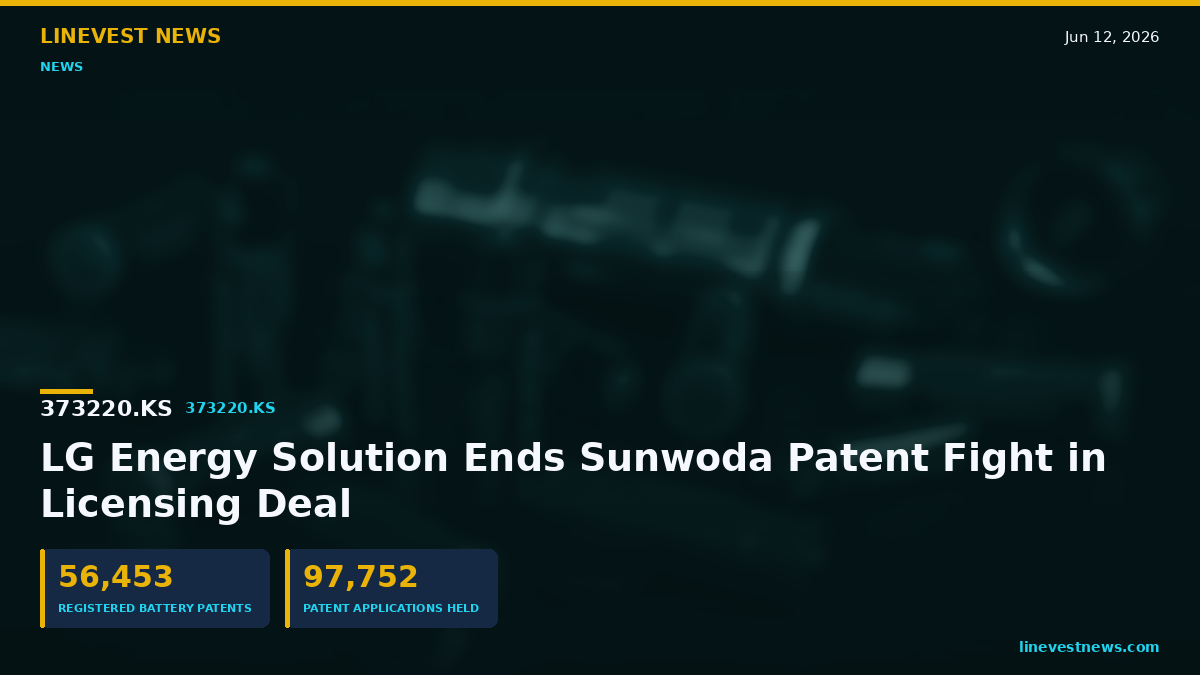
LG Energy Solution Ends Sunwoda Patent Fight in Licensing Deal
LG Energy Solution (373220.KS), Korea's largest electric-vehicle battery maker, has converted a two-year cross-border patent war into a license agreement with Chinese cell maker Sunwoda — but the financial reward it extracted is, for now, a black box.
Tulip Innovation, the Budapest-based licensing entity that manages lithium-ion battery patents owned by LG Energy Solution and Japan's Panasonic Energy, said on June 11 that it had signed a patent license agreement with Sunwoda. As a result, the parties will withdraw all pending legal actions in Germany, China, and Korea, resolving “all issues relating to LG Energy Solution and Panasonic Energy battery technology for Sunwoda and Sunwoda's customers” (Tulip Innovation/Sunwoda joint release via PR Newswire, June 11, 2026). “The terms of the agreement remain confidential,” the release stated — meaning the royalty rate and any lump-sum payment are undisclosed.
The question for shareholders: monetization, not just cleanup
For an investor, the signal is less about ending litigation than about whether LG Energy Solution can turn its patent stockpile into recurring income. The company reported holding 56,453 registered battery patents and 97,752 patent applications as of the end of March 2026 (Chosun Biz, June 11, 2026). Those filings are channelled through Tulip Innovation, which manages over 5,000 patents pooled from LG Energy Solution and Panasonic Energy — covering separators, electrodes, electrolytes, and structural cell designs — since the program was established in May 2024 (Knowmade, battery IP analysis). The Sunwoda settlement is the first major Chinese licensee to emerge from that pool, making it a proof point for the licensing model rather than a one-off legal outcome. Because terms are confidential, the size of any royalty stream cannot be quantified from public disclosure.
How LG won the leverage
The settlement followed a sustained enforcement campaign in Germany. Tulip Innovation secured two parallel infringement injunctions at the Munich District Court on May 22, 2025, over patents EP1829139 and EP2528141 covering composite separator technology, then a third injunction on July 17, 2025, based on patent EP2378595 covering electrode-separator architecture (Knowmade). When Sunwoda declined to negotiate a license, LG Energy Solution escalated by targeting automakers that use Sunwoda cells — filing legal actions and trade-commission complaints over vehicles including the Volvo EX30 and the Renault Grand Koleos, all of which are now being withdrawn under the settlement (Chosun Biz, June 11, 2026). Pressuring downstream carmakers, rather than only the cell supplier, is what ultimately forced Sunwoda to the table.
The counterparty is no minor player: Sunwoda, founded in 1997 and listed in Shenzhen, is a lithium-ion specialist that ranks around the global top 10 in EV battery market share, according to Seoul-based researcher SNE Research (Electronic Times, June 11, 2026). A license from a top-tier Chinese maker lends credibility to the broader licensing program.
Historical context and the open question
The deal echoes LG Energy Solution's earlier IP enforcement posture — most notably its 2021 settlement with domestic rival SK Innovation over EV battery trade-secret claims, in which SK agreed to pay LG 2 trillion won ($1.8 billion) in cash and royalties to end a U.S. International Trade Commission dispute that had produced a 10-year U.S. import ban against SK (BusinessWire, April 11, 2021). That case established that LG would litigate aggressively and monetize the outcome; the Sunwoda agreement extends that playbook across borders into China.
The specific data point that will confirm whether this licensing strategy is material: the German Federal Patent Court is expected to rule on the validity of the underlying patents around mid-2026, according to Knowmade, with preliminary opinions reported to favor validity. Those rulings are now moot for Sunwoda but will determine how much leverage Tulip Innovation retains against other potential licensees. Equally telling will be whether LG Energy Solution begins to itemize patent-licensing income in its quarterly results — a line item that, if it appears, would signal the company sees IP as a standalone revenue engine rather than a defensive tool.
This article is for informational purposes only and does not constitute investment advice. Figures are sourced from the cited publications and company disclosures as of the dates noted; licensing terms in this matter are confidential and were not disclosed by the parties.