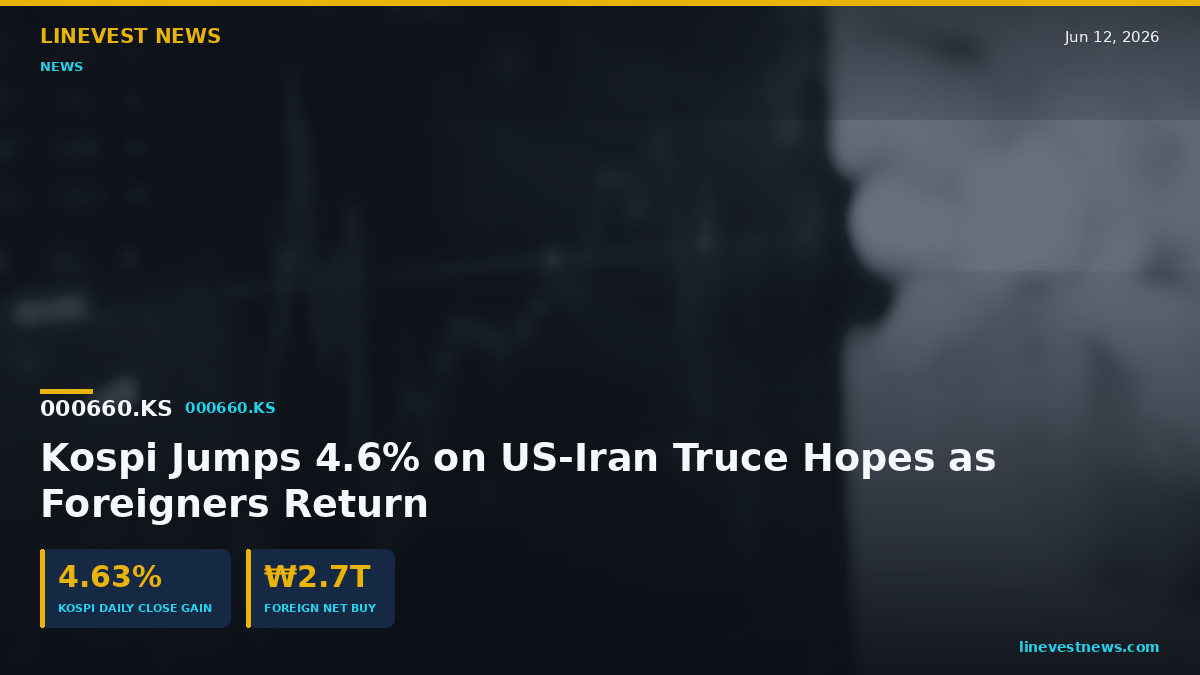
South Korea's benchmark Kospi index surged 4.6%, closing at 8,123.62, on Friday as hopes for an end to the US-Iran war pulled foreign capital back into Seoul for the first time in more than a month, with memory-chip heavyweights leading the advance.
The Kospi closed at 8,123.62, up 359.62 points, or 4.63%, after opening 6.44% higher at 8,263.85 and briefly trading more than 8% up near the 8,400 level, according to ChosunBiz. The early spike was sharp enough to trigger a "buy sidecar," a five-minute halt on program buy orders. The tech-heavy KOSDAQ secondary bourse closed at 1,029.05, up 3.22%, reclaiming the 1,000 mark, per ChosunBiz.
The one question: is this a durable re-rating or a relief spike?
For a global fund manager, the move's size is less interesting than its composition — and the answer is mixed. The rally was driven by two distinct forces that happen to have peaked on the same day: a geopolitical relief trade that has reversed before, and a Korea-specific chip catalyst that has not.
The geopolitical trigger came from Washington. President Donald Trump said on June 11 (local time) that he had reached "a great agreement on the war with Iran," adding that only final coordination of the document remained and that the signing of a ceasefire memorandum of understanding was imminent, ChosunBiz and Newsis reported. Newsis, citing details of the proposed terms, said the framework includes normalizing traffic through the Strait of Hormuz, pursuing further nuclear negotiations, and releasing frozen Iranian assets — though implementation specifics are not finalized.
That optimism is not yet confirmed by the other side. Iran's foreign ministry has said no final agreement has been reached, and hardliners in Tehran have characterized Trump's announcement as a deception tactic, Newsis reported.
Why caution is warranted: this is not the first ceasefire trade
The market has run this playbook before in 2026 and been burned. An April 2026 US-Iran ceasefire announcement triggered a comparable jump of more than 5% in the Kospi and Japan's Nikkei before the truce frayed; by mid-May, Trump described the ceasefire as on "life support" and Brent crude topped USD 104 a barrel, according to CNBC reporting. The pattern of declared-then-broken truces is precisely why the move should be read as a relief rally rather than a confirmed peace dividend.
Oil markets reflected the same guarded optimism. After Trump's remarks, Brent crude fell 2.25% to USD 88.35 a barrel and US West Texas Intermediate dropped 2% to USD 85.96, Newsis reported — still well above the roughly USD 70 level seen in late February before the conflict began. ING commodity analysts Warren Patterson and Ewa Manthey cautioned that Trump "has claimed a deal was imminent several times before, only for fighting to resume," and warned against assuming the truce is already secured, per Newsis.
The structural leg: chips, not just geopolitics
The more durable part of the story is company-specific. Samsung Electronics (005930.KS), the world's largest memory-chip maker, closed up about 7% after reports that it would manufacture part of Google's next-generation AI chip, ChosunBiz reported. Separately sourced coverage from The Information (via Yahoo Finance) indicates Google is in talks to have Samsung produce a memory-interface component of its 10th-generation Tensor Processing Unit on Samsung's 2-nanometer process, with potential mass production in 2028 — a contract that would bolster Samsung's contract-chipmaking ambitions.
The surge was extreme intraday before paring. At 11 a.m. local time, Samsung traded up 11.54% at ₩333,500 (USD 243) and SK Hynix (000660.KS), the world's second-largest memory maker and a leading high-bandwidth-memory supplier, was up 8.00% at ₩2,269,000 (USD 1,656), according to ET News. By the close, SK Hynix's gain had narrowed to about 2%, while its holding-company affiliate SK Square rose more than 10%, ChosunBiz reported. Bloomberg, in coverage dated June 12, noted the Kospi rose as much as 8.5% intraday with Samsung and SK Hynix each climbing more than 9% at their peaks, and described Korea as the world's best-performing major market this year with a roughly 97% gain.
Flows: the standout signal
The most notable shift was in positioning. Foreign investors net bought more than ₩2.7 trillion (USD 2.0 billion) of Korean shares — their first net purchase in 25 trading sessions — while institutions added more than ₩3 trillion (USD 2.2 billion), ChosunBiz reported. Retail investors net sold more than ₩5.5 trillion (USD 4.0 billion). "Concentration in large caps eased the discount-rate burden, and major sectors strengthened as the index returned to 1,000," Kang Jin-hyuk, a senior researcher at Shinhan Investment Corp (a Korean brokerage), told ChosunBiz, referring to the KOSDAQ.
The rally was regional. Japan's Nikkei 225 rose 3.5% to 66,442.95, Hong Kong's Hang Seng gained 1.8%, China's Shanghai Composite added 1.6%, Taiwan's Taiex climbed 2.6%, Australia's S&P/ASX 200 rose 1.9% and India's Sensex gained 1.2%, Newsis reported. Sentiment was also lifted by the Nasdaq debut of SpaceX, which began trading at USD 135 a share; Newsis put the raise at about USD 75 billion and the implied valuation at roughly $1.78 trillion, the largest IPO on record — figures consistent with CNBC and Investing.com reporting of a USD 135 fixed price and a USD 75 billion raise.
What to watch next
The data point that confirms or refutes the geopolitical leg is concrete: whether the US-Iran ceasefire MOU is actually signed in the coming days, as Trump suggested, and whether traffic through the Strait of Hormuz normalizes. Until then, the foreign-investor flow — whether the first net buy in 25 sessions extends or reverses next week — is the cleanest read on whether Seoul's institutions believe the truce will hold. The chip-demand leg, by contrast, hinges on a separate timeline: confirmation of the Samsung-Google foundry arrangement and its 2028 production target.
This article is for informational purposes only and does not constitute investment advice. Figures are sourced from the cited outlets; currency conversions use an approximate rate of 1 USD = 1,370 KRW. Readers should conduct their own research before making any investment decision.
Sources
- https://biz.chosun.com/stock/stock_general/2026/06/12/DVKK43DK5ND5LC2GRVJFWAVI6A/
- https://www.newsis.com/view/NISX20260612_0003667259
- https://www.etnews.com/20260612000138
- https://www.bloomberg.com/news/articles/2026-06-12/korea-s-kospi-surges-7-as-iran-deal-hopes-lift-chip-stocks
- https://www.cnbc.com/2026/05/11/oil-price-today-brent-wti-iran-war-trump.html
- https://finance.yahoo.com/sectors/technology/articles/googl-explores-samsung-partnership-next-170139630.html
- https://www.investing.com/news/stock-market-news/spacex-prices-ipo-at-135-per-share-for-june-12-nasdaq-debut-432SI-4738217