Home prices in Dongtan, a planned new town in Hwaseong, Gyeonggi Province that serves as a key dormitory district for Samsung and SK hynix chip workers, have now risen fast enough to meet Korea's quantitative thresholds for a "regulated-zone" designation — a status that would restrict who can buy, tighten mortgage limits and, in its strictest form, require government permission for transactions.
What would trigger a designation, and how close is Dongtan
Under Korean rules cited by Chosun Biz, an area can be named an "adjustment target area" (the lighter tier) when its three-month price gain exceeds 1.3 times the local consumer-price inflation rate, and a "speculative overheating district" (the stricter tier) when the gain tops 1.5 times that rate, alongside signs of subscription frenzy or resale churn. Gyeonggi Province's consumer-price inflation ran 1.38% from March to May, per Chosun Biz — putting the trigger lines at roughly 1.8% and 2.1% over three months.
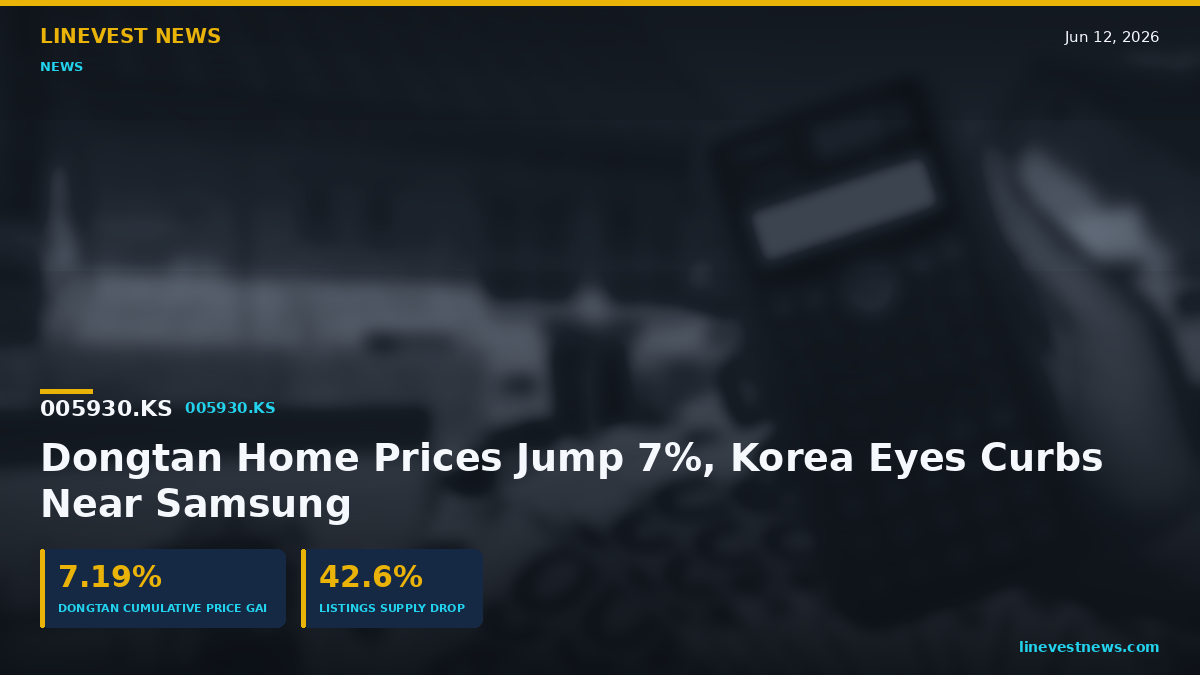
Dongtan has blown past both. Its apartment sale prices rose 1.98% in the second week of June (as of June 8), triple the prior week's 0.60%, according to Korea Real Estate Board data reported by Chosun Biz and the Seoul Economic Daily. The cumulative gain since the Korea Real Estate Board began surveying the redrawn Hwaseong district on February 1 reached 7.19%. Chosun Biz reported the area is "understood to satisfy" the numeric requirements for designation.
Who gets hit first
The immediate pressure shows up in supply. Listings in Dongtan shrank about 40% over three months, according to big-data provider Asil cited by Chosun Biz — the Seoul Economic Daily put the drop at 42.6%, from 6,501 in early March to 3,733 in early June. May apartment sales totaled 1,179 units, up 134.4% year over year, per the Seoul Economic Daily. An 84-square-meter unit at Dongtan Station Lotte Castle traded at ₩2.08 billion ($1.37 million) in May, up from ₩1.88 billion ($1.24 million) in February, making Dongtan the fourth Gyeonggi area where a standard apartment cleared ₩2 billion.
Chosun Biz also reported a rush of pre-emptive buying: one prospective Dongtan purchaser said brokers were urging clients to close deals early because of talk that a regulated-zone or land-transaction-permit designation could be coming.
Why this matters: chip bonuses are the demand engine
The story sits at the intersection of property policy and the semiconductor cycle. Dongtan sits near Samsung Electronics (005930.KS) — Korea's largest company and the world's biggest memory-chip maker — and SK hynix, Korea's second-largest chipmaker. A Woori Bank property researcher quoted by Chosun Biz attributed the strength to "expectations of a semiconductor boom" driving demand in southern Gyeonggi's dormitory towns, amplified by chip-sector performance bonuses and gap-investment buying ahead of any rule change. The regulatory action, if it comes, targets the housing market rather than the chipmakers directly — but it underscores how the chip upcycle's payouts are spilling into the asset markets around Korea's fabrication clusters.
The heat is radiating outward. Bundang in Seongnam has risen 6.87% this year and the Gwanggyo area of Suwon's Yeongtong district 5.35%, as Dongtan owners trade up, Chosun Biz reported. Yongin's Giheung, another node on the "chip belt," gained 0.13% in the second week of June for a 5.66% year-to-date rise, and is also floated as a designation candidate. The boom extends to unregulated chip-belt towns farther south: developers opened a model house on June 12 for a 403-unit project in Pyeongtaek's Godeok International New Town, citing Samsung's Pyeongtaek campus as backstop demand, according to Newsis.
The precedent and the open question
Dongtan was conspicuously left out of Korea's October 15, 2025 housing package, which roped all of Seoul and 12 Gyeonggi areas into adjustment-target, speculative-overheating or land-transaction-permit status, Chosun Biz noted — an omission local outlets have since framed as a policy miss. Past designations have typically cooled transaction volumes and asking prices in the targeted area.
The binary catalyst is procedural: a designation requires a vote by the Housing Policy Review Committee under MOLIT (Korea's Ministry of Land, Infrastructure and Transport). A MOLIT official told Chosun Biz the government is "continuously monitoring market conditions" and that no committee meeting has yet been scheduled. The next Korea Real Estate Board weekly reading and any committee announcement are the data points that will confirm or defuse the designation thesis.
This article is for informational purposes only and does not constitute investment advice. All figures are attributed to the sources cited and were accurate as of publication. Currency conversions use an approximate rate of 1 USD = 1,520 KRW as of June 12, 2026.
Sources: biz.chosun.com | www.newsis.com | en.sedaily.com | www.asiae.co.kr