LG Chem, Korea's largest chemical maker, on June 11 disclosed interim results from its long-running observational study of the growth-hormone brand Eutropin, pairing the data release with a new injection device in a move squarely aimed at protecting the company's lead in Korea's pediatric short-stature market. The figures came at the 21st LG Growth Study (LGS) Symposium, an event for pediatric endocrinologists, as reported by etnews and Maeil Business Newspaper (MK), a Korean business daily.
The one number that matters: 0.2%
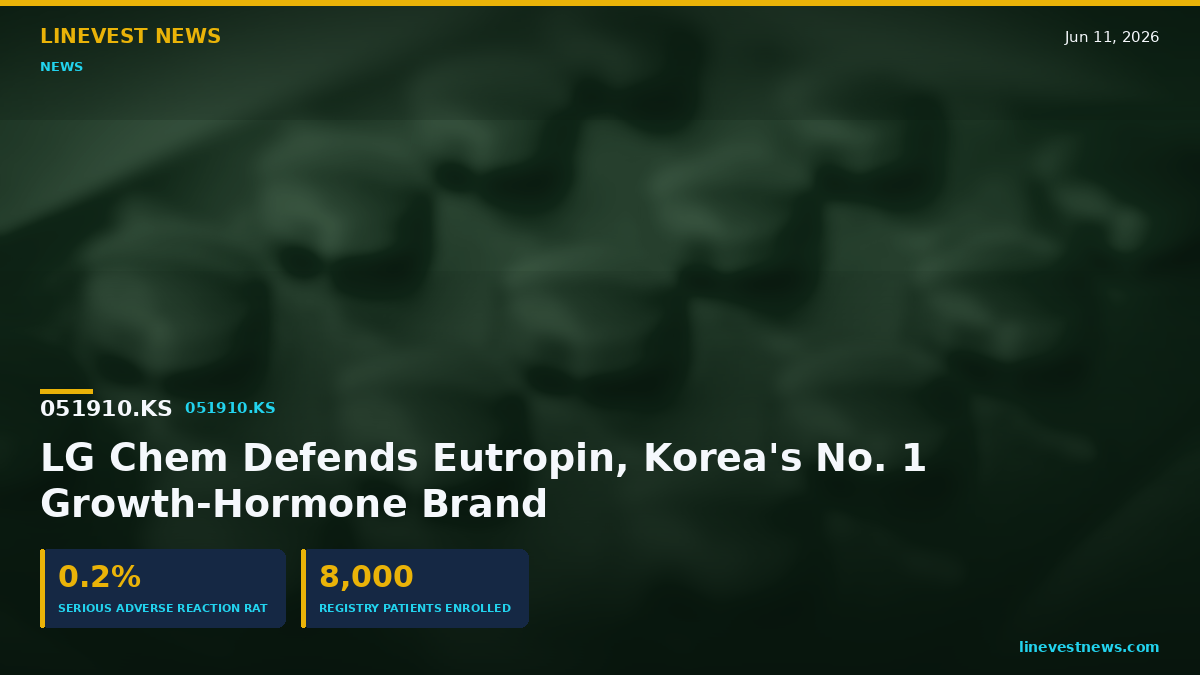
For specialists weighing long-term growth-hormone therapy, the headline figure is the safety signal. Across the cohort, serious adverse drug reactions (SADR) were observed at 0.2%, with overall safety indicators holding stable, per etnews. On efficacy, the company reported that height standard-deviation scores improved across all short-stature indications over four years of treatment, with children who started before puberty showing relatively stronger gains; a separate seven-year analysis found thyroid function and blood glucose remained stable, etnews reported.
The data set is what gives LG Chem its moat. The LG Growth Study is a non-interventional registry launched in 2012 to track Korean children on Eutropin in real-world settings. As of year-end 2025, roughly 8,000 short-stature patients were enrolled against a long-term target of about 10,000, according to etnews; MK put the accumulated tracking at about 15 years of data. LG Chem said 23 peer-reviewed papers have been published from the registry — a body of Korea-specific evidence that imported rivals cannot easily replicate.
What is actually being defended
Eutropin was Korea's first domestically developed short-stature treatment when it launched in 1993 to replace imported products, and it remains the country's leading growth-hormone brand, according to Korea Biomedical Review (KBR), a Korean healthcare trade outlet. The clinical-data release lands alongside a device push: on April 21, 2026, LG Chem launched the Eutropin EcoPen48, described by Seoul Economic Daily as Korea's first cartridge-replaceable growth-hormone set, built with Swiss medical-device maker Ypsomed. The pen uses a spring-driven semi-automatic injection mechanism and carries a 48 IU capacity, which Seoul Economic Daily said is the largest among growth-hormone products in Korea, aimed at easing the burden of repeated self-injection for children and caregivers. LG Chem has invested more than ₩30 billion (USD 21.9 million) to bring pen-formulation production in house, per KBR.
The competitive backdrop helps explain the timing. The defensive story is sharpened by rival retreat: KBR reported that Pfizer Korea ended promotion of its once-weekly growth-hormone therapy Ngenla amid market uncertainty — a sign that convenience-led challengers to the daily-injection franchise have struggled to gain traction.
How material is it for LG Chem?
For a global investor, the franchise needs to be sized against the parent. LG Chem reported roughly ₩48.9 trillion (USD 35.7 billion) in consolidated revenue for 2024, a business dominated by petrochemicals and battery materials — petrochemical sales alone were about ₩4.46 trillion (USD 3.26 billion) in the third quarter of 2025, per an LG Chem earnings transcript summarized by Investing.com. Life Sciences is a small slice of that group, posting about ₩101 billion (USD 73.7 million) in third-quarter 2025 operating profit. In other words, this is a margin-protective story for a profitable niche division, not a needle-mover for the consolidated top line.
The open question
The registry runs for years yet, so the data will keep maturing; the more immediate test is commercial. The figure to watch is whether EcoPen48 adoption holds or grows Eutropin's share through 2026 as weekly-injection competitors circle and then, in some cases, retreat. LG Chem's next quarterly Life Sciences disclosure, and any updated LGS interim read-out, will show whether the combination of long-term safety evidence and a new device translates into defended share rather than merely defended messaging.
This article is for informational purposes only and does not constitute investment advice. Figures are drawn from cited Korean and English-language sources; currency conversions use an approximate rate of 1 USD = 1,370 KRW.
Sources:
- https://www.etnews.com/20260611000235
- https://www.mk.co.kr/news/it/12071514
- https://www.koreabiomed.com/news/articleView.html?idxno=25117
- https://en.sedaily.com/markets/2026/04/21/lg-chem-launches-growth-hormone-eutropin-ecopen-for-easier
- https://www.koreabiomed.com/news/articleView.html?idxno=26277
- https://www.investing.com/news/transcripts/earnings-call-transcript-lg-chem-q3-2025-returns-to-profitability-93CH-4322570