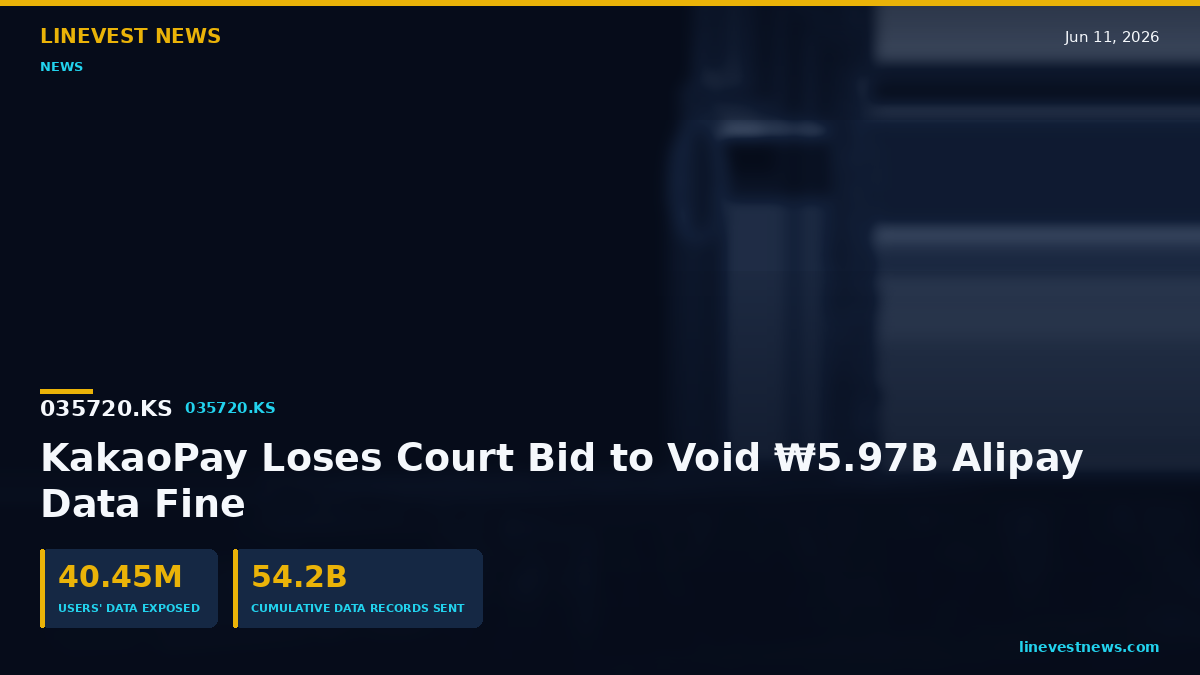
A Seoul court has rejected KakaoPay's bid to overturn a privacy fine for sending tens of millions of users' data to China's Alipay—a ruling that matters far more for what it validates than for the cash at stake.
The Seoul Administrative Court's Administrative Division 12 (presiding judge Kang Jae-won) on June 11 dismissed in full the suit brought by KakaoPay (377300.KS), the mobile-payments arm of Korean messaging giant Kakao, against the Personal Information Protection Commission, or PIPC (Korea's privacy regulator). The court let stand the ₩5.968 billion ($4.4 million) penalty and the related corrective order the PIPC imposed in January 2025, according to Chosun Biz and Electronic Times (etnews).
Why a $4.4 million fine is the small part
The penalty itself is immaterial to KakaoPay's finances. At about ₩5.97 billion it equals roughly 0.11% of the company's market value of around $3.95 billion (companiesmarketcap.com) and about 2.5% of the ₩238.4 billion ($174 million) in revenue KakaoPay booked in the third quarter of 2025 (companiesmarketcap.com).
What the ruling does is harden the legal theory underpinning a much larger enforcement chain. The court accepted the regulator's core finding—that shipping data to Alipay was an unauthorized "provision" of personal information rather than a lawful "processing consignment," and that KakaoPay users' right to informational self-determination was violated, per etnews. That same theory now backstops the separate ₩12.976 billion ($9.5 million) fine the Financial Supervisory Service (FSS), Korea's financial watchdog, levied in February 2026, and a criminal probe: the Gyeonggi Nambu Provincial Police booked KakaoPay as a corporation on suspicion of violating the Credit Information Act and opened an investigation in spring 2026, according to Seoul Economic Daily.
What actually happened
KakaoPay transmitted data on roughly 40.45 million customers—IDs, mobile numbers, email addresses, linked-account status and top-up counts—to Alipay from June 2019 to May 2024, with cumulative transfers reaching about 54.2 billion records and no user consent obtained, Chosun Biz reported. The PIPC found the data fed an "NSF" (Non-Sufficient Funds) scoring model that Apple commissioned Alipay to build to gauge the likelihood a user's payment would fail. The court noted the transfers swept in even Android users who never used Apple's services, Chosun Biz said.
KakaoPay said it had "thoroughly encrypted" the data and followed "lawful procedures" to meet fraud-prevention duties on Apple payments, adding it found the ruling regrettable and would "review the judgment and decide on a future response," per Chosun Biz—language that leaves an appeal open.
The conflict the market is watching
The counterparty in this case is also an insider. An affiliate of Alipay operator Ant Group ranks as KakaoPay's second-largest shareholder, (The Korea Times, The Register), holding a stake reported at roughly 32% as of 2024 (The Korea Times). That overlap—data flowing to a company that is simultaneously a major owner—is the structural question hanging over the firm as the criminal and financial-regulatory tracks proceed.
History favors the regulators. In a closely watched parallel, the PIPC fined Meta ₩6.7 billion in November 2020 for sharing 3.3 million Koreans' data without consent; Meta sued, lost at the administrative court in 2023, and saw the Supreme Court reject its final appeal, upholding the penalty in full (The Korea Herald). Korean courts have repeatedly backed the PIPC's consent-based reading of the law.
The next signal
The figure to watch is not this fine but whether KakaoPay appeals—and how it fares against the FSS's larger ₩12.976 billion action and the police inquiry, which together test exposure well beyond the administrative penalty just affirmed. With 40 million-plus affected users now backed by a court finding of unlawful data provision, the open question is whether civil claims follow. KakaoPay's decision on whether to take the case higher will be the first concrete read on how far it intends to fight.
This article is for informational purposes only and does not constitute investment advice. Figures are drawn from the cited sources; currency conversions use an approximate rate of 1 USD = 1,370 KRW.
Sources
- https://www.etnews.com/20260611000351
- https://biz.chosun.com/topics/law_firm/2026/06/11/JAWFG2IHRJBDXG6VW3ZZWDEOVI/
- https://en.sedaily.com/society/2026/05/13/police-launch-probe-into-kakaopay-over-542-billion-data
- https://koreatechtoday.com/kakao-pay-fined-5-8-million-for-unauthorized-user-data-transfer/
- https://companiesmarketcap.com/kakaopay/marketcap/
- https://www.koreatimes.co.kr/www/biz/2024/12/602_380503.html
- https://www.theregister.com/2024/08/15/kakao_pay_data_leak/
- https://www.koreaherald.com/article/10441192