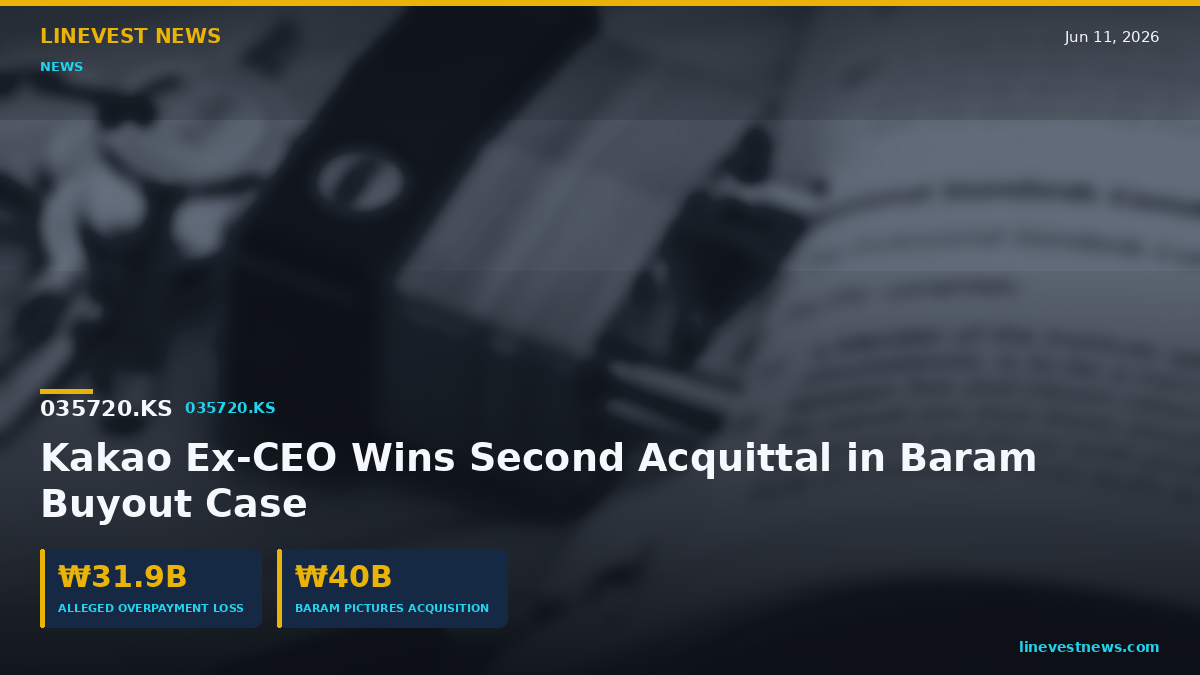
An appellate court has upheld the acquittal of Kim Sung-su, former chief executive of Kakao Entertainment — the unlisted music, web-comics and drama-production arm of Kakao Corp (035720.KS), Korea's dominant mobile-messaging and internet-platform group. On June 11, the Seoul High Court's Criminal Division 3, presided over by Judge Lee Seung-han, dismissed the prosecution's appeal and found Kim not guilty of breach-of-trust and bribery charges, mirroring his earlier acquittal at trial (Chosun Biz, June 11, 2026).
Prosecutors had alleged that in 2020 Kim conspired to have Kakao Entertainment overpay for Baram Pictures, a Korean television-drama production studio, inflicting roughly ₩31.9 billion ($23.3 million) of losses on the company (Chosun Biz; Seoul Economic Daily, April 28, 2026). On appeal they sought a 10-year prison term and forfeiture of about ₩1.25 billion ($912,000), the same demand made at trial (Seoul Economic Daily).
How big is this, really?
The figures sit well below the scale at which they would move Kakao's reported earnings. Baram Pictures was acquired for around ₩40 billion ($29.2 million), a sum local court reporting said the bench found hard to deem significantly above the studio's actual worth (Kyunghyang Shinmun, June 11, 2026). For context, Kakao Entertainment is a subsidiary and is not separately listed; the listed entity exposed to the headline is parent Kakao Corp. The case has always been a governance and management-accountability question, not a profit-and-loss event — which is precisely why an acquittal that endorses the deal as a legitimate business decision matters more for the overhang it removes than for any number on a balance sheet.
Why the court cleared him
The central dispute was whether the acquisition caused Kakao Entertainment any loss at all. The court held that to establish loss, Baram Pictures' fair value first had to be specifically calculated — and the evidence on file did not allow that calculation (Chosun Biz; Numbers, June 11, 2026). The bench also accepted the deal as sound business judgment: Kakao Entertainment had, from around April 2018, planned to build a content production-and-distribution platform alongside Kakao, recruited Kim from a rival, and had a genuine commercial need to acquire a studio housing well-known screenwriters (Chosun Biz).
On the bribery count — that Kim took about ₩1.2 billion ($876,000) from Lee Jun-ho, former head of Kakao Entertainment's investment-strategy division, in return for pushing the deal — the court declined to convict, though it noted it remained "highly suspicious" whether the money was a reward for an improper request (Chosun Biz).
Lee fared less well. His appeal was dismissed and his first-instance sentence — two years in prison, suspended for three years — stood, tied to embezzling about ₩1.05 billion ($766,000) of the roughly ₩6 billion ($4.4 million) Baram Pictures received in 2017 as drama-development fees, allegedly diverted to personal real-estate purchases (Chosun Biz; Seoul Economic Daily).
A pattern in Kakao's courtroom run
The ruling extends a string of favorable outcomes for Kakao's leadership. In October 2025, the Seoul Southern District Court acquitted Kakao founder Kim Beom-su of manipulating SM Entertainment's share price during the 2023 bidding war against HYBE, the agency behind BTS, in a decision local media described as lifting a major legal cloud over the group (Korea Herald, October 21, 2025). Prosecutors have since appealed that acquittal (Korea Herald).
What confirms or unwinds this
The open question is whether prosecutors take the Baram Pictures case to the Supreme Court, as they did with the SM Entertainment verdict. Given they pressed for a decade-long sentence and lost twice, a final appeal is plausible; until that deadline passes, the acquittal is not legally settled. A Supreme Court referral — or a decision to let the verdict stand — will be the next concrete data point on whether this chapter of Kakao's legal exposure is truly closed.
This article is for informational purposes only and does not constitute investment advice. Figures are based on cited court reporting and primary-source coverage; currency conversions use an approximate rate of 1,370 KRW per USD.