Kakao Stages First Strike in Its History; Service Hit Is Negligible, but the Pay Demand Is Not
Kakao (035720.KS) — operator of KakaoTalk, the messaging-and-payments app on which roughly 49 million South Koreans depend (Tech Times) — faced the first walkout in its history on Wednesday, June 10, 2026. The headline reads dramatic; the operational reality is small. The question that matters for anyone holding the stock is therefore not “is KakaoTalk going down,” but “what does it cost Kakao to make this dispute go away?”
What actually stopped
Not much. About 600 union members from five Kakao entities — headquarters, Kakao Pay, Kakao Enterprise, DK Techin and XL Games — staged a partial, five-hour stoppage and rally near the company's Pangyo campus from 10 a.m. to 3 p.m. local time (Chosun Biz; The Korea Herald). It was a five-hour walk-out paired with a rally, deliberately partial rather than full-scale. The union — the Kakao branch of the Nationwide Chemical, Textile and Food Industry Workers' Union — said it chose a limited action first “and, depending on future negotiation developments, may escalate the intensity” (The Asia Business Daily). Industry observers told The Korea Herald they expect minimal service disruption because core services are largely automated and essential staff stayed on duty. So the messaging app, mobility and payments ran normally.
The real exposure: a structural pay formula
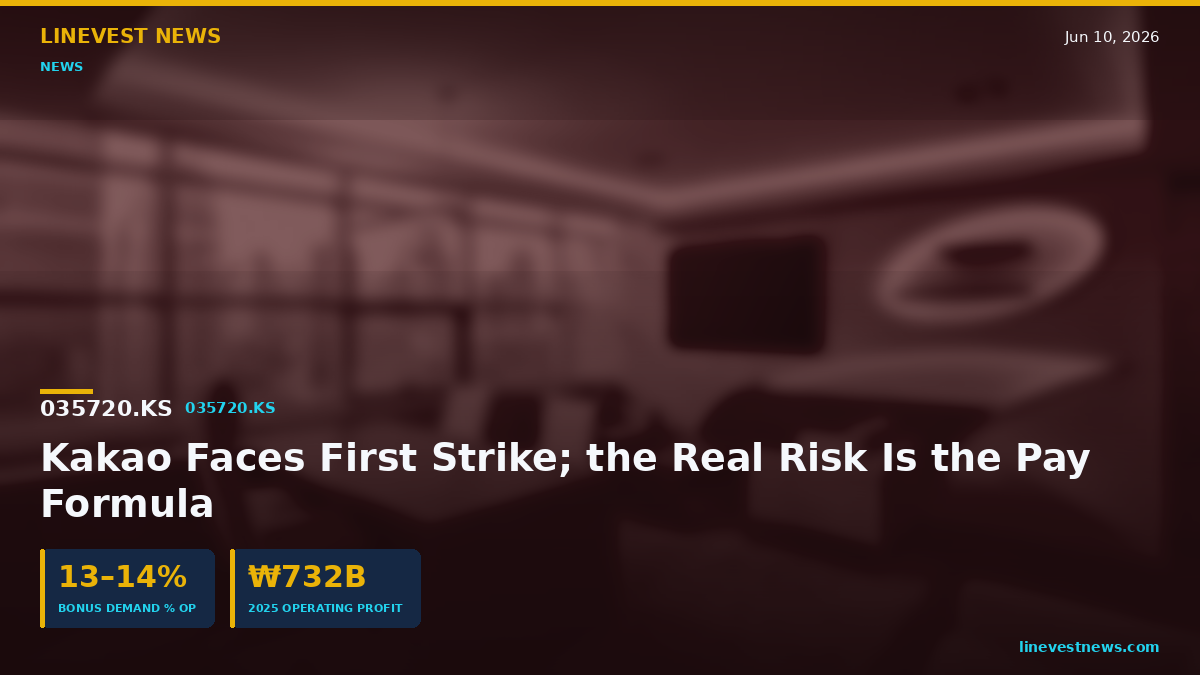
The stoppage is symbolic; the demand behind it is not. The dispute centers on two compensation issues. First, the union wants performance bonuses pegged at 13 to 14 percent of last year's operating profit (The Korea Herald). Second, it wants restricted stock units (RSUs) treated as separate from — not a substitute for — cash bonuses; Kakao introduced annual RSU grants worth ₩5 million (about USD3,600) for employees with at least a year of tenure in 2025 (Tech Times).
Size the first demand against the company's own numbers. Kakao posted record full-year 2025 operating profit of ₩732 billion (USD534 million), up 48 percent year-on-year (Seoul Economic Daily; Digital Today). Applying the union's 13–14 percent to that base implies a bonus pool of roughly ₩95–102 billion (USD69–75 million) — a recurring, formula-driven claim on operating profit, not a one-off. Management says the demands could impose a “huge burden” and has not accepted them (The Korea Herald).
The precedent the union is copying
The model is explicit. The union is mirroring a landmark 2025 agreement at SK hynix — Korea's second-largest memory-chip maker — which committed 10 percent of operating profit to a bonus pool and produced a payout worth more than ₩100 million (about USD73,000) per employee in early 2026 (Tech Times). That outcome is precisely why pegging bonuses to a fixed share of profit has become the template Korean tech labor now reaches for, and why Kakao management is resisting importing it.
Why the timing stings
Kakao is negotiating from a position of record profit but a sinking share price. Q1 2026 revenue hit a record ₩1.94 trillion (USD1.42 billion) and operating profit rose 66 percent to ₩211 billion (USD154 million) (The Pickool; Telecompaper). Yet the stock has not followed earnings. Shares traded at ₩38,500 (USD28) around mid-morning on June 10, down 2.53 percent on the day; the stock is off 36.39 percent from its ₩62,100 level at the start of the year and touched a one-year intraday low of ₩37,600 on June 8 (Chosun Biz). The gap reflects investor unease over when Kakao's AI push will convert into visible revenue — a monetization question the record results have not yet answered.
That combination — record profits, a falling stock, and employees pointing to executives' bonuses — frames the union's grievance, which it summarized as halting “management failures leading to sell-offs, spinoffs, and restructuring” and securing employment stability (The Asia Business Daily).
The data point to watch
Mediation already failed once, collapsing on May 27, 2026, after more than eight hours at the Gyeonggi Regional Labor Relations Commission, Korea's regional labor mediation body (Tech Times). The question now is whether the union follows through on its escalation warning. The signal to watch is twofold: any next-round negotiation outcome, and whether Kakao's forward operating-expense guidance moves — the point at which a symbolic, five-hour stoppage would translate into a measurable line item. Until then, the strike's market significance lies in the pay formula it is trying to establish, not the hours it cost.
This article is for informational purposes only and does not constitute investment advice. Figures are sourced as cited; currency conversions use an approximate rate of 1 USD = 1,370 KRW unless a source provided its own conversion.