Artificial-intelligence demand for high-bandwidth memory (HBM) has shifted from a pricing story to a capital-spending story. For a portfolio manager weighing memory exposure, the question is whether that spending is durable, multi-year money backed by real fabs — or a euphoric demand spike that ends the way memory cycles usually do. This week brought hard evidence on both sides of that question.
The capex is real, and it is being quantified
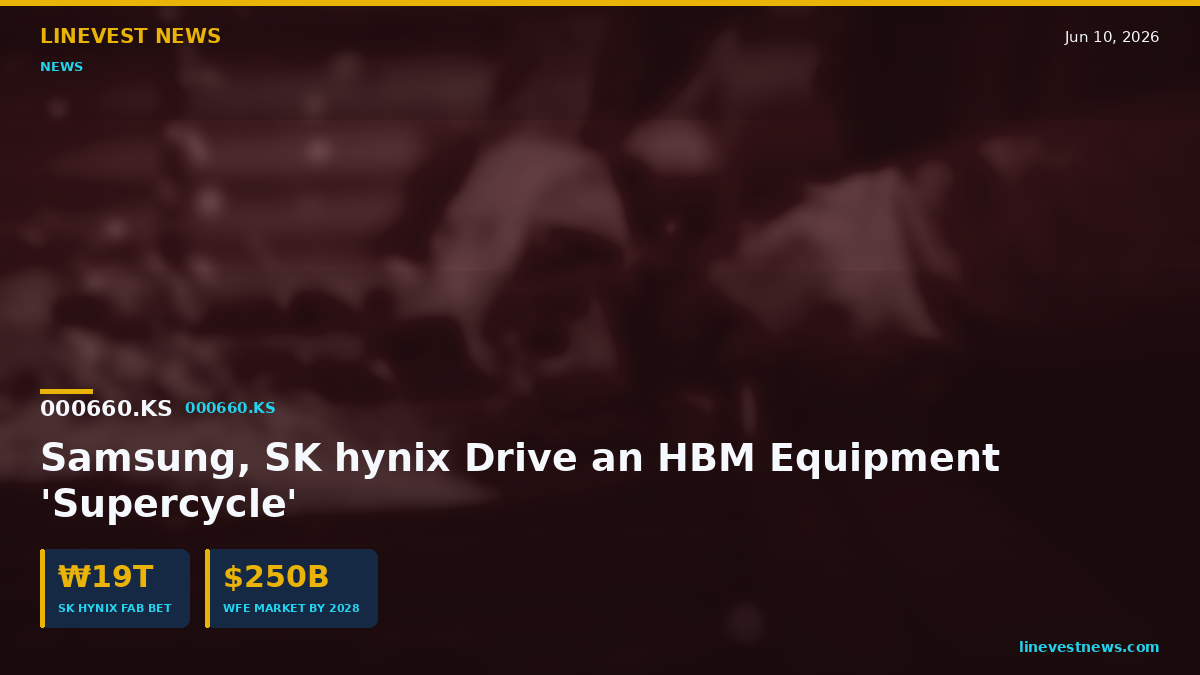
In a June 9 report, UBS argued the wafer-fab-equipment (WFE) industry is entering a "megacycle." Analyst Timothy Arcuri projects the equipment market will reach USD250 billion by 2028, with 2026 revenue of roughly USD147 billion, up 27% year over year, as Micron, Samsung Electronics (005930.KS), the world's largest memory chipmaker, and SK hynix (000660.KS), the leading supplier of HBM, bring new fabs online (UBS via Bloomingbit, June 9). UBS also lifted its 2027 memory-WFE forecast by USD10.5 billion. Korean coverage of the same UBS work, reported by Newsis citing MarketWatch, put 2027 total equipment revenue at about USD200 billion (up 35%), with memory-specific equipment sales rising roughly 50% and suppliers reporting visibility into eight quarters of customer demand — a sign orders reflect multi-year build plans rather than spot buying. Newsis named Lam Research and Applied Materials as the equipment vendors UBS flagged as beneficiaries.
That demand-visibility point matters because it is what separates a capex commitment from a sentiment rally: equipment ordered against eight-quarter plans is hard to cancel quietly.
The concrete proof: SK hynix's ₩19 trillion bet
The clearest physical evidence is already in the ground. SK hynix broke ground in April 2026 on P&T7, an advanced packaging and test fab in Cheongju, committing about ₩19 trillion (USD12.9 billion) — an additional Cheongju advanced-packaging site complementing its P&T3 plant in Cheongju and packaging lines in Icheon, dedicated to packaging and testing HBM (The Korea Herald). The company has guided completion by the end of 2027 (The Korea Herald), and it cites market expectations of roughly 33% annual HBM market growth from 2025 to 2030. Packaging — stacking and connecting finished chips — has become a competitive chokepoint for HBM, which is why back-end capacity is now drawing the kind of spend once reserved for front-end wafer fabs.
A possible second front: the southwest
Samsung is weighing a further step. According to Seoul Economic Daily and The Korea Times (June 9–10), Samsung is conducting a final review of a chip-packaging plant in the Jeonnam-Gwangju area — South Jeolla province and Gwangju city in Korea's southwestern Honam region — with SK hynix also reported to be eyeing a regional hub. Per the Chosun Biz reporting in the source cluster, Samsung today runs its packaging lines around Onyang and Cheonan; were a Honam plant realized, it would be its first new domestic back-end site since the 1991 Onyang campus. Both companies cautioned that nothing is final: a Samsung official said "nothing has been decided" (The Korea Times). The interest is driven by power and water limits in the Seoul-area chip cluster, and MOTIE (Korea's Ministry of Trade, Industry and Energy) has offered up to 100% support for industrial-infrastructure costs at non-metropolitan clusters (Seoul Economic Daily).
What history warns
The supercycle thesis carries a familiar tail risk. In the 2017 memory boom, Samsung more than doubled its semiconductor capital spending, to about USD24 billion from roughly USD11 billion a year earlier (Design & Reuse); that wave of capacity helped trigger the 2019 bust, when memory revenue fell sharply — a pattern UncoverAlpha argues has repeated across every memory cycle. The bullish counter this time is that HBM supply is being reserved years ahead and SK hynix posted a record first-quarter profit in 2026 (CNBC), suggesting demand is structural rather than speculative. Which view is right will not be settled by forecasts.
The data points to watch
Two near-term events will test the thesis. First, a presidential meeting with conglomerate chiefs later this month — reported to include SK Group chairman Chey Tae-won (The Korea Times) — may convert the Honam packaging talk into a firm number or leave it as speculation. Second, equipment-maker order books and the chipmakers' next capex guidance will show whether the eight-quarter demand visibility UBS describes holds, or whether the cycle is again pulling capacity forward into an eventual glut.
This article is for informational purposes only and does not constitute investment advice. Figures are sourced as cited; plans described as under review are not confirmed commitments.
Sources
- https://en.bloomingbit.io/feed/news/113938
- https://www.newsis.com/view/NISX20260610_0003663909
- https://www.koreaherald.com/article/10654507
- https://en.sedaily.com/finance/2026/06/09/samsung-plans-chip-packaging-fab-in-gwangju-as-sk-hynix
- https://www.koreatimes.co.kr/business/tech-science/20260610/samsung-mulls-new-chip-packaging-plant-in-gwangju
- https://biz.chosun.com/it-science/ict/2026/06/10/7QWHMNXMFNGUDEULVFCMTLJWJ4/
- https://www.uncoveralpha.com/p/every-memory-cycle-ends-the-same
- https://www.cnbc.com/2026/04/23/sk-hynix-earnings-ai-memory-shortage-hbm-demand.html
- https://www.design-reuse.com/news/5906-samsung-s-big-semi-capex-spending-keeps-pressure-on-competition/