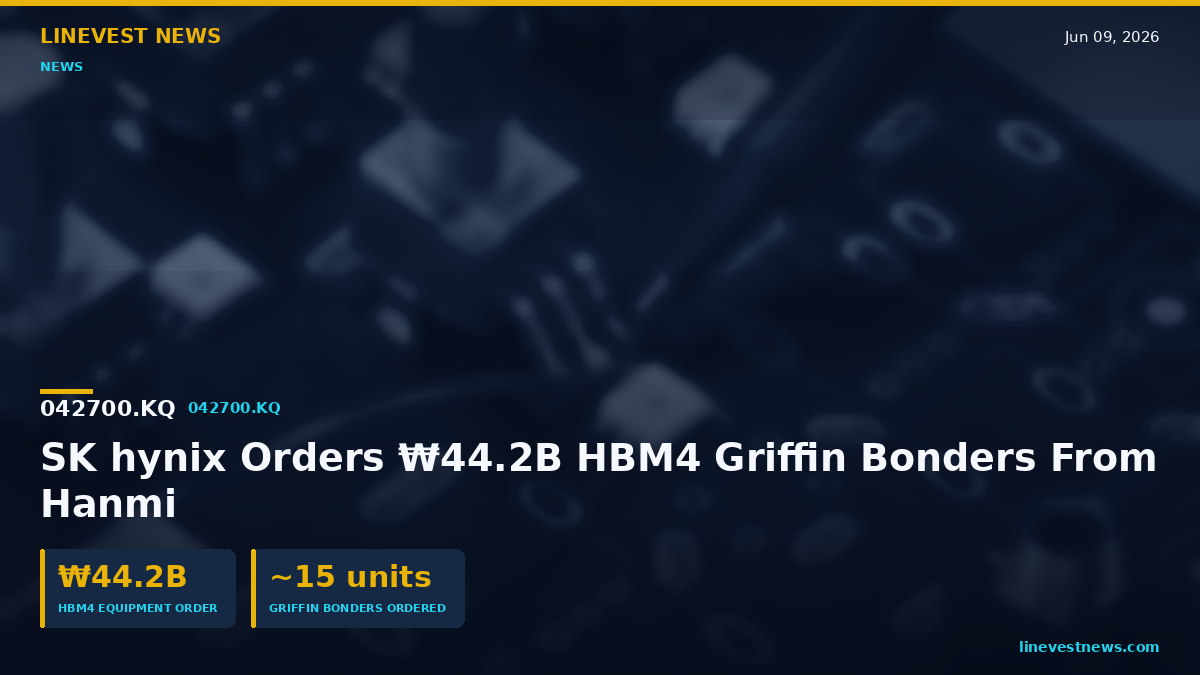
SK hynix (000660.KS), the world's top supplier of high-bandwidth memory (HBM), has ordered HBM4 production equipment worth ₩44.2 billion ($28.7 million) from Hanmi Semiconductor (042700.KS), Korea's dominant maker of HBM thermo-compression (TC) bonders, according to a regulatory filing disclosed Monday and reported by The Korea Times. The deal pairs at roughly ₩1,540 to the dollar, the rate implied by the filing.
The single number that matters for Hanmi is the model name. The contract covers the TC Bonder 4.5 Griffin, which The Elec, a Korean electronics-industry outlet, calls "a newly developed system designed specifically for HBM4 manufacturing processes" and describes as Hanmi's first HBM4 TC bonder order from SK hynix. A TC bonder stacks multiple DRAM dies into a single HBM cube and is regarded as core HBM equipment; with a single unit priced near ₩3 billion ($1.9 million), industry watchers quoted by the Korea Times estimate the order covers about 15 units. Delivery, installation and inspection run through Sept. 2.
Why it matters: the first hard signal that HBM4 capacity is moving to Hanmi's tools
At ₩44.2 billion, the order equals roughly 7.7% of the record ₩576.7 billion (about $375 million) in 2025 revenue Hanmi reported in February, when it also disclosed a 43.6% operating margin, according to Seoul Economic Daily. One filing does not move an annual number much, but its significance is strategic rather than arithmetic: it is the first time SK hynix has committed Hanmi's purpose-built HBM4 platform to volume, after a quieter stretch. The Elec notes the agreement is Hanmi's first TC bonder contract with SK hynix in five months, following a ₩9.6 billion (about $6.2 million) order in January 2026 that did not involve the Griffin.
The gap mattered because Hanmi's grip on the next memory generation was no longer assumed. In December 2025, SK hynix placed an HBM4 TC bonder order with Singapore-based ASMPT, a step TrendForce and Digitimes tied to an escalating patent fight between Hanmi and Hanwha Semitech, the equipment arm of Korea's Hanwha group. Hanwha alleges Hanmi's Griffin and Dragon bonders infringe patents on flux-application inspection and surface planarization, seeking ₩1 billion ($740,000) in damages and disposal of the machines, per The Elec; the first hearing was held at the Seoul Central District Court. Monday's Griffin order is the clearest indication so far that the dispute has not dislodged Hanmi from SK hynix's HBM4 line.
What Hanmi is defending
Hanmi entered 2026 holding a 71.2% revenue share of the global HBM TC bonder market through the third quarter of 2025, ahead of SEMES (13.1%) and ASMPT (5.6%), per Asia Business Daily citing TechInsights' 2025 TC Bonder Market Report. Industry reporting separately credits Hanmi with more than 90% of bonders for the prior HBM3E 12-stack generation, per Techovedas. The open question for HBM4 is whether that near-monopoly carries over or compresses toward a more contested split as SK hynix dual-sources with ASMPT.
The equipment is bound for SK hynix's new M15X fab in Cheongju, North Chungcheong Province — about 110 kilometers south of Seoul — which The Korea Herald describes as a new fabrication plant slated to become a primary HBM production hub. SK hynix began mass-producing HBM4 in September 2025, per the Korea Times filing report, with the chips destined for Nvidia's (NVDA) Vera Rubin AI platform. MarketScreener reported Hanmi shares jumped about 8% on the disclosure.
The next confirmation point is concrete: follow-on Griffin filings on Korea's DART (the country's electronic disclosure system) and Hanmi's second-quarter results, which will show whether SK hynix's HBM4 ramp generates a string of repeat orders or whether the January-to-June pause repeats. Until then, this filing answers one question — Hanmi is on the HBM4 line — without yet settling how large a share of it the company will keep.
This article is for informational purposes only and does not constitute investment advice. Figures are sourced from company regulatory filings and the cited publications as of June 9, 2026.