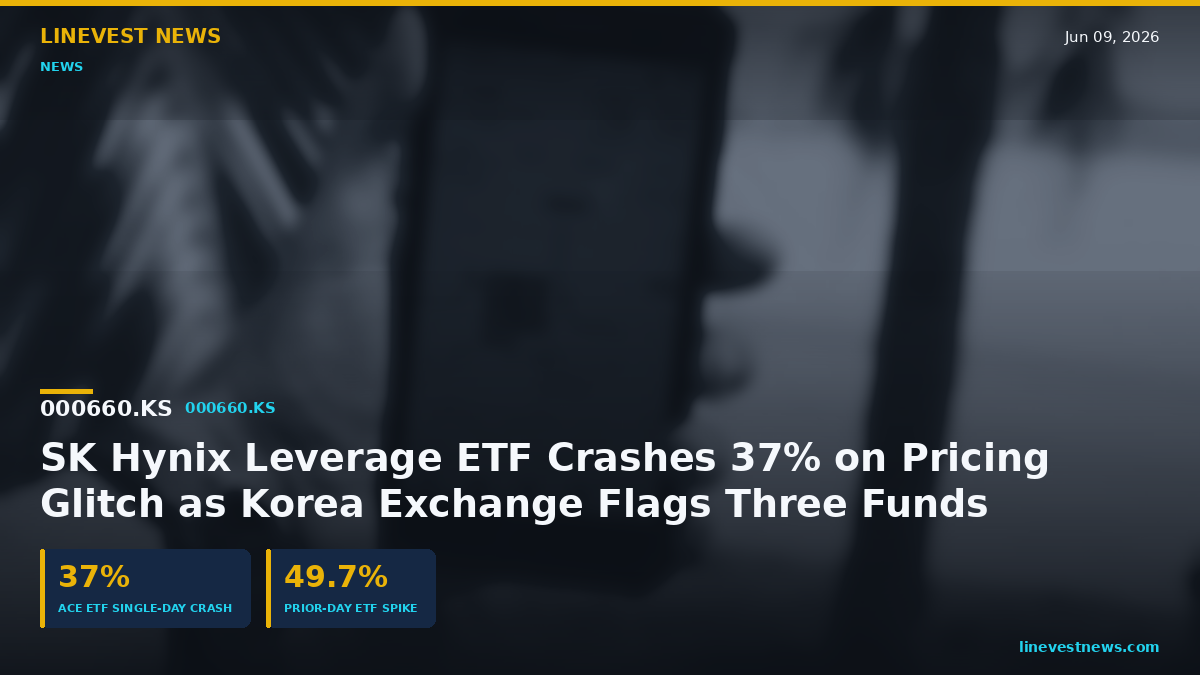
On June 9, the ACE SK Hynix Single-Stock Leverage ETF — a fund built to deliver twice the daily move of SK Hynix, the world's second-largest memory-chip maker — collapsed about 37% in early Seoul trading even as the underlying stock rose roughly 7%. The fund fell ₩11,105 ($7.30) to ₩18,895 ($12) by 9:19 a.m., and slid further toward ₩18,300 (down about 39%) by mid-morning, according to Chosun Biz and Seoul Economic Daily. The drop came one session after the same fund had spiked 49.7% to ₩30,000 ($20) on June 8 — a day SK Hynix itself fell 7.68% (Seoul Economic Daily).
The Korea Exchange (KRX), operator of South Korea's stock and derivatives markets, responded by flagging three SK Hynix-tracking leverage ETFs — the ACE, 1Q (Hana), and Kiwoom versions — as "investment-caution" (투자유의종목) issues, a designation that warns traders of abnormal price action, per Korean exchange disclosures reported across Yonhap and domestic financial press. By midday the ACE fund's price had converged back toward its net asset value, a return to "normal-price" trading — meaning the 37% plunge effectively unwound the prior day's distorted 49.7% jump.
What Broke
Korea Investment Management, the asset manager behind the ACE ETF brand, blamed a market-making glitch. It said that just before the June 8 close, the quotes posted by its liquidity provider (LP) widened sharply — LPs are exempt from their quote-submission obligation during the closing single-price auction — and incoming market-price buy orders were filled into that gap, driving the fund's price far above the value of its holdings (Chosun Biz, Seoul Economic Daily). Other SK Hynix leverage products that did not suffer the same dislocation tracked the stock's rebound normally on June 9, with Mirae Asset's TIGER version up 11.87%, Kiwoom's SK Hynix futures version up 7.96%, RISE up 9.89%, and SOL up 9.34% as of mid-morning trading (Chosun Biz, Seoul Economic Daily).
Sizing the Retail Exposure
Retail appetite for these wrappers — Korea's first single-stock leverage ETFs, listed May 27 — has been outsized. Individual investors net bought ₩2.0845 trillion ($1.36 billion) of Mirae Asset's TIGER SK Hynix Single-Stock Leverage ETF and ₩1.4614 trillion ($0.96 billion) of its TIGER Samsung Electronics version through June 8 — a combined ₩3.55 trillion ($2.3 billion) in just seven trading sessions, Mirae Asset said (Asia Business Daily, ET News). Samsung Electronics is Korea's largest company and top memory-chip maker.
That money has been sitting in a volatile vehicle. Fourteen long single-stock leverage ETFs tracking Samsung and SK Hynix fell an average 26% over the two sessions through June 8, hit by the "negative compounding" decay that erodes 2x daily funds in choppy markets, Seoul Economic Daily reported — because the products reset to double the daily return, holding them across swings can diverge sharply from twice the cumulative move.
A Violent Tape Amplifies the Decay
The underlying swings have been extreme. The KOSPI, South Korea's benchmark index, cratered roughly 8% in a June 8 "Black Monday" chip selloff, then rebounded hard on June 9: it opened up 4.64% at 7,831.77, triggered a buy "sidecar" (a five-minute program-trading halt) after KOSPI 200 futures jumped above threshold, and reached 8,030.25, up 7.29%, by early afternoon (Chosun Biz). The bounce tracked an overnight U.S. chip rally — the Philadelphia Semiconductor Index, a U.S. chip-stock benchmark, rose 5.61%, with Micron up 9.87% and Intel up 11.19% — plus easing Middle East tension after Israel and Iran halted mutual strikes (Chosun Biz). SK Hynix jumped as much as 13% to ₩2.16 million ($1,412) and Samsung 8% to ₩310,000 ($203); the won firmed 5.6 to 1,529.4 per dollar as the National Pension Service, Korea's state pension fund, hedged FX for the first time since the year began (Chosun Biz). For a fund that doubles the daily move, a roughly 14% two-day round trip in the underlying is exactly the setup that magnifies tracking slippage.
A Familiar Korean Pattern
Korea has watched retail crowd into leveraged wrappers before, with painful endings. In 2020, individual investors poured a net ₩380 billion ($314 million) into leveraged WTI crude-oil ETNs in March alone — a near 14-fold jump in two months — according to The Korea Times. As demand detached prices from underlying value, premiums over net asset value at the four issuing brokerages ran between 35.6% and 95.4%, prompting the Financial Supervisory Service (FSS), South Korea's financial regulator, to force scheduled sell-downs of the most-inflated notes from April 13, 2020. Many buyers booked losses because payouts settled on net worth, not the inflated market price.
The Open Question
The near-term tell is what the KRX does with its three caution-flagged SK Hynix funds — and whether it tightens LP quote rules around the closing single-price auction, the specific mechanism the ACE manager blamed. The second is whether the ₩3.55 trillion of retail money in the TIGER products keeps growing or reverses once the index volatility that powered the inflows subsides. Both are observable in KRX disclosures and daily fund-flow data over the coming sessions.
This article is for informational purposes only and does not constitute investment advice. Figures are drawn from the cited sources as of June 9, 2026; current won-to-dollar conversions use the day's rate of about 1,530 won per U.S. dollar, while the 2020 figure reflects that period's exchange rate.