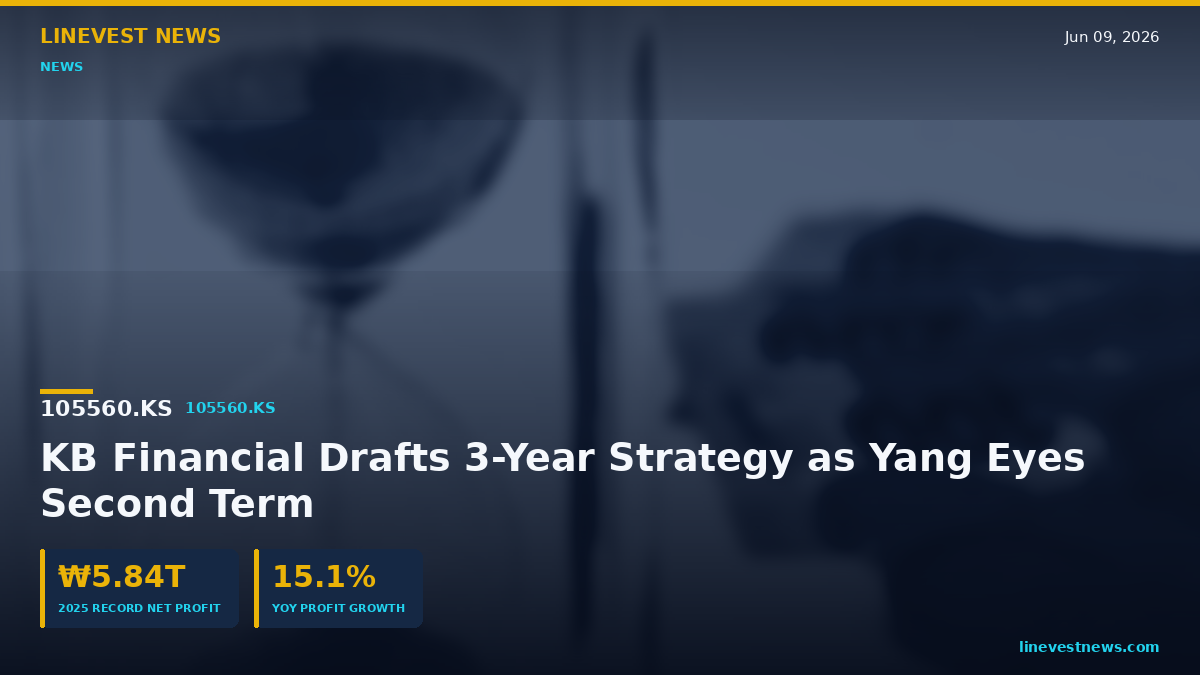
KB Financial Drafts 3-Year Strategy as Yang Eyes Second Term
KB Financial Group, Korea's largest financial holding group by net profit, has begun drafting a fresh mid-to-long-term strategy at the very moment it opens the contest to choose its next chairman — a sequencing that signals leadership continuity rather than a clean break. According to Asia Business Daily (Asiae), the group has been running a "mid-to-long-term management strategy task force" since April 27, framing the next three years as the "golden time" to advance into the top tier of global finance, with the blueprint set to cover business-portfolio restructuring and an overhaul of its profit mix.
The immediate question for any global investor is simple: is the leadership that would execute that plan actually locked in? Incumbent Chairman Yang Jong-hee's term runs out in November 2026 — he took office on November 21, 2023, succeeding nine-year chairman Yoon Jong-kyu — and the board has just started the process to fill the seat.
Why the market treats reappointment as the base case
The numbers under Yang make a continuity case hard to argue against. KB Financial's 2025 net profit hit a record 5.843 trillion won (about USD4.3 billion at 1,370 won to the dollar), up 15.1% year on year, returning the group to the No. 1 spot among Korea's four big financial holdings for the first time in four years, per KED Global's tally of full-year results (KB 5.84tn won, ahead of Shinhan's 4.97tn won, Hana's 4.0tn won and Woori's 3.14tn won). The Korea Herald reports the shareholder return ratio climbed to 52.4% in 2025 from 38% in 2023, with annual returns topping 3 trillion won (roughly USD2.2 billion). Over Yang's tenure the share price has run from around 54,600 won to about 156,600 won — a gain Seoul Economic Daily (Sedaily) puts at 186.8% — lifting market value to roughly 60 trillion won (about USD44 billion). As one financial-sector official told Sedaily, "Based on the numbers, there should be no obstacle to his reappointment."
The timeline that will confirm or refute it
The Chairman Nomination Committee has already cut a longlist of 20 names to 12 — evenly split between six internal and six external contenders, according to the Korea Herald. From here the calendar is concrete: a first shortlist of six is due around July 3, interviews on August 27 narrow the field to three, and a single final candidate is set to emerge after second-round interviews on September 11, followed by committee and board recommendation in early October and a formal vote at an extraordinary shareholders' meeting in November. The July 3 and September 11 dates are the checkpoints that will show whether the contest stays a coronation or turns competitive.
The governance wildcard
What makes this cycle different from 2023 is the regulatory backdrop. Korea's financial authorities are tightening the rules on how holding-company chairs are chosen. The Financial Services Commission (FSC, Korea's top financial regulator) has convened a task force on financial-group governance reform — covering board independence, the fairness of CEO selection and performance-pay design — and is aiming to finalize proposals around March, The Korea Times reports. Separately, the Korea Herald reports that financial authorities are reviewing changes to governance rules, including a proposal to require a special shareholder resolution when a sitting chair seeks reappointment, which would demand approval from at least two-thirds of shareholders present.
The scrutiny is already visible in the ecosystem. On June 9, former KB Financial chairman Yoon Jong-kyu delivered his first external lecture of the year — to incoming outside directors of financial firms, at the Bankers Club in central Seoul — as part of a Korea Banking Institute course, just as the FSC prepares its governance package, according to Asiae. KB's succession is widely viewed in Seoul as the first real-world test of whether the reform drive reshapes how the country's biggest financial groups pick their leaders.
That is the genuine open question. The earnings record points to continuity; the rulebook is being rewritten mid-race. Whether the strategy task force's three-year blueprint is executed by Yang or by a successor will not be settled until the September 11 final selection — and the new governance standards may shape the margin by which it happens.
This article is for informational purposes only and does not constitute investment advice. Figures are sourced from the cited publications; won-to-dollar conversions use an approximate rate of 1,370 won per U.S. dollar and are indicative.
Sources
- https://view.asiae.co.kr/article/2026060907382599076
- https://view.asiae.co.kr/article/2026060908351251811
- https://www.koreaherald.com/article/10762876
- https://www.koreatimes.co.kr/business/banking-finance/20260116/kb-financial-chairman-in-spotlight-as-first-test-of-governance-reform
- https://en.sedaily.com/finance/2026/06/02/kb-financial-begins-ceo-selection-yangs-reappointment-in
- https://www.kedglobal.com/earnings/newsView/ked202602060004