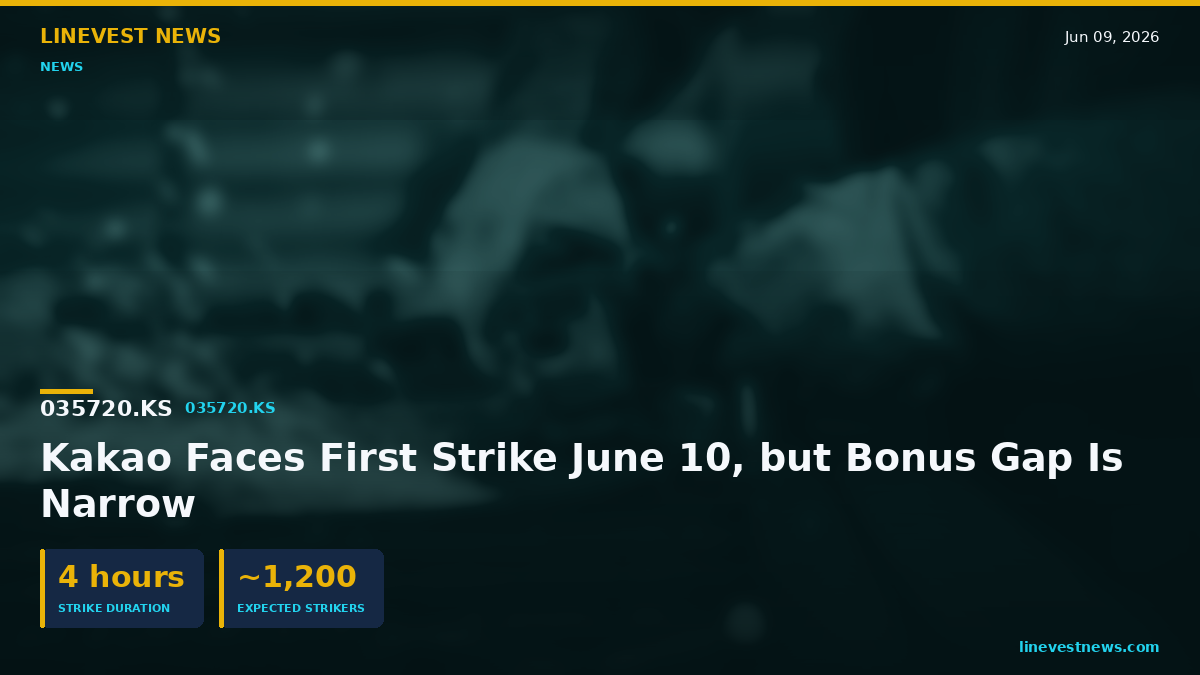
Kakao (035720.KS), the operator of South Korea's dominant KakaoTalk messaging platform, will face the first work stoppage in its corporate history on June 10, when its labor union stages a four-hour partial strike and rally near Pangyo Station in Seongnam, just south of Seoul. Yonhap reports the walkout begins at 10 a.m.; organizers expect roughly 1,200 of the union's more than 4,000 members to take part (Yonhap; The Asia Business Daily).
The headline reads dramatically, but the first question for anyone holding the stock is narrower: does KakaoTalk go dark, and what is actually being fought over? On both counts the answer is more contained than "first-ever strike" suggests.
KakaoTalk is unlikely to go down
The union — the Kakao branch of the Korean Federation of Chemical, Textile and Food Industry Trade Unions, known as Crew Union — deliberately framed June 10 as a partial strike, acknowledging concern about disrupting the app that most Koreans use daily (The Asia Business Daily). KakaoTalk serves roughly 45.6 million of South Korea's 52 million people and underpins logins for Kakao Pay, Kakao T ride-hailing and Kakao Map, so any service interruption carries outsized public weight (TechTimes). Management said it has "prepared a response system" to keep services running (Yonhap). The relevant precedent for a Kakao blackout is not labor at all: an October 2022 fire at a Pangyo data center knocked out 134 affiliated services for more than 11 hours (TechTimes). A four-hour, ~1,200-person rally is a different order of magnitude.
The dispute, sized
The sticking point is the year-end bonus and how restricted stock is counted. Management has offered performance pay equal to 10% of Kakao's 2025 separate (non-consolidated) operating profit of ₩440.2 billion (USD321 million), with a ₩5 million (USD3,650) restricted stock unit (RSU) grant folded into that figure. The union wants 13–14% of the same profit base and wants the ₩5 million RSU paid on top, not counted inside the bonus (Sedaily).
That makes the cash gap modest in corporate terms. Ten percent of ₩440.2 billion is about ₩44 billion (USD32 million); 13–14% is roughly ₩57–62 billion (USD42–45 million). The distance between the two sides — before the RSU treatment — is on the order of ₩13–18 billion (USD9–13 million), against a company that, by trade-press tallies of its 2025 results, posted record revenue of ₩8.0991 trillion (USD5.9 billion) and consolidated operating profit of ₩732 billion (USD534 million), up about 48% year over year.
Why now
The union's argument is one of distribution, not solvency: it contends Kakao delivered its best-ever year while senior executives collected large bonuses and rank-and-file rewards lagged (Sedaily). Beyond pay, the union is demanding a halt to the divestitures, spin-offs and restructuring that have reshaped the group, and stronger job-security guarantees (The Asia Business Daily). Mediation at the Gyeonggi Regional Labor Relations Commission collapsed on May 27 after the two sides failed to narrow differences, which cleared the union's legal right to strike; strike ballots had passed at five affiliates on May 20 (Sedaily; TechTimes).
What to watch
The union has explicitly said it will escalate "depending on circumstances" (The Asia Business Daily), so the open question is whether June 10 stays a one-off four-hour action or hardens into a broader, multi-affiliate walkout that could begin to touch services. The concrete signals to track are whether the two sides return to the table after the rally and whether any of the five strike-authorized affiliates — beyond headquarters — join in. The narrowness of the cash gap argues for a negotiated close; the symbolism of a first-in-history strike argues that neither side wants to blink first.
This article is for informational purposes only and does not constitute investment advice. All figures are sourced as cited; currency conversions use an approximate rate of 1 USD = 1,370 KRW.
Sources
- https://www.yna.co.kr/view/AKR20260609147100017
- https://www.etnews.com/20260609000280
- https://www.mk.co.kr/news/business/12069122
- https://www.asiae.co.kr/en/article/2026060109262132713
- https://www.sedaily.com/article/20049399
- https://www.techtimes.com/articles/316866/20260520/kakao-workers-authorize-strike-five-affiliates-threatening-kakaotalk-service-45-million-users.htm