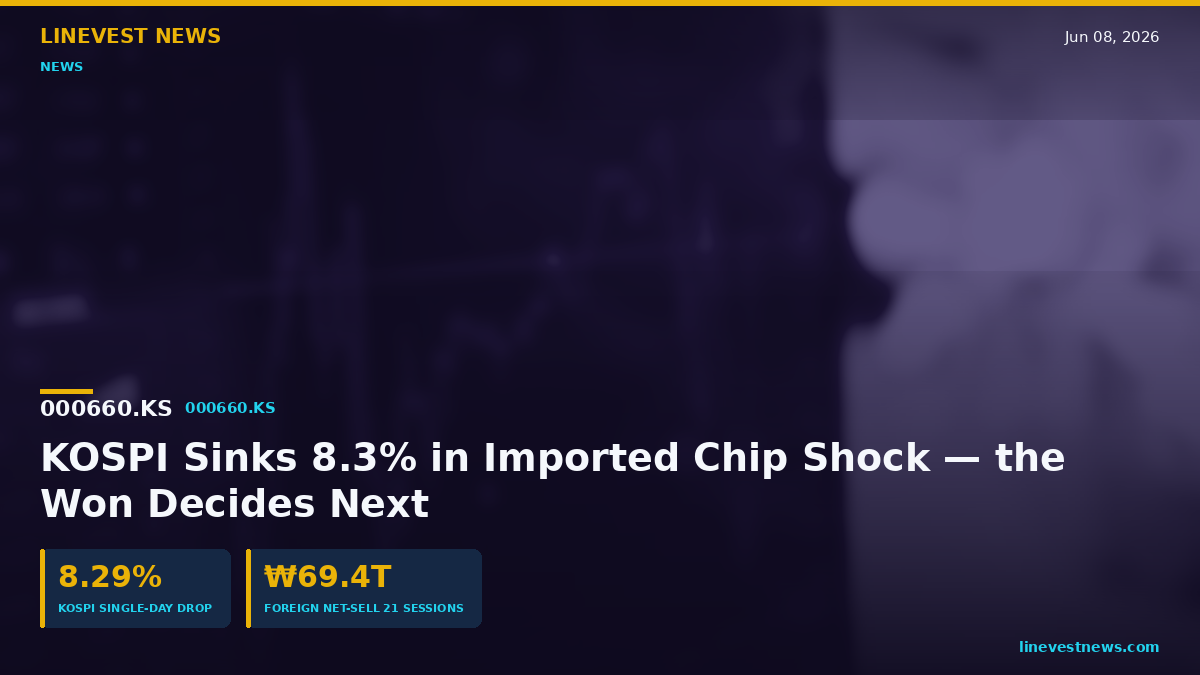
South Korea's benchmark KOSPI closed down 676.18 points, or 8.29%, at 7,484.41 on Monday, June 8, the ninth circuit-breaker trigger in KOSPI history and the second-biggest point drop ever, according to Chosun Biz citing Korea Exchange data. The selloff was violent enough to trip a Level 1 circuit breaker at the open — a 20-minute halt of all trading on the main board after the index fell more than 8% for a full minute — followed by a program-trading "sell sidecar" on the tech-heavy KOSDAQ, per Chosun Biz. Bloomingbit reported it was the third circuit breaker of 2026.
For a portfolio manager in New York or London, the first question is whether this breaks the Korean semiconductor and AI investment case or simply imports a U.S. shock. The evidence points firmly to the latter.
What actually triggered it
The catalyst sat entirely offshore. On Friday in New York the Philadelphia Semiconductor Index plunged about 10.3%, per Bloomingbit — its worst single-day decline in roughly six years — after Broadcom (the U.S. custom-AI-chip designer) guided next-quarter AI semiconductor revenue to roughly $16 billion, below the market's ~$17.2 billion estimate, reviving "AI bubble" fears. Micron Technology, the U.S. memory maker, sank 13.25% on "peak memory cycle" concerns after rising more than 900% over the prior year, while Nvidia fell 6.20% and AMD 10.86%, according to Chosun Biz.
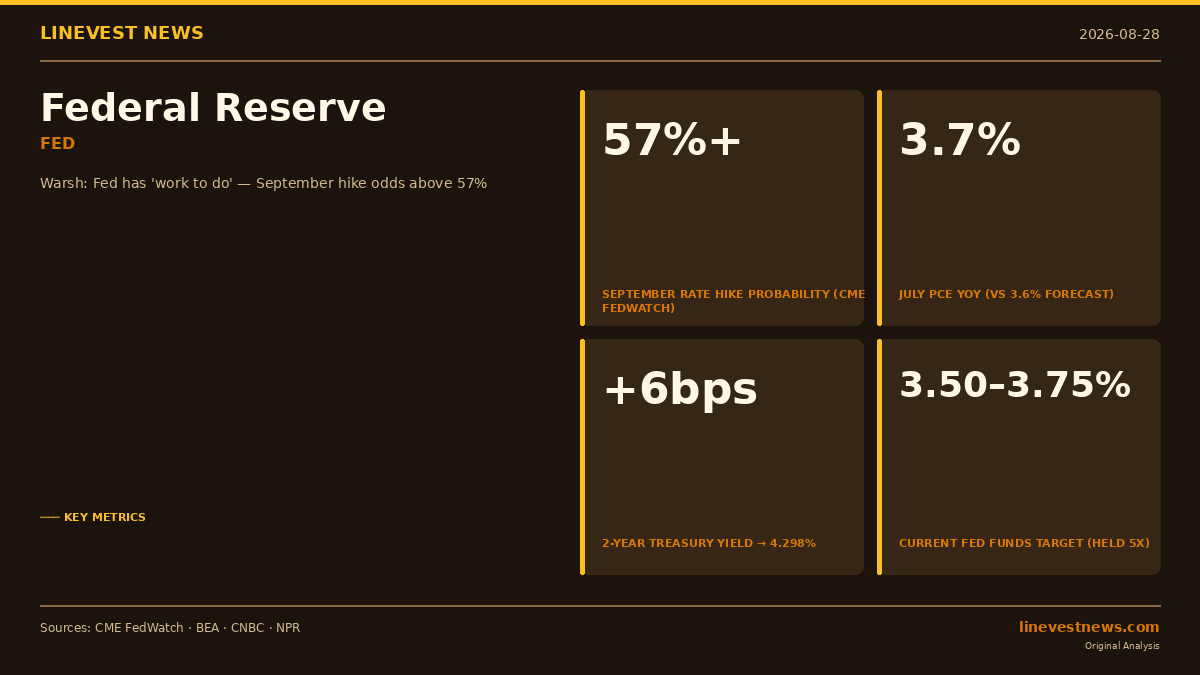
Layered on top was a U.S. rate scare. May nonfarm payrolls came in at 172,000 — more than double the ~85,000 consensus — with April revised up by 64,000, Chosun Biz reported, pushing the U.S. 10-year Treasury yield back to 4.537% and collapsing the market's implied 2026 rate-cut odds toward 1% as traders began pricing one to two Fed hikes. Newsis, citing The Wall Street Journal, noted CME futures put the odds of at least one hike by year-end at 43% (up from 38%) and two-or-more hikes at 27% (up from 12%), and quoted Bridgewater founder Ray Dalio describing the concentration in AI names as "a classic bubble." The same WSJ account noted the Philadelphia index had still gained 73% year-to-date despite shedding more than $1 trillion of market value over two sessions.
Korea's index heavyweights took the brunt: Samsung Electronics (005930.KS) closed down 10.18%, SK Hynix (000660.KS, the world's leading high-bandwidth-memory supplier) down 7.68%, SK Square down 11.13% and Hyundai Motor down 8.73%, per Chosun Biz. Breadth was brutal — just 42 stocks rose while 876 fell.
Sizing the foreign exit — and why it may be misread
The more important structural signal is the flow. Foreign investors have now net-sold the main board for 21 straight sessions, offloading roughly ₩69.4 trillion ($45 billion) since May 7, with domestic individuals absorbing about ₩57.9 trillion ($38 billion) over the same span, according to Chosun Biz. The foreign selling has been concentrated in exactly the two names that led the rally: about ₩3.39 trillion ($2.2 billion) of Samsung Electronics and ₩2.75 trillion ($1.8 billion) of SK Hynix.
Yet two sell-side analysts cited by Chosun Biz argue this is rebalancing, not capitulation. Daishin Securities' Lee Kyung-min noted the foreign ownership share of the KOSPI has actually risen above 39% even as foreigners sold, and Korea Investment & Securities' Yeom Dong-chan said foreigners have net-sold more than ₩100 trillion this year while their ownership ratio still climbed — a mechanical effect of Samsung's and SK Hynix's swelling index weight. Working against the domestic buyers is leverage: KOSPI margin-loan balances hit a record ₩28.3 trillion ($18 billion) as of June 5, with the all-market total at ₩37.8 trillion ($25 billion), per Chosun Biz — a debt load that can force selling if losses deepen.
The swing variable is the currency. The won traded near its weakest level since March 2009, around the 1,535–1,560 range against the dollar, Chosun Biz reported, citing a night-session spike to 1,559 from a 1,537.1 daytime close. Chosun Biz separately flagged that the won's drop since the Middle East conflict ranked third-steepest among 42 currencies the Bank of Korea tracks — weaker even than the Argentine peso — pressured by a Korea–U.S. policy-rate gap of as much as 1.25 percentage points (Korea at 2.5% versus the U.S. 3.50–3.75%). A weak, unstable won keeps foreign capital away regardless of how cheap equities look.
The historical frame, and the same-day bull case
Monday's drop is severe but not unprecedented. Chosun Biz noted the record single-day decline was March 4, 2026's 12.06% (the U.S.–Iran war shock), and the list includes the August 5, 2024 "yen-carry" unwind at 8.77% — an episode the market clawed back within weeks. Each of those was an externally-driven liquidity event rather than a domestic earnings break.
Striking, too, was what rose during the rout: NAVER (035420.KS) jumped about 11% and SK Telecom about 3% intraday on Nvidia-partnership optimism, per Chosun Biz — the opposite of a market giving up on AI. And in Seoul the very same day, Nvidia CEO Jensen Huang called the selloff "noise" and declared "Korea's Moment," telling reporters at the Shilla Hotel that the market reaction to recent results was "wrong," per Chosun Biz. Huang said Nvidia plans a 200-megawatt AI cloud with NAVER, scaling toward gigawatt class — though neither side disclosed a dollar figure, per Chosun Biz — and that SK Hynix's plan to double capacity by 2030 "may not be enough." Reinforcing that demand signal, SK Hynix placed a ₩44.2 billion ($29 million) order for TC bonder equipment with Hanmi Semiconductor (042700.KQ, a Korean HBM packaging-tool maker) to begin HBM4 capacity expansion, according to Hankyung and ETNews.
The open question
The data point that confirms or refutes a quick recovery is the won. If it stabilizes well below the ~1,500 line, the rebalancing-not-exit thesis from Daishin and Korea Investment holds and the leverage overhang stays contained; if it pushes back toward the 1,560 highs, forced deleveraging by record margin balances becomes the tail risk. The next read on the chip cycle itself — upcoming memory-maker guidance and SK Hynix's HBM4 ramp progress — will show whether Broadcom's miss was company-specific or the start of the "peak memory" the bears fear.
This article is for informational purposes only and does not constitute investment advice. Figures are sourced from Chosun Biz, Newsis, Hankyung, ETNews and Bloomingbit as cited; currency conversions use an approximate rate of 1,540 won per U.S. dollar and are indicative only.