South Korea's currency has slid to its weakest level since the global financial crisis, the visible cost of the heaviest foreign exodus from Korean equities on record. The won closed at 1,535.0 per dollar on June 8, up 4.1 won on the day but only after touching 1,560 in night trading on June 6 — a level last seen in March 2009, according to Newsis and The Korea Times. The question for any global manager watching from New York or London is blunt: is this the early stage of a balance-of-payments crisis, or a portfolio rebalance with a floor in sight?
The numbers behind the move
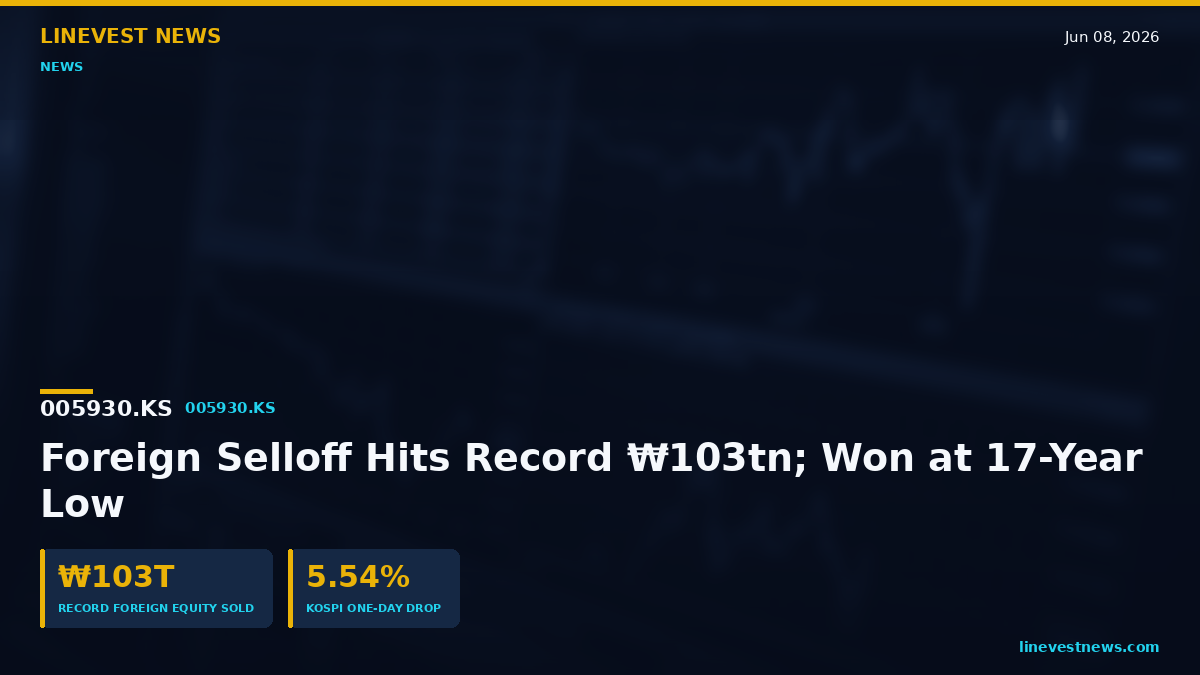
Foreign investors net sold a record 103.25 trillion won (about USD 67 billion) of stock on the KOSPI — Korea's benchmark equity index — in the year through June 2, Seoul Economic Daily reported, citing exchange data. That dwarfs the 62 trillion won (USD 40 billion) dumped during the 2007–08 financial crisis and the 25 trillion won (USD 16 billion) sold in the 2020 pandemic shock. The selling has been relentless and recent: foreigners were net sellers for 20 straight sessions, offloading roughly 70 trillion won (USD 46 billion) through June 5, including 3.52 trillion won (USD 2.3 billion) on that Friday alone, per The Korea Times.
What makes the outflow unusual is its backdrop. The KOSPI set an all-time high of 8,933.62 earlier in the year before sliding; it closed at 8,160.59 on June 5, a 5.54% one-day drop that triggered the year's tenth "sidecar" program-trading curb, The Korea Times reported. In other words, foreigners are selling into a market that had already roughly doubled, not fleeing a collapse.
Crisis or rebalance?
Seoul's official line is that this is the latter. President Lee Jae-myung, South Korea's head of state, told a first-anniversary news conference on June 8 that the won's spike is "high but temporary," arguing that foreign funds had simply grown over-weighted in a market that rallied too fast and "will eventually find balance," per Newsis. Korea's Ministry of Economy and Finance (MOEF) and the Bank of Korea, the country's central bank, issued a joint warning that they "will never tolerate excessive volatility and one-directional movements that deviate from fundamentals," according to Newsis.
The government's core argument is that the plumbing of a crisis is absent. Unlike 1997 or 2008, when dollar liquidity evaporated, Korea is running a record current-account surplus that keeps dollars plentiful, officials told Newsis. Analysts cited by Seoul Economic Daily framed the selling as automatic portfolio rebalancing rather than pessimism, noting that while the absolute won figure is a record, as a share of KOSPI market capitalization it is smaller than the foreign net selling seen in 2020–2022.
Where the floor might be
The most concrete evidence for the "rebalance" thesis sits in the ownership data for Korea's two chip giants. Foreign ownership of Samsung Electronics (005930.KS), the world's largest memory-chip maker, has fallen from 52.3% to 47.8%, while foreign holdings of SK Hynix, Korea's second-largest chipmaker and a leading high-bandwidth-memory supplier, have eased from 53.8% to 51.3%, Newsis reported. Because so much foreign weight in these index heavyweights has already been unwound, officials argue the remaining overhang of forced selling is limited — and they note fresh foreign money has begun rotating into names outside the two chipmakers.
Notably, foreign net selling through June 8 had reached 77.6 trillion won (about USD 51 billion) over the trailing 20 days as the won moved from 1,454 to 1,539, per Newsis — a larger cumulative tally than the June-5 figure, confirming the outflow kept building even as authorities leaned against it.
The domestic counter-bid
While foreigners sell, domestic brokerages are raising price targets, a tension worth flagging. NH Investment & Securities, a major Korean brokerage, lifted its Samsung Electronics target to 530,000 won (USD 345) from 490,000 won (USD 319) on June 8 and kept a "buy" rating, citing entry into what it called an "agentic AI diffusion cycle" and a forward valuation of 5.9x earnings versus 9.1x for U.S. rival Micron, per Asia Economy. Separately, Hana Securities raised its target on Samsung C&T, the Samsung group's de facto holding and construction arm, to 650,000 won (USD 424) from 600,000 won (USD 391), arguing the stock trades at just 0.7x book even before crediting its nuclear, solar and affiliate-investment exposure, Asia Economy reported.
What to watch
Korean authorities had delivered four rounds of verbal intervention through June 5 with limited effect, The Korea Times reported, and the National Pension Service — one of the world's largest state pension funds — has resumed forward-dollar selling as part of an expanded overseas-hedging framework, a flow that adds downward pressure on the won, per Newsis. The June 8 verbal intervention raised market expectations that officials could move from words to actual dollar sales. The near-term confirmation point is straightforward: whether the daily foreign net-selling figure decelerates over the coming sessions and whether the won holds below the 1,560 night-session peak. A break of that level despite intervention would test the "temporary" thesis; a stabilization would support it.
This article is for informational purposes only and does not constitute investment advice. Figures are sourced from Newsis, The Korea Times, Seoul Economic Daily and Asia Economy as cited; currency conversions use an approximate rate of 1 USD = 1,535 KRW, the prevailing June 8 level. Readers should conduct their own research before making any financial decision.