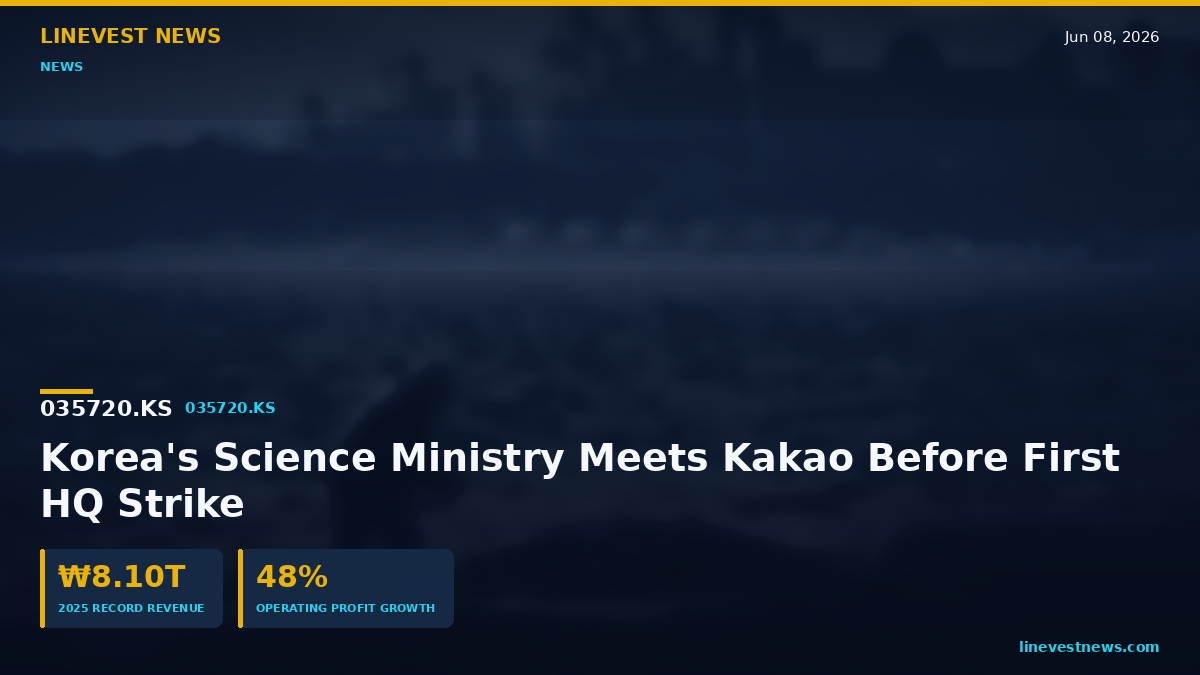
South Korea's tech ministry pulled Kakao Corp. (035720.KS), the operator of the dominant messaging app KakaoTalk, into an emergency meeting on Monday — an unusual move for a four-hour walkout. The intervention says less about the strike's scale than about what Kakao now is to the country: a piece of national infrastructure that the government cannot let wobble.
MSIT, Korea's Ministry of Science and ICT, met Kakao officials in Sejong on June 8 to "ensure stable operations" of KakaoTalk and KakaoMap ahead of a planned partial strike, with both sides agreeing to a cooperative framework for prompt response and information sharing in the event of a service disruption, the ministry said (Korea Times; Yonhap).
What is actually happening on June 10
Kakao's union, the Crew Union, has called a four-hour partial strike and a rally in Pangyo — the Gyeonggi-province tech cluster south of Seoul that houses Kakao's headquarters — on June 10, after wage mediation collapsed (The Asia Business Daily; The Elec). The Gyeonggi Regional Labor Relations Commission terminated mediation following a second session on May 27, when labor and management failed to narrow their differences (The Asia Business Daily).
The choice of a limited walkout is deliberate. The union opted for a partial strike rather than a full one specifically out of concern over disrupting KakaoTalk, according to reporting on its rationale (The Asia Business Daily). In other words, the action is designed not to knock out the service the government is worried about.
That caution is well-founded. KakaoTalk had roughly 48.9 million monthly active users in 2025 — close to Korea's entire population — with market share estimated near 97% (Statista). Korea also has a live memory of what a Kakao outage feels like: a 2022 fire at a data center hosting Kakao servers took KakaoTalk and linked services offline for hours and triggered a national outcry and regulatory scrutiny. Monday's pre-emptive ministry meeting reads against that backdrop.
The money in dispute
The fight is over how Kakao splits a record year. The company posted 2025 revenue of about ₩8.10 trillion ($5.91 billion) — its first year above ₩8 trillion — and operating profit of roughly ₩732 billion ($534 million), up about 48% year-on-year (Telecompaper; BigGo Finance, citing Kakao results). The union has demanded performance pay equivalent to 13–15% of last year's operating profit (Seoul Economic Daily). Applied to ₩732 billion, that demand works out to roughly ₩95–110 billion ($69–80 million) — a figure Kakao says would place a substantial burden on management relative to its profit level (The Elec).
The union argues executives captured the upside: it says short-term performance bonuses of up to 150% went only to executives while the rank-and-file bonus pool shrank, despite the record results (Seoul Economic Daily). A separate sticking point is whether restricted stock units count as part of performance bonuses — management says yes, the union says RSUs are separate (per reporting on the negotiation terms).
Why this is bigger than four hours
The walkout would be the first strike at Kakao's headquarters since the company's founding; only Kakao Mobility, an affiliate, has previously struck, with a two-hour partial stoppage in June 2025 (Seoul Economic Daily). Five entities are involved in the current action — Kakao headquarters, Kakao Pay, Kakao Enterprise, DK Techin and XL Games (Seoul Economic Daily). Korean media estimate about 1,200 union members across the affiliates will join the rally (Herald Business and other Korean outlets).
The union has signaled it will escalate the intensity of its action depending on how talks progress (The Asia Business Daily). That makes the June 10 walkout less an endpoint than a first move — and the reason a four-hour stoppage warranted a ministry sit-down.
What to watch
The near-term signal is whether last-ditch talks before June 10 produce a deal or the strike proceeds as planned, and — critically — whether the union holds to its stated intent to keep KakaoTalk running. Beyond that, the union's escalation language is the variable: a move from a four-hour partial action toward a longer or full stoppage would change the operational risk calculus that drove Monday's government meeting in the first place.
This article is for informational purposes only and does not constitute investment advice. Figures are sourced from cited reporting; currency conversions use an approximate rate of 1 USD = 1,370 KRW.