Greater Seoul's ready-mix concrete delivery network stopped on the morning of June 8, 2026, and the question for anyone holding Korean chip names is narrow: does this actually threaten the construction timelines at Samsung Electronics' Pyeongtaek campus and SK Hynix's Yongin cluster, or is it another labor scuffle that clears in days?
What stopped, and how big it is
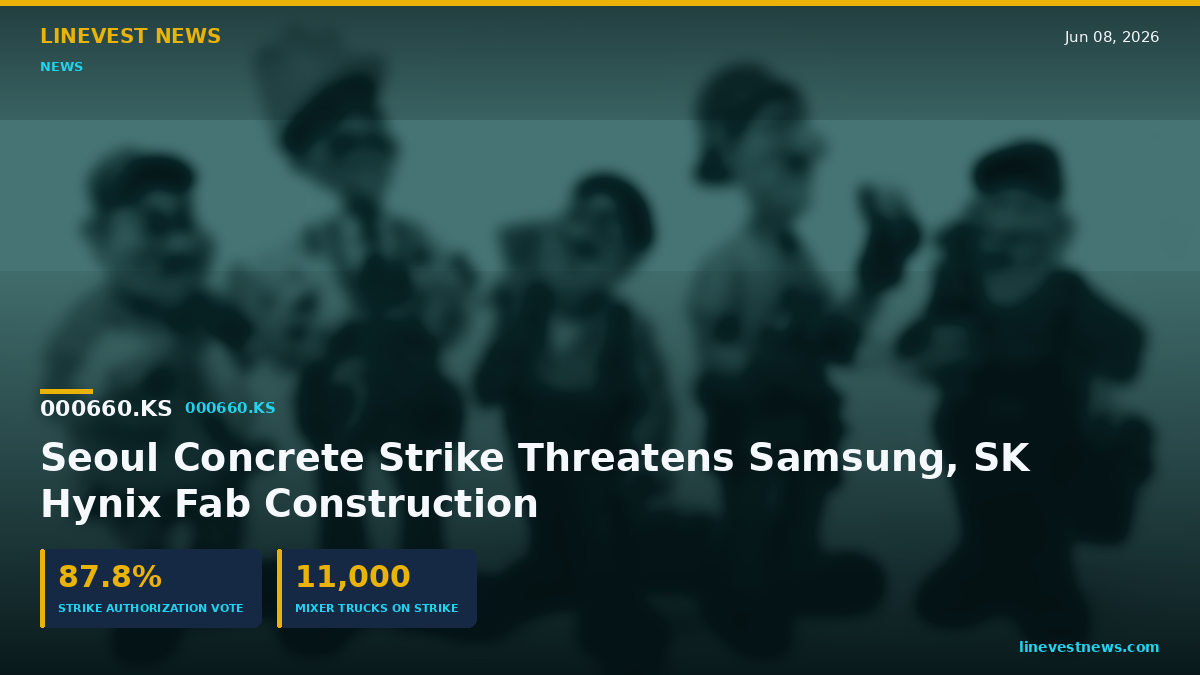
The National Ready-Mix Concrete Transport Union (Jeonunryeon, an affiliate of the Federation of Korean Trade Unions) began a full work stoppage at 8 a.m. on June 8 across Seoul, Gyeonggi and Incheon. Roughly 8,000 union drivers and about 11,000 mixer trucks are taking part, according to the union's own count cited by Newsis and Chosun Biz, with a rally held at Yeouido Plaza in Seoul. A strike-authorization vote passed with 87.8% in favor.
Ready-mix concrete ("remicon") cannot be stockpiled — it must be poured shortly after it is batched — so a halt in delivery is effectively a halt in supply.
Why the chip fabs are named
Manufacturers themselves warned the stoppage would "inevitably disrupt processes at semiconductor facilities such as those of Samsung Electronics and SK Hynix," per Seoul Economic Daily. Samsung Electronics (005930.KS), Korea's largest chipmaker, is still building out its Pyeongtaek campus in Gyeonggi, while SK Hynix (000660.KS), the world's second-largest memory maker and the leading high-bandwidth-memory supplier, is constructing its Yongin semiconductor cluster — both large, concrete-intensive sites in the affected region.
As of June 8, no source has confirmed an actual stoppage at either fab site. Chosun Biz reported that no site-wide work halts had yet been observed.
The number that frames the fight
The dispute is about a per-trip haulage fee that has climbed from ₩51,500 (about 8) per trip in 2020 to ₩75,730 (5) in 2025 — roughly a 47% increase over five years, per Aju Business Daily. The Daejeon region recently settled at ₩81,000 (9) per trip; the capital-area rate clearing ₩80,000 is the figure to watch.
The precedent — and what is different now
History argues for a quick resolution. When Greater Seoul drivers walked out on July 1, 2022, the dispute was sealed in two days at a 24.5% fee increase. A 2024 work stoppage was also withdrawn quickly.
What is structurally different in 2026 is the union's legal footing. The Seoul Administrative Court recognized the drivers' worker status under the Trade Union Act in February 2026, and the Ministry of Employment and Labor issued a nationwide union-establishment certificate in March. Manufacturers still classify mixer-truck drivers as independent operators and refuse collective bargaining.
What to watch
The near-term tell is duration. Builders can reorder pours and tap non-union volumes for a short window, but schedule slippage becomes unavoidable if the halt drags on. The specific data points: whether the capital-area per-trip fee settles above or below ₩80,000, whether the two sides agree to unified bargaining, and any confirmation of an actual pour stoppage at Pyeongtaek or Yongin.
This article is for informational purposes only and does not constitute investment advice. Currency conversions use approximately 1 USD = 1,370 KRW.