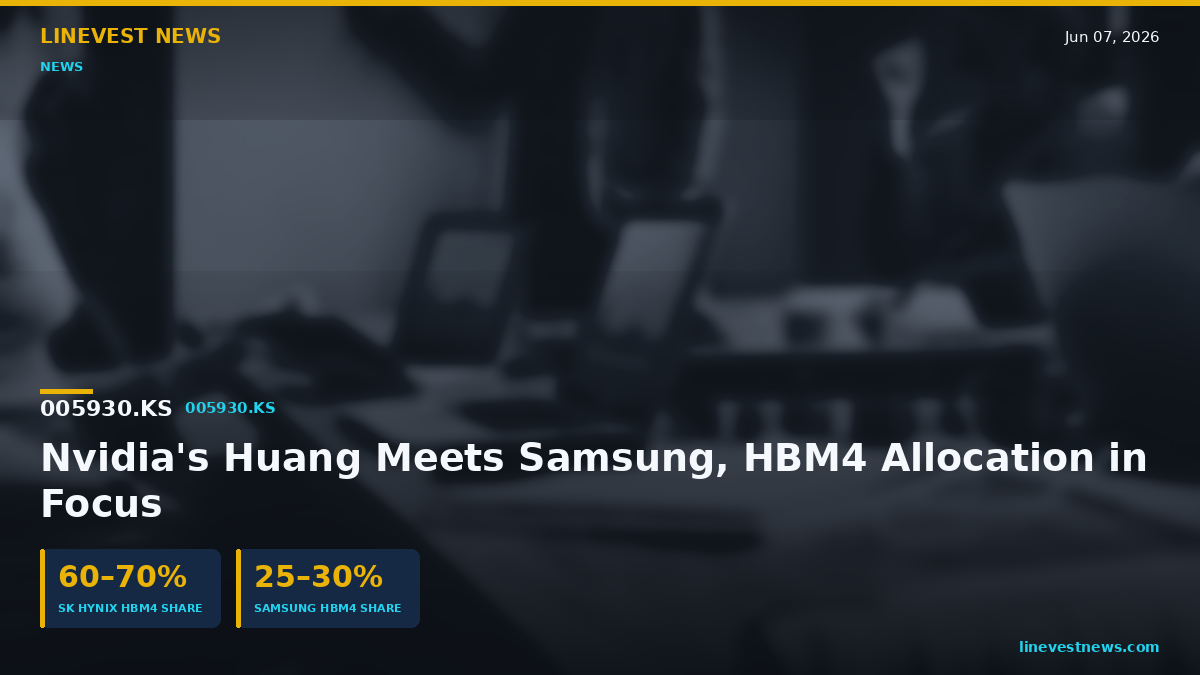
Nvidia chief executive Jensen Huang spent the first week of June working his way through the chairmen of Korea's largest conglomerates, and the meeting that matters most for the memory market comes last. According to Korea's Hankyung (a Seoul financial daily), Huang is scheduled to sit down on the morning of June 8 with Jeon Young-hyun, the vice chairman who runs the chip business at Samsung Electronics (005930.KS), the world's largest memory maker, at a venue near the Shilla Hotel in central Seoul. Hankyung reports the agenda is HBM4 supply scheduling and long-term memory contracts for Nvidia's next-generation "Vera Rubin" AI accelerator, with Huang framing the trip's purpose as "coordinating supply chains."
The single question a fund manager asks on seeing this: with all three memory makers now cleared to ship, is Samsung actually closing the HBM4 gap on SK Hynix (000660.KS), or is the incumbent's roughly two-thirds lead holding?
What the meetings are really about
The timing is not coincidental. Tech Times reported that on June 5 Huang confirmed Samsung, SK Hynix and Micron had all passed certification to supply HBM4 — the stacked high-bandwidth memory that feeds Nvidia's GPUs — for the Vera Rubin platform, with shipments slated to begin in the third quarter of 2026. An earlier Tech Times report named AWS, Google Cloud, Microsoft Azure and Oracle among the first cloud providers confirmed for early Vera Rubin deployment. Certification clears all three to ship; it does not equalize how much each ships.
The allocation is where the lead sits. Supply-chain analysts cited by Tech Times put SK Hynix at roughly 60–70% of Vera Rubin's HBM4 volume, Samsung at about 25–30%, and Micron taking the remainder. That tracks with earlier reporting from TrendForce (a Taiwan-based memory research firm), which in January 2026 said SK Hynix's share was "close to 70%" — up from an earlier expectation of just over 50% — while Samsung was "poised to begin official HBM4 shipments" in February 2026 and was expected to hold over 30% of the global HBM market this year. TrendForce also reported that 12-layer HBM4 parts are expected to price above $600 each and that SK Hynix and Samsung would supply Nvidia at comparable prices.
Read together, that is the substance behind the handshake photos: Samsung is in the supply chain, but as the smaller of the two Korean suppliers, and Huang's stop at Jeon's table is a negotiation over how much of the gap Samsung can claw back as Vera Rubin ramps.
The conglomerate circuit
The Samsung meeting caps a week of high-profile sit-downs. Korean media including Edaily and Heraldcorp reported that on June 7 Huang met Chung Euisun, chairman of Hyundai Motor Group (Korea's largest automaker), around 11:50 a.m. for Pyongyang naengmyeon (cold buckwheat noodles) at Woolaeok, a long-running restaurant on Eulji-ro in Seoul's Jung-gu district. Korea's ETNews reported he then threw the ceremonial first pitch at a professional baseball game at Jamsil Stadium at 5 p.m. and dined that evening with Chey Tae-won, chairman of SK Group — parent of SK Hynix — at the Gangnam branch of Kkanbu Chicken, a fried-chicken chain. ETNews notes the chicken restaurant is the same spot where Huang gathered with Chung and Samsung chairman Lee Jae-yong during his October 2025 Korea visit, the so-called "Kkanbu meeting." Huang is also due to visit Hyundai's Yangjae headquarters on June 8, per ETNews.
Precedent: the last visit moved the smaller name more
The market has a recent template for how it reads a Huang visit. Hana Securities analyst Kim Doo-eon, cited by Seoul Economic Daily, noted that around Huang's October 2025 trip SK Hynix shares rose 22% between the visit's announcement and the meeting, while Samsung gained 6.3% over the same window. Kim's framing was that the durable value lies in recurring revenue inside Nvidia's ecosystem rather than the symbolism of a meeting — an observation, not a recommendation. The gap in those two moves is itself a reminder that the HBM trade has rewarded SK Hynix's allocation lead.
Sizing it
The stakes are concentrated in the HBM franchise. If Samsung holds the 25–30% Vera Rubin share that analysts cited by Tech Times describe, against SK Hynix's 60–70%, the immediate prize from this visit is incremental: scheduling and volume commitments that could nudge Samsung's slice upward over the Vera Rubin cycle rather than reorder the standings outright. Huang underscored the demand backdrop on June 2, walking up to SK Hynix's Computex booth and writing "Please Make More" on an HBM4E wafer — a public nudge to his top memory supplier that semiconductor supply remains tight, Tech Times reported. Nvidia also announced it is hiring for its first Korean R&D center, focused on physical AI and robotics, Tech Times reported — a sign the Seoul relationship extends beyond this quarter's memory orders.
The open question
Certification and a meeting do not settle the allocation. The figures that confirm or refute whether Samsung is narrowing the gap will land in the upcoming quarterly results from both companies' chip divisions and in third-quarter Vera Rubin shipment data, when actual HBM4 volumes — not analyst estimates — become visible. Until then, the photos from Seoul show access; the income statements will show share.
This article is for informational purposes only and does not constitute investment advice. Figures attributed to analysts and news outlets are estimates and reporting as of early June 2026 and may be revised.