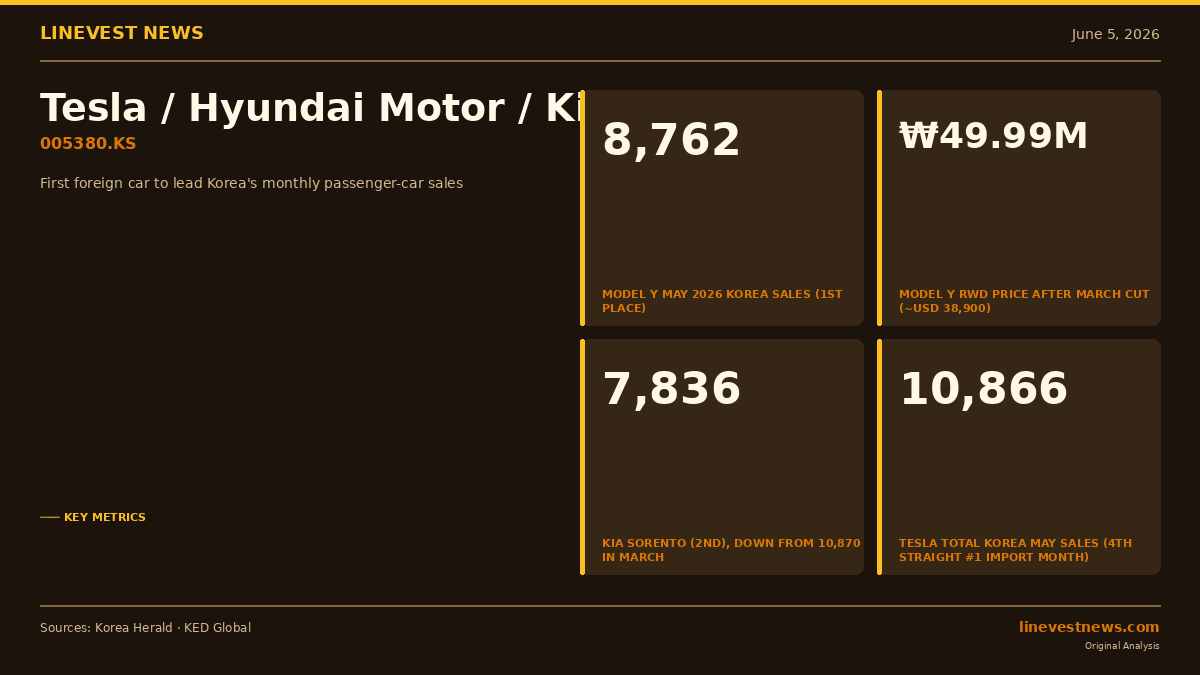
Tesla's Model Y sold 8,762 vehicles in South Korea in May — enough to lead the country's monthly passenger-car rankings for the first time in history, according to data released Friday by the Korea Automobile Importers and Distributors Association.
The result, driven by an aggressive March price cut and a fourth-consecutive month of record Tesla Korea imports, hands a U.S. brand a milestone long thought unreachable in one of Asia's most entrenched domestic auto markets. Kia's Sorento fell to second at 7,836 units; Hyundai's Grandeur ranked third at 5,183; Kia's Sportage and Carnival placed fourth and fifth at 4,760 and 4,543, respectively.
The Price Is the Story
Tesla trimmed the Model Y Rear-Wheel-Drive from ₩52.99 million to ₩49.99 million (approximately USD 38,900) in March, punching below a psychological price threshold that Korean buyers historically reserved for domestic premium sedans. Layered with government EV subsidies, real out-of-pocket costs can fall into the ₩40 million range — a zone once dominated by Hyundai and Kia's core lineups.
Tesla's total Korea sales in May reached 10,866 vehicles, extending its run as the country's best-selling imported-car brand to four consecutive months. The company surpassed 10,000 monthly deliveries in Korea for the first time in March 2026.
Domestic Brands Losing Ground at Home
The Sorento's retreat is telling: the model sold 10,870 units as recently as March before sliding in April and settling at 7,836 in May. The Grandeur followed a similar arc, falling from 7,574 in March to 6,622 in April and 5,183 in May. Both declines track the period after Tesla's price revision, though Korea's broader cooling of gasoline-vehicle demand — amid elevated fuel costs — is also a factor.
Hyundai Motor (005380.KS) and Kia (000270.KS) remain dominant in aggregate Korean auto market share, and their combined EV offensive across North America and Europe continues to underpin consensus analyst targets. Yet the domestic monthly ranking, while not a direct proxy for margins, carries symbolic weight: Korean consumers have historically been among the most brand-loyal to domestic automakers globally.
BYD recorded 1,032 Korea sales in May — modest against Tesla's tally but part of a widening Chinese-EV competitive front that compounds the challenge for Hyundai and Kia at the lower end of the price spectrum.
Subsidies and the Road Ahead
Korea's EV subsidy regime is widely expected to face phased adjustments from late 2026, which could narrow the effective price gap that Tesla currently exploits. Whether May marks a structural reversal or a subsidy-amplified inflection point may depend heavily on how Seoul calibrates future incentives.
For now, the monthly sales chart tells a clear story: in a market long defined by domestic dominance, a foreign nameplate — for the first time — stands at the top.