Nvidia CEO Jensen Huang spent the evening of June 5 grilling pork belly in a Hongdae barbecue joint with three of Korea's most powerful businessmen, toasting "Go Korea, Go SK, Go LG, Go Naver" and handing snack packs to a crowd of roughly 1,000 onlookers (Chosun Biz, June 5). The spectacle was deliberate. The signal underneath it is what matters to anyone holding Korean memory stocks: with Nvidia's next-generation Vera Rubin platform now in full production, all three of the world's HBM makers have been qualified to supply its HBM4 memory — and the question is how the volume splits.
What actually happened
Huang arrived at Gimpo International Airport on the afternoon of June 5, his first Korea trip in about seven months following the October 2025 APEC summit in Gyeongju (Seoul Economic Daily, June 4). That evening he dined at a samgyeopsal restaurant named Hyungnim Jeoyo near Hongik University in Mapo-gu, western Seoul, with Chey Tae-won, chairman of SK Group — the parent of memory maker SK hynix (000660.KS); Koo Kwang-mo, chairman of LG Group; and Lee Hae-jin, founder of Naver, Korea's dominant search-and-internet group (The Korea Times, June 5).
The theatrics were heavy. Chey taught Huang to wrap pork belly in perilla leaves; Koo, the youngest of the group, worked the grill tongs; and the four handed out twisted donuts and "HBM Chips" — a Honey Banana Mat corn-chip snack co-developed by convenience chain Seven Eleven Korea and SK hynix — to fans chanting Huang's name (Chosun Biz, June 5). A 180-gram serving of the samgyeopsal runs 14,000 won (about $10).
The signal beneath the snacks
Strip away the barbecue and the substance is a memory-demand story. At his GTC Taipei keynote on June 1, Huang said the Vera Rubin AI platform has reached full production (The Next Web, June 1), with customer shipments slated for the third quarter of 2026 (TechTimes, June 5). In Seoul he confirmed that all three HBM4 suppliers are cleared to ship: "All three vendors have been qualified. All three vendors are in production, and they're all racing to support Vera Rubin" (TechTimes, June 5). The named suppliers are SK hynix, Samsung Electronics (005930.KS) — Korea's largest chipmaker — and U.S.-based Micron Technology (MU).
Huang also walked the dinner table through Nvidia's other launches this week — the Vera CPU, the RTX Spark Windows AI superchip built with MediaTek, and the Jetson Thor robotics computer — all of which lean on large amounts of HBM or low-power LPDDR memory (Chosun Biz, June 5; The Korea Times, June 5). His framing of the customers in the room was blunt: "LG, SK hynix, Samsung, Naver — we are all booming."
How big is the prize, and who gets it
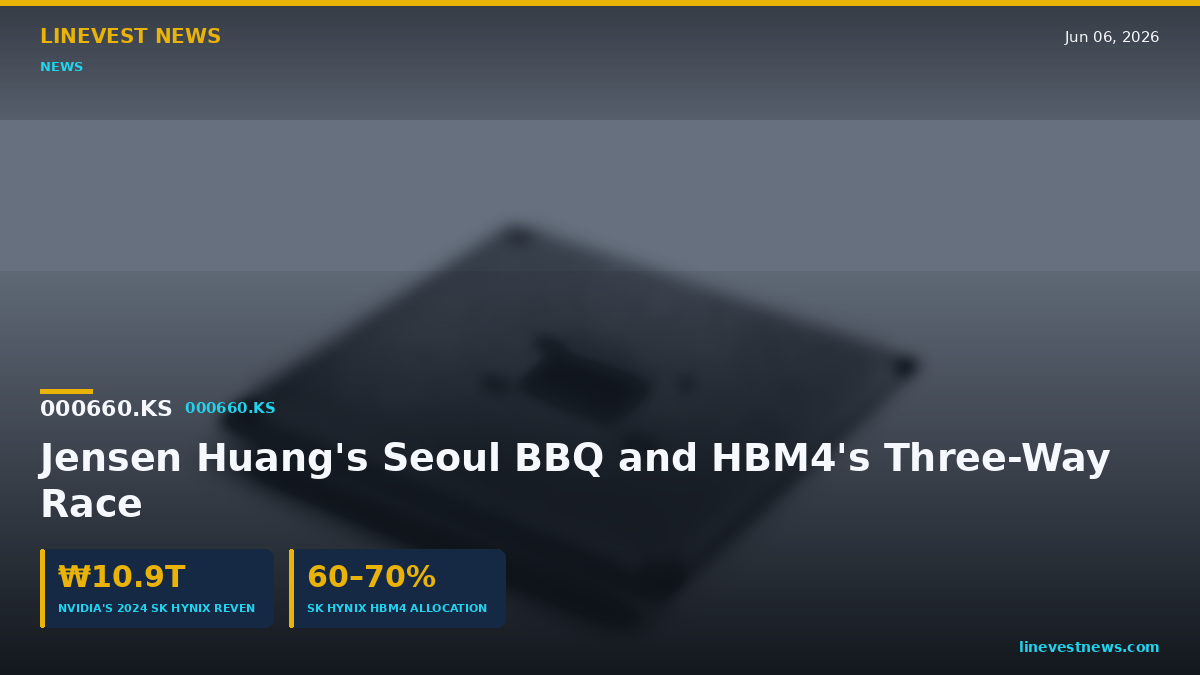
Nvidia does not publish allocation figures, but industry analysts cited by TechTimes (June 5) estimate SK hynix holds roughly 60–70% of allocated HBM4 volume for Vera Rubin, Samsung 25–30%, and Micron the remainder. That split, if it holds, would preserve the dominance SK hynix built in the prior generation rather than expand it.
The scale of Nvidia as a customer is already concrete for SK hynix. In 2024, Nvidia contributed roughly 10.9 trillion won (about $8 billion), or 16% of SK hynix's total sales (CNBC, Oct. 29, 2025), and TrendForce estimated Nvidia drove about 27% of SK hynix revenue in the first half of 2025. SK hynix said in October 2025 it had already sold out its 2026 memory output (CNBC, Oct. 29, 2025). Huang reinforced the trajectory in Seoul, telling reporters the second half of 2026 would be a "considerably larger" production ramp than the first, with 2027 larger still (TechTimes, June 5).
The precedent that frames the risk
The reason the three-way qualification matters is that the last cycle was a near-monopoly. SK hynix was effectively Nvidia's sole HBM3 supplier through 2023–2024 and began mass-producing HBM3E in March 2024, while Samsung and Micron spent that year still working through Nvidia's qualification process (Blocks & Files, April 2024). HBM4 changes the starting line: Samsung and Micron arrive qualified at launch rather than chasing certification months later. Whether that erodes SK hynix's share or simply rides a bigger pie is the open question the allocation data over the next two quarters will answer.
Not just chips
The visit carried other Korea-specific commitments. Huang said Nvidia has begun hiring for an R&D center in Korea — likely in Seoul — focused on physical AI, robotics and AI-infrastructure work: "As soon as we have enough people here, we'll build a site" (The Korea Times, June 5). Naver Cloud, the cloud arm of Naver, expanded its alliance with Nvidia at GTC Taipei into a Global AI Factory partnership (UPI, June 2), building on an October 2025 MOU around the Omniverse and Isaac Sim physical-AI platforms (The Korea Times, June 5). LG Electronics is developing humanoid robots on Nvidia platforms, and Hyundai Motor Group — absent from some accounts of the dinner but a partner since an October 2025 MOU — continues robotics collaboration with the chipmaker. SK Telecom, meanwhile, was named a strategic partner for Nvidia's AI-RAN 6G effort during the GTC Taipei keynote (Chosun Biz, June 5).
Chey's broader play is a "triangle alliance" linking SK hynix, Nvidia and TSMC (TSM), the world's largest contract chipmaker; Chey met TSMC chairman C.C. Wei in Taiwan on June 3 to discuss AI-chip technical cooperation (Chosun Biz, June 5). Chey and Huang have now met six times in seven months.
What to watch
The confirmation point is not the next photo op but the Q3 2026 Vera Rubin shipment ramp and the first allocation disclosures that accompany Korean memory makers' third-quarter earnings — the data that will show whether HBM4's open field narrows SK hynix's lead or leaves it intact.
This article is for informational purposes only and does not constitute investment advice. Figures are sourced from the outlets cited inline; currency conversions use an approximate rate of 1 USD = 1,370 KRW and are indicative only.