South Korea's Financial Services Commission convened an emergency meeting with the asset management industry on Thursday after single-stock 2x leveraged exchange-traded funds tied to Samsung Electronics and SK Hynix collapsed by as much as 20% in a single session — a stress test that arrived barely 10 days after the products made their historic debut on the Korea Exchange.
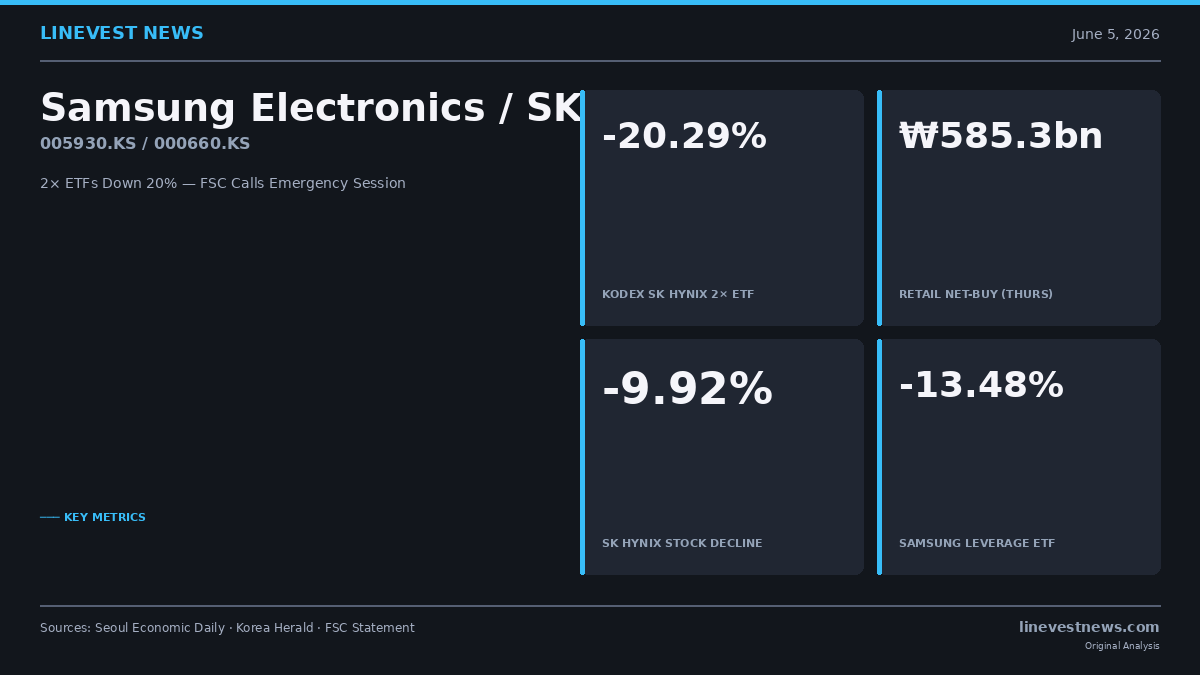
Samsung Electronics (005930.KS) fell 6.40% and SK Hynix (000660.KS) dropped 9.92% on June 5 as foreign selling routed the benchmark KOSPI, which closed 1.84% lower at 8,639, amid broader global risk-off sentiment. The decline triggered mechanical de-leveraging across the 16 newly listed single-stock ETFs: KODEX SK Hynix Single Stock Leverage sank 20.29% and its Mirae Asset TIGER rival fell 20.11%, while Samsung-linked products from the same two managers shed 13.24% and 13.48% respectively.
The Dip-Buy Paradox
Rather than retreating, individual investors accelerated their exposure. Net purchases of Samsung Electronics leveraged products reached ₩190.7 billion on Thursday, and SK Hynix leveraged instruments saw ₩394.6 billion in net retail buying — a combined ₩585.3 billion flood into products that had just posted their worst session since listing.
Market analysts attributed part of the scale of the underlying stocks' moves to the rebalancing mechanics of leveraged products themselves. Because these ETFs must continuously buy and sell the underlying spot assets and stock futures throughout each session, concentrated supply-and-demand flows can amplify price swings in the target shares — a so-called "wag the dog" dynamic that regulators had flagged as a latent risk even before the May 27 launch.
FSC Steps In
The FSC's emergency session was framed by officials as a coordination mechanism rather than punitive action. "This meeting was arranged to share with the industry the impact of the ETFs as well as investor reactions, and to hear opinions from experts," an FSC official stated. The commission had already taken pre-emptive steps: on May 28 — one day after the products listed — it barred senior FSC officials at grade 4 and above from investing in them directly, treating the instruments as "equivalent to individual equity securities" rather than conventional diversified funds. Equivalent restrictions were placed on Financial Supervisory Service department and bureau heads.
Even before Thursday's crash, warning signs had been building. By June 4, tracking errors in some smaller-manager offerings had topped 2.7%, with RISE Samsung Electronics Single Stock Leverage and PLUS Samsung Electronics Single Stock Leverage flagging deviations of 2.36% and 2.15% respectively — a risk because investors can incur losses even when they correctly predict price direction. Two dominant managers, Samsung Asset Management's KODEX franchise and Mirae Asset's TIGER line, each topped ₩1 trillion in assets within their first week of trading.
Wider Market Context
Thursday's semiconductor rout landed on top of a broader currency shock: the Korean won weakened past ₩1,560 per dollar, a level not seen since 2009, as foreign investors pulled capital from domestic equity markets. Finance Minister Choi Sang-mok had pledged "immediate measures" to address excessive foreign-exchange volatility as recently as Wednesday.
The Korea Exchange is closed Friday for the national Memorial Day holiday (Hyunchungil), giving the FSC and industry participants the weekend to formulate a response before markets reopen Monday. Goldman Sachs raised its 12-month KOSPI target to 12,000 earlier this week, implying more than 35% upside from Thursday's close — a bullish structural thesis that now has to contend with evidence that the same retail demand driving Korea's market boom can amplify, rather than absorb, sharp downside moves.
Sources: Seoul Economic Daily (en.sedaily.com), Korea Herald, Asia Economic Daily (asiae.co.kr/en), Financial Services Commission statement