Korean Won Closes at 17-Year Low of 1,539 as Foreign Rout, Broadcom Shock and Dollar Strength Pile On
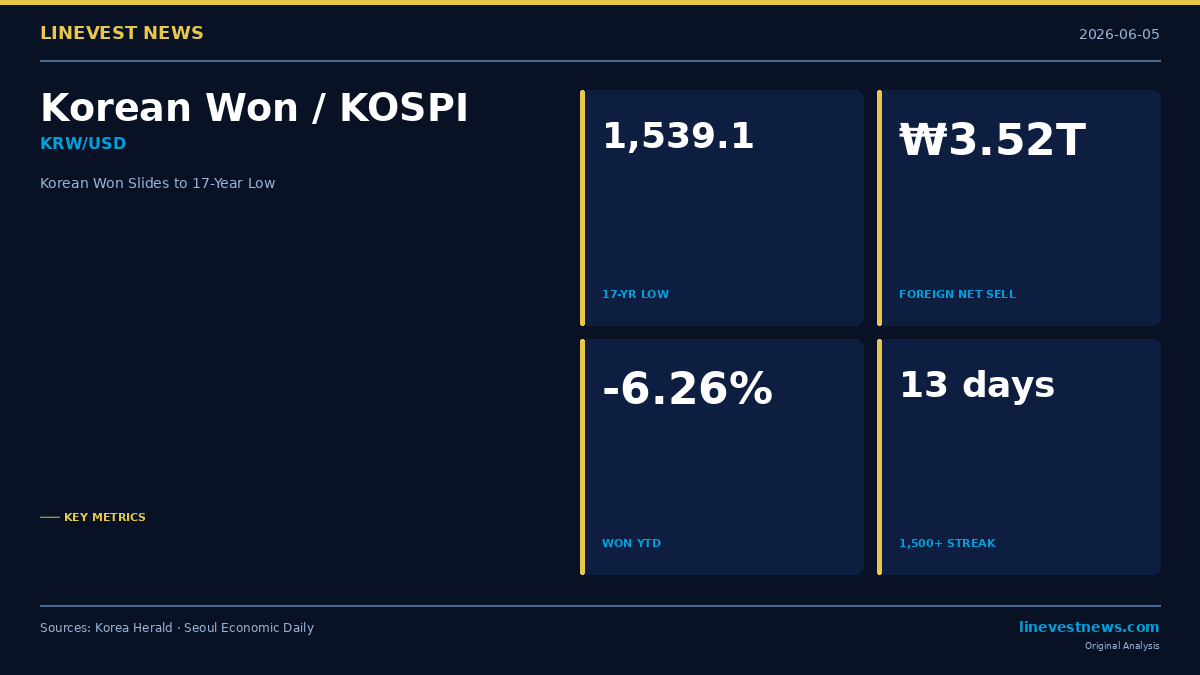
The Korean won settled at 1,539.1 per dollar on Friday, its weakest closing level in 17 years, after touching an intraday trough of 1,549.1—a level not reached since March 9, 2009, at the depth of the global financial crisis. The KOSPI simultaneously fell 5.54% to 8,160.59, triggering a sell-side trading curb for the tenth time in 2026, while KOSDAQ briefly dipped below the 1,000-point threshold before closing at 1,002.44, down 4.5%.
Three forces converged in a single session. Broadcom's Wednesday earnings report landed below the AI-fuelled expectations markets had priced in, sparking a global semiconductor selloff that dragged Samsung Electronics down 6.4% and SK Hynix 9.92%. Simultaneously, overseas investors extended a 19-session-long liquidation of Korean equities, offloading a net KRW 2.41 trillion (approximately USD 1.6 billion) on Friday alone and a cumulative KRW 115.3 trillion year-to-date. Underpinning both was a structural shift in global capital: with the dollar index pushing past 99.5 and Middle East tensions keeping oil prices elevated, the won has fallen 6.26% against the dollar year-to-date—the steepest decline among major currencies and far wider than the euro's 1.07%, the yen's 1.94% or sterling's 0.28%.
Retail investors provided partial offset, buying a net KRW 4.22 trillion—a contrarian posture reminiscent of the so-called Donghak Ant movement of 2020—but were outnumbered by combined institutional and offshore net selling of KRW 4.46 trillion.
A Threshold With Historical Precedent
The won has now traded in the 1,500-per-dollar band for 13 consecutive sessions, the longest such run since the 1997–98 Asian financial crisis. The currency first breached 1,530 in overnight trading on Thursday—territory not entered since March 2009—and extended those losses through Friday's close. Foreign-exchange reserves fell USD 880 million in May to USD 426.99 billion as the Bank of Korea deployed reserves to cushion the currency's decline.
Official Caution, Expert Warning
Deputy Prime Minister Koo Yun-cheol said on Friday that authorities "will immediately take necessary measures against excessive herding," echoing recent verbal-intervention language without specifying mechanics. Economist Lee Young-hwa cautioned that rates sustained above 1,530 could trigger sentiment shifts that make "the upper end of exchange-rate forecasting difficult to predict."
Structural Pull Toward U.S. Assets
Beyond Friday's session, the won's YTD decline reflects a persistent pattern of capital rotating toward U.S. technology assets. Analysts noted that expectations around a large upcoming U.S. tech IPO have added to dollar-liquidity demand globally, pulling flows away from emerging markets including Korea. The dollar index above 99.5 and elevated oil prices compound the pressure, threatening import costs for small and mid-sized Korean manufacturers.
With no imminent catalyst for offshore investors to return to Korean equities and the structural U.S. AI premium intact, authorities face a familiar bind: FX intervention depletes reserves without addressing the underlying incentive for outflows.
Sources: Korea Herald; Seoul Economic Daily (en.sedaily.com); Chosun Biz