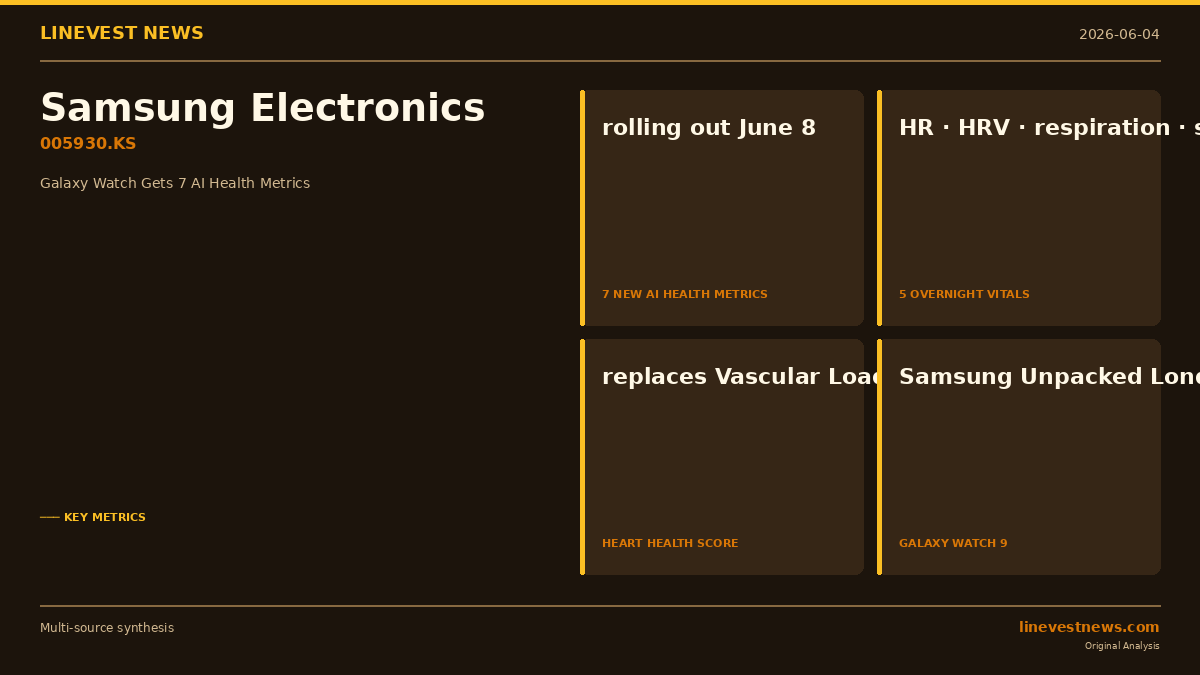
Samsung Electronics unveiled a sweeping overhaul of its Samsung Health platform on Wednesday, announcing seven biometric-tracking features that transform Galaxy Watch into a proactive AI health companion — laying the groundwork for a Galaxy Watch 9 launch widely expected at Samsung Unpacked in London on July 22.
Heart Health Score and Vitals: Two New Flagships
At the heart of the update is the Heart Health Score, which replaces the earlier Vascular Load metric. Rather than surfacing isolated measurements, it synthesises sleep quality, stress, daily activity and body composition into a single daily number — giving wearers an at-a-glance readout of their long-term cardiovascular well-being.
A companion feature, Vitals, runs through the night, measuring five signals: heart rate, heart rate variability, respiratory rate, skin temperature and blood oxygen levels. Each reading is benchmarked against the user's own personal baseline, and the watch will flag meaningful changes before symptoms typically surface — edging the device into territory that was once the domain of clinical monitors.
Five More Features Round Out the Health Stack
Beyond the headline pair, the update adds a Daily Cardio Load tracker, which accumulates cardiovascular strain across the day and recommends training intensity or recovery; a Fitness Index that rates heart rate, VO2 max and step counts against a peer cohort; and a Hearing Health tool that uses Galaxy Watch's ambient-noise sensors to build personalised hearing-protection analytics, whether the wearer is on a crowded commute or mid-workout playlist.
Two additional indices round out the stack: an enhanced Antioxidant Index with trend charts and daily history, and a new AGEs Index that runs automatic overnight measurements to track glycation-related lifestyle patterns over time.
Samsung redesigned the Health app around five pillars — Sleep, Activity, Nutrition, Mindfulness and Vitals — with the full update starting to roll out on June 8. The company stopped short of naming a next-generation watch in Wednesday's release, but the timing leaves little ambiguity: Galaxy Watch 9 is widely anticipated at a Samsung Unpacked event in London on July 22, and these features are poised to be its flagship differentiators.
Samsung Health cleared a milestone earlier this year when it received South Korea's first registration as a digital health-support device under the country's Digital Medical Products Act, covering heart rate, blood oxygen and activity monitoring. The Galaxy Watch's evolving health stack has since expanded further: researchers at Chung-Ang University demonstrated in May that a biosignal model on Galaxy Watch could predict vasovagal syncope — commonly known as fainting — five minutes in advance with 85% accuracy.
Sources: Samsung Global Newsroom · Android Authority · Gadgets & Wearables · The Korea Herald