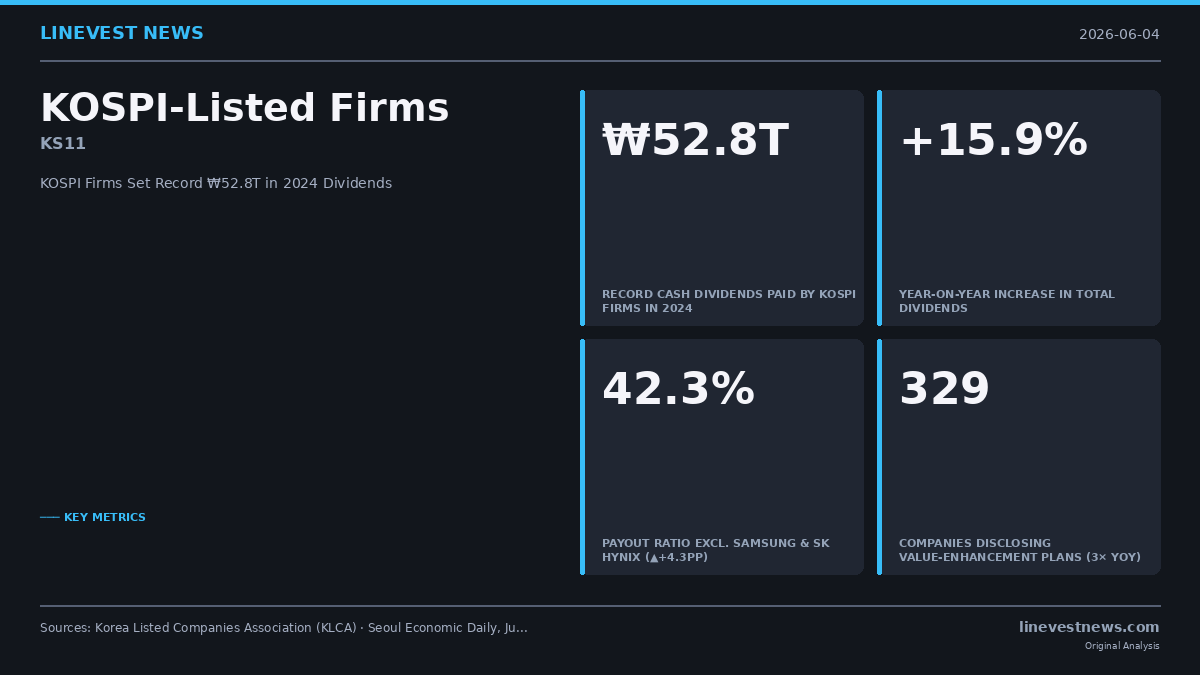
South Korea’s publicly listed companies returned a record ₩52.8 trillion (approximately USD 38.2 billion) to shareholders in cash dividends during 2024—a 15.9 percent increase from the previous year—as a semiconductor-driven earnings boom swelled the market-wide payout pool to 2.4 times its 2016 level, the Korea Listed Companies Association (KLCA) said Thursday.
Of the 797 securities market-listed companies with December fiscal year-ends, 569, or 71.4 percent, paid dividends last year. The record total, up from roughly ₩45.5 trillion in 2023 and just ₩21.8 trillion a decade ago, reflects both wider participation and surging per-share payouts across the semiconductor and broader technology sectors.
Yet the headline figure masks a divergence in shareholder-return behavior. The market-wide payout ratio—the share of net profit returned as dividends—actually fell 3.6 percentage points to 31.1 percent, entirely because net profits at Samsung Electronics and SK hynix soared faster than the dividends they distributed. Strip out those two semiconductor giants, and the payout ratio for the rest of the market rose 4.3 percentage points to 42.3 percent, suggesting that companies outside the chip sector are growing more shareholder-friendly.
Measured by sector, the electrical and electronics industry—home to Samsung and its supply-chain peers—posted the highest average cash dividend per listed company at ₩365.3 billion, well above the cross-sector average.
A parallel shift toward interim payouts is also visible. The number of companies making interim dividend payments climbed from 72 in 2023 to 107 in 2025, a 49 percent jump that reflects ongoing pressure from regulators and institutional investors to align Korea’s cash-return cadence with global practice.
Corporate governance disclosures are accelerating in tandem. A total of 329 companies published value-enhancement plans last year, more than triple the roughly 100 that did so the previous year. Regulators introduced the Corporate Value-Up program in 2023 to close the longstanding “Korea discount,” a persistent valuation gap relative to global peers driven partly by opaque capital allocation.
The data arrives on a day when the KOSPI itself retreated 1.84 percent to close at 8,639.41, with foreign investors posting their 19th consecutive day of net selling at ₩6.95 trillion. That short-term outflow has not reversed the structural case: analysts at Korea Investment and Securities this week raised their second-half KOSPI upper target to 11,000, underpinned by an expectation of roughly 10 percent upward revisions to forward operating profit at Samsung and SK hynix as the chip super cycle deepens.
Sources: Korea Listed Companies Association (KLCA) dividend survey, June 4, 2026; Seoul Economic Daily (en.sedaily.com), June 4, 2026.