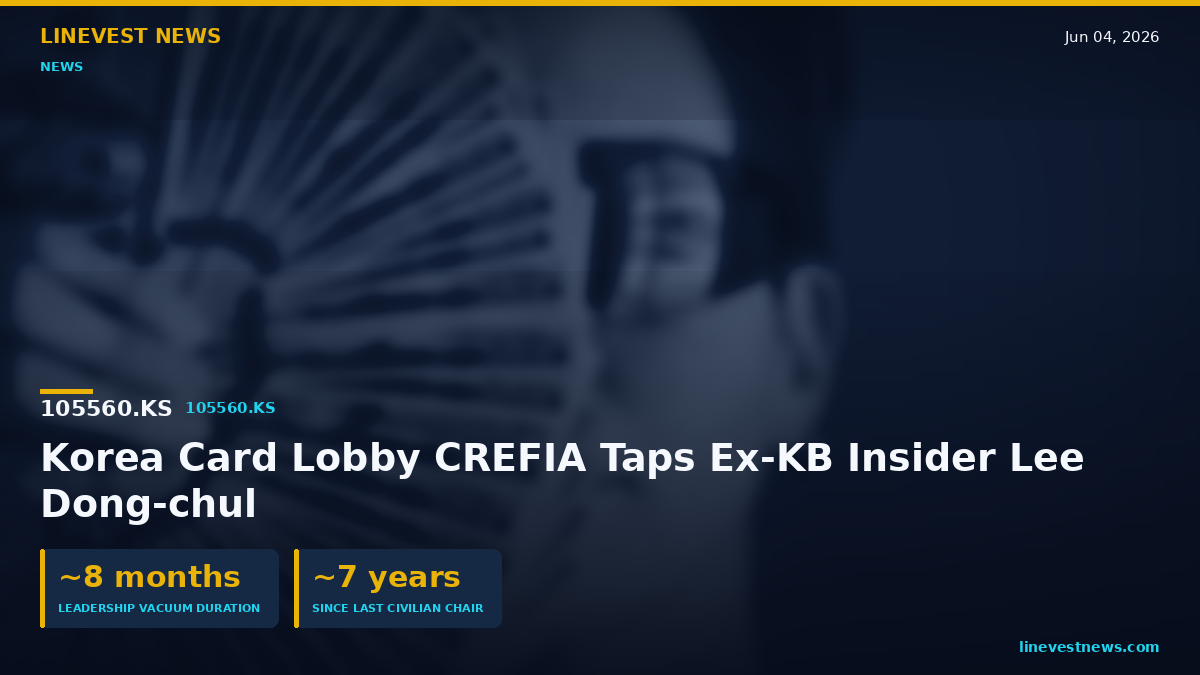
On June 4, South Korea's Credit Finance Association of Korea (CREFIA) — the trade body for the country's credit-card issuers and capital, leasing and installment-finance firms — named Lee Dong-chul, former vice chairman of KB Financial Group (105560.KS), as its sole final candidate to become the association's 14th chairman, according to reports from Yonhap, Maeil Business Newspaper and ChosunBiz.
For a global investor scanning the headline, the operative question is narrow: who will now negotiate merchant fees and funding-related rules on behalf of Korea's card issuers, and does replacing a regulator with an industry insider change the lobby's posture toward Seoul?
What happened
The recommendation committee interviewed three finalists before voting, per ChosunBiz: Lee Dong-chul; Park Kyung-hoon, former chief executive of Woori Financial Capital; and Yoon Chang-hwan, former policy chief to the speaker of Korea's National Assembly. Lee secured a majority and was advanced as the single nominee, ChosunBiz and Yonhap reported. The committee comprised the chief executives of 15 member firms, ChosunBiz said — 14 member directors including Shinhan Card, Hyundai Card, KB Kookmin Card, Lotte Card, Woori Card and Hana Card, plus Samsung Card as auditor.
The nomination is not yet final. CREFIA's full general meeting is scheduled to vote on June 16 and requires majority member approval, according to Newsway. A single endorsed candidate clearing that step is, in practice, the closing formality.
Why an insider matters here
Lee, 65, is a career financier rather than a former government official. A Korea University law graduate, he served as an executive vice president at KB Life Insurance, as strategy chief (CSO) at KB Financial Group, as chief executive of KB Kookmin Card — the group's credit-card unit — and finally as vice chairman of KB Financial Group, per ChosunBiz.
That resume is the story. CREFIA would be installing its first chief from outside the bureaucracy in roughly seven years; the last civilian-background chairman left in 2019, after which the post went to government-linked figures, Herald Economy reported. The outgoing chairman, Jung Wan-kyu, is himself a former regulator; his term expired in October 2025, and the association has run under a caretaker arrangement since, according to Korean financial press including News1. The June 16 vote would therefore end a leadership vacuum of roughly eight months.
There is precedent for what an insider-led lobby looks like in Korea's financial trade bodies, where former-bureaucrat "parachute" appointments have long been the norm precisely because they ease access to regulators. Choosing a card-industry veteran instead signals member firms want technical fluency in their own profitability problems over a direct line to the Financial Services Commission (FSC, Korea's top financial regulator).
The in-tray
Those profitability problems are concrete. Korean financial coverage of the race, including Herald Economy and Newsway, framed the next chairman's agenda around merchant-fee rate cuts that compress card-issuer margins, rising funding costs, delinquency management across the card and capital sectors, and intensifying competition from big-tech and fintech payment platforms. Newsway reported that candidates pressed the case for financial deregulation during the selection process.
Merchant fees are the recurring flashpoint: Korea reprices card acceptance fees on a multi-year cycle, and each round has historically squeezed issuer economics, making the association's negotiating stance with regulators the single variable members watch most closely.
What to watch
The immediate confirmation point is the June 16 general meeting. Beyond that, the test of whether an insider chairmanship shifts anything practical will be the association's public positioning in the next merchant-fee review and any concrete deregulation asks it lodges with the Financial Services Commission — the first read on whether Lee's elevation is a change in tone or merely a change in face.
This article is for informational purposes only and does not constitute investment advice. Figures and claims are attributed to the sources cited.